|
IC 1318
This is an image of part of the diffuse emission nebula that surrounds
the star Gamma Cygni (Sadr). Sadr is the bright glow just to the upper left of the image.
This nebula also contains a number of dark nebulae as well
|
IC 1318 - Black and White
This is a black and white version of the image to the left. Often, processing an image this
way will show more contrast and thus more detail. Adding some star diffraction spikes may also
give the image a little more visual appeal
|
Messier 1 - The Crab Nebula
The Crab Nebula was first identified by John Bevis in 1731. It is a supernova remnant that was first
observed by Chinese astronomers in 1054. It is about 6500 light years away and spans a diameter of
about 11 light years. The star that went supernova is now known as the Crab Pulsar, a pulsar that
spins 30 times per second
|
IC 1805 - The Heart Nebula
The Heart Nebula is an emission nebula consisting of dark dust lanes and glowing gas. It is about
7800 light years away
|
- Location: Bonny Doon Airport, CA
- Date: November 10, 2012
- Mount: AP 900GTO
- Telescope: Orion 190mm f/5.3 Mak/Newt
- Camera: SBIG ST-4000xcm OSC @-28c
- Exposure: 18x10 min RGB 3hrs
|
- Location: Bonny Doon Airport, CA
- Date: November 10, 2012
- Mount: AP 900GTO
- Telescope: Meade 10" f/10 SCT
- Camera: SBIG ST-4000xcm OSC @-26c
- Exposure: 3 x20 min. subs = 1hr.
|
- Location: Lake San Antonio, CA
- Date: February 3, 2011
- Mount: Losmandy G11 Go-To
- Telescope: Orion 190mm f/5.3 Mak/Newt
- Camera: SBIG ST-4000xcm OSC @-28c
- Exposure: 3x20 min RGB 1hr
|
- Location: Borrego Springs, CA
- Date: October 28, 2011
- Mount: Losmandy G11 Go-To
- Telescope: Orion 190mm f/5.3 Mak/Newt
- Camera: SBIG ST-4000xcm OSC @-14c
- Exposure: 10x10 min RGB 1hr 40min
|
|
IC 1805 - The Heart Nebula
This is a black and white version of the image to the left
|
Messier 8 - The Lagoon Nebula
The Lagoon Nebula is an immense cloud of interstellar gas and
is an emission nebula. It lies about 6500 light years away and
spans 110 by 50 light years
|
Messier 45 - The Pleiades
Messier 45, sometimes known also as The Seven Sisters, is an
open cluster. It's made up of a number of very hot blue stars
that formed within the last 100 million years. The cluster is
moving through an interstellar dust cloud and illuminating the
dust which makes the dust cloud a reflection nebula
|
Messier 57 - The Ring Nebula
The Ring Nebula is a planetary nebula that lies 4100 light years
away and is between 6000 and 8000 years old. As an average size
star nears the end of its life it expands to a very large diameter.
As the last of its fuel is expended it explosively sheds its outer
atmosphere and then contracts to leave an expanding planetary
nebula and a white dwarf star at its center. The ring is more than
1000 times the width of our own solar system (Sun to Neptune distance)
|
- Location: Borrego Springs, CA
- Date: October 28, 2011
- Mount: Losmandy G11 Go-To
- Telescope: Orion 190mm f/5.3 Mak/Newt
- Camera: SBIG ST-4000xcm OSC @-14c
- Exposure: 10x10 min RGB 1hr 40min
|
- Location: Cabrillo College Observatory, CA
- Date: September 24, 2008
- Mount: Losmandy GM-8
- Telescope: Meade LDX-75 8" f/4
- Camera: SBIG ST-4000xcm OSC @-23c
- Exposure: 3x 5min RGB 15min
|
- Location: Bonny Doon Airport, CA
- Date: October 23, 2011
- Mount: Losmandy G11 Go-To
- Telescope: Orion 190mm f/5.3 Mak/Newt
- Camera: SBIG ST-4000xcm OSC @-14c
- Exposure: 6x10 min RGB 1hr
|
- Location: Cabrillo College Observatory, CA
- Date: November 22, 2008
- Mount: Losmandy GM-8
- Telescope: Meade LDX-75 8" f/4
- Camera: SBIG ST-4000xcm OSC @-23c
- Exposure: 6x10 min RGB 1hr
|
- Location: Cabrillo College Observatory, CA
- Date: September 29, 2010
- Mount: Losmandy G11 Go-To
- Telescope: Orion 190mm f/5.3 Mak/Newt
- Camera: SBIG ST-4000xcm OSC
- Exposure: 5x10 min RGB 50min
|
- Location: Bonny Doon Airport, CA
- Date: March 9, 2013
- Mount: AP 900GTO
- Telescope: Celestron 9.25" f/10 Cassegrain
- Camera: SBIG ST-4000xcm OSC
- Exposure: 18x5 min RGB 1hr 30min
|
- Location: Cabrillo College Observatory, CA
- Date: September 15, 2010
- Mount: Losmandy G11 Go-To
- Telescope: Orion 190mm f/5.3 Mak/Newt
- Camera: SBIG ST-4000xcm OSC
- Exposure: 6x5 min RGB 30min
|
- Location: Cabrillo College Observatory, CA
- Date: September 29, 2010
- Mount: Losmandy G11 Go-To
- Telescope: Orion 190mm f/5.3 Mak/Newt
- Camera: SBIG ST-4000xcm OSC
- Exposure: 5x10 min RGB 50min
|
|
NGC 7293 - The Helix Nebula
The Helix Nebula is a planetary nebula that was discovered by
Karl Ludwig Harding sometime before 1824. It is about 700 light-
years away. Its estimated age is around 11,000 years
|
NGC 2264 - The Christmas Tree Cluster and Cone Nebula
NGC 2264 is the bright area near the center known as the Christmas
Tree Cluster. The Cone Nebula is in the upper right and is part of the star-making
cloud that surrounds the central cluster. It is about 2600 light-years away
|
NGC 7635 - The Bubble Nebula
The Bubble Nebula is an emission nebula that was discovered by
William Herschel in 1787. It is about 7800 light-years away
|
Messier 20 - The Trifid Nebula
This is one of my favorite images. The red portion is the more
visible area and seems to be divided into three lobes, thus the name Trifid. The lower,
red portion is an emission nebula. The upper, blue portion is a reflection nebula, and
the dark areas that separate the sections are dark nebula. It is about 9000 light-years away
|
- Location: Bonny Doon Airport, CA
- Date: September 6, 2010
- Mount: Losmandy G11 Go-To
- Telescope: Orion 190mm f/5.3 Mak/Newt
- Camera: SBIG ST-4000xcm OSC @ -12c
- Exposure: 9x10 min RGB 1hr 30min
|
- Location: Bonny Doon Airport, CA
- Date: March 15, 2013
- Mount: AP 900GTO
- Telescope: Orion 190mm f/5.3 Mak/Newt
- Camera: SBIG ST-4000xcm OSC @-30c
- Exposure: 6x10 min RGB 1hr
|
- Location: Sun River, Bend, OR
- Date: July 24, 2011
- Mount: Losmandy G11 Go-To
- Telescope: Orion 190mm f/5.3 Mak/Newt
- Camera: SBIG ST-4000xcm OSC @-18c
- Exposure: 8x20 min RGB 2hrs 40min
|
- Location: Golden State Star Party, Adin, CA
- Date: July 6, 2013
- Mount: AP 900GTO
- Telescope: Celestron 9.25" f/10 Cassegrain
- Camera: SBIG ST-4000xcm OSC @-18c
- Exposure: 20x10 min RGB 3hrs 20min
|
|
Messier 27 - The Dumbbell Nebula
One of the more popular objects of visual astronomers and
imagers alike, The Dumbbell Nebula is a planetary nebula
located about 800 light-years away. It was discovered by
Charles Messier in 1764
|
NGC 1977 - The Running Man Nebula
The Running Man Nebula is another of my favorite images. It is
a reflection nebula with a shape that looks like a running man,
and is located just north of the Great Orion Nebula. This image
has been flipped horizontally
|
Barnard 33 - The Horsehead Nebula and NGC 2024 - The Flame Nebula
The Horsehead Nebula is a dark nebula within the emission nebula
IC 434 in the constellation Orion. It was first detected on a
photographic plate by Williamina Fleming in 1888. It is nicely
contrasted by the cloud of red hydrogen gas behind it. The bright
star to the left of center is Alnitak. The bright area to the
lower right of Alnitak is a star-making region behind the dark
nebula that is shining through from behind. The Flame Nebula to
the bottom left is an emission nebula that lies about 1500 light-
years away. It is gas that is illuminated and excited by the star
Alnitak above it. There are clouds of dark gas and dust in front
of the nebula that gives it its flame appearance
|
Messier 42 - The Great Orion Nebula
The Orion Nebula is a diffuse nebula located about 1600 light-
years away and is about 24 light-years across. The bright central
region known as the Trapezium is an active star-making area.
This nebula is just part of a larger cloud of gas and dust that
encompasses most of the constellation Orion
|
- Location: Golden State Star Party, Adin, CA
- Date: July 8, 2013
- Mount: AP 900GTO
- Telescope: Celestron 9.25" f/10 Cassegrain
- Camera: SBIG ST-4000xcm OSC @-18c
- Exposure: 26x10 min RGB 4hrs 20min
|
- Location: Bonny Doon Airport, CA
- Date: December 17, 2011
- Mount: Losmandy G11 Go-To
- Telescope: Orion 190mm f/5.3 Mak/Newt
- Camera: SBIG ST-4000xcm OSC @-24c
- Exposure: 14x5 min RGB 1hr 10min
|
- Location: Bonny Doon Airport, CA
- Date: November 22, 2008
- Mount: Losmandy GM-8
- Telescope: Meade LDX-75 8" f/4
- Camera: SBIG ST-4000xcm OSC @-23c
- Exposure: 6x10 min RGB 1hr
|
- Location: Bonny Doon Airport, CA
- Date: November 22, 2008
- Mount: Losmandy GM-8
- Telescope: Meade LDX-75 8" f/4
- Camera: SBIG ST-4000xcm OSC @-23c
- Exposure: 4x5 min RGB 20min
|
|
Messier 42 - The Great Orion Nebula
This is another image of the Great Orion Nebula. It was
taken for practice out on the back deck. I had just
purchased an SBIG AO-8 adaptive optics unit for improved
guiding
|
NGC 6888 - The Crescent Nebula
The Crescent Nebula is an emission nebula that lies about
5000 light-years away. It was discovered by Friedrich Wilhelm
Herschel in 1792
|
NGC 6888 - The Crescent Nebula
Here is another image of the Crescent Nebula taken two years
after the one to the left. This was also imaged at the Nightfall
Star Party at Borrego Springs, CA
|
NGC 6995 - The Veil Nebula East
A section of the Eastern Veil Nebula. Taken at the Golden State
Star Party. The Veil Nebula is a very faint cloud of hot gas that is a supernova remnant.
It is estimated to be approximately 1500 light-years distant. I combined 5 subs at -18c and
10 subs at -20c
|
- Location: Watsonville, CA
- Date: March 2, 2012
- Mount: Losmandy G11 Go-To
- Telescope: Orion 190mm f/5.3 Mak/Newt
- Camera: SBIG ST-4000xcm OSC @-28c
- Exposure: 10x5 min RGB 50min
|
- Location: Borrego Springs, CA
- Date: October 28, 2011
- Mount: Losmandy G11 Go-To
- Telescope: Orion 190mm f/5.3 Mak/Newt
- Camera: SBIG ST-4000xcm OSC @-12c
- Exposure: 6x10 min RGB 1hr
|
- Location: Borrego Springs, CA
- Date: October 31, 2013
- Mount: Losmandy G11 Go-To
- Telescope: Orion 190mm f/5.3 Mak/Newt
- Camera: SBIG ST-4000xcm OSC @-20c
- Exposure: 22x10 min RGB 3hr 40min
|
- Location: Golden State Star Party, Adin, CA
- Date: June 28, 2014
- Mount: AP 900GTO
- Telescope: Celestron 9.25" f/10 Cassegrain
- Camera: SBIG ST-4000xcm OSC @-20c
- Exposure: 15x10 min RGB 2hr 30min
|
|
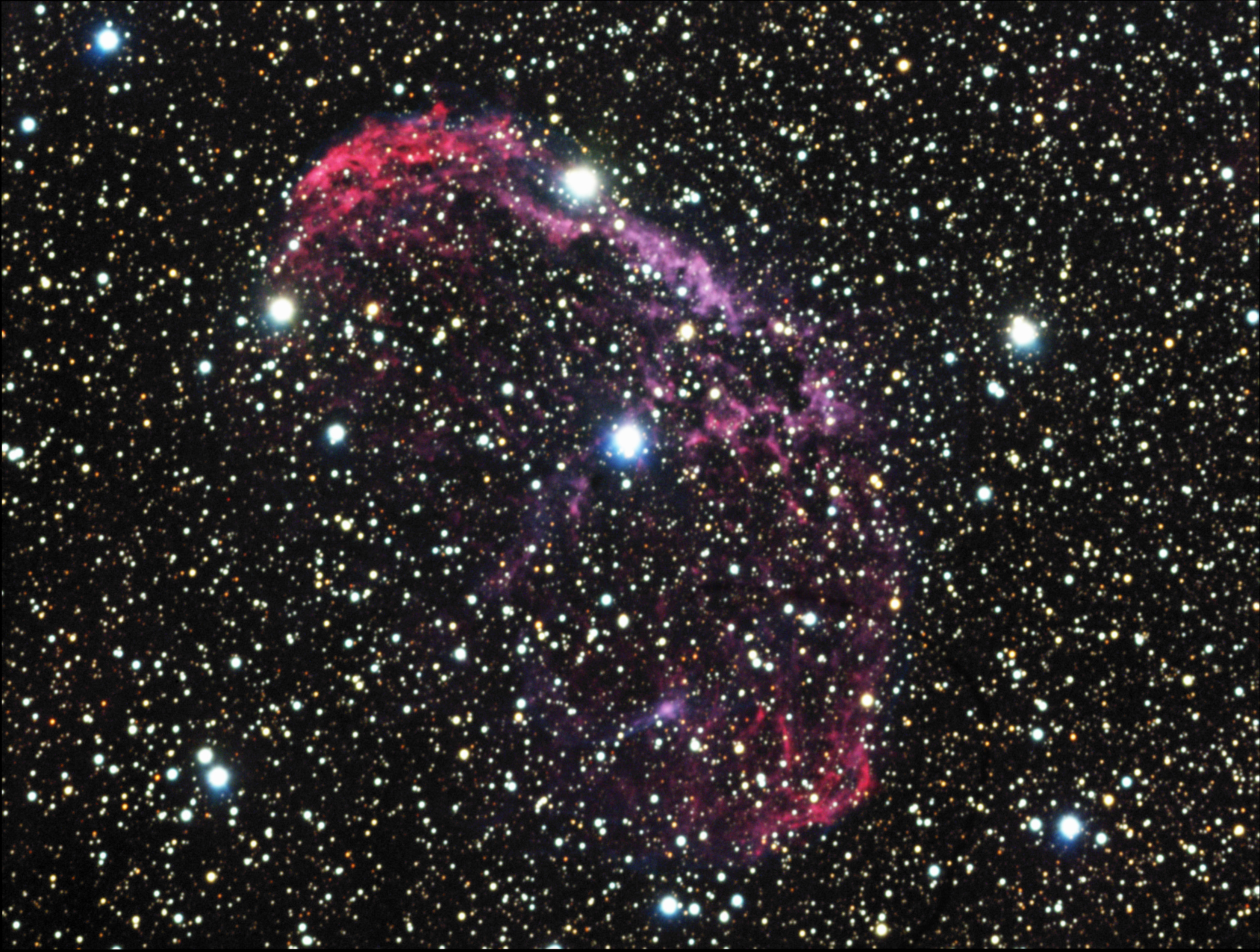
NGC 6888 - The Crescent Nebula
Here is my first real attempt at imaging with my new SBIG
STF-8300m camera with filters. This first image is 6 hours
of color data. The other two to the right demonstrate how
incorporating a Hydrogen Alpha image into a color image changes
the end product
|
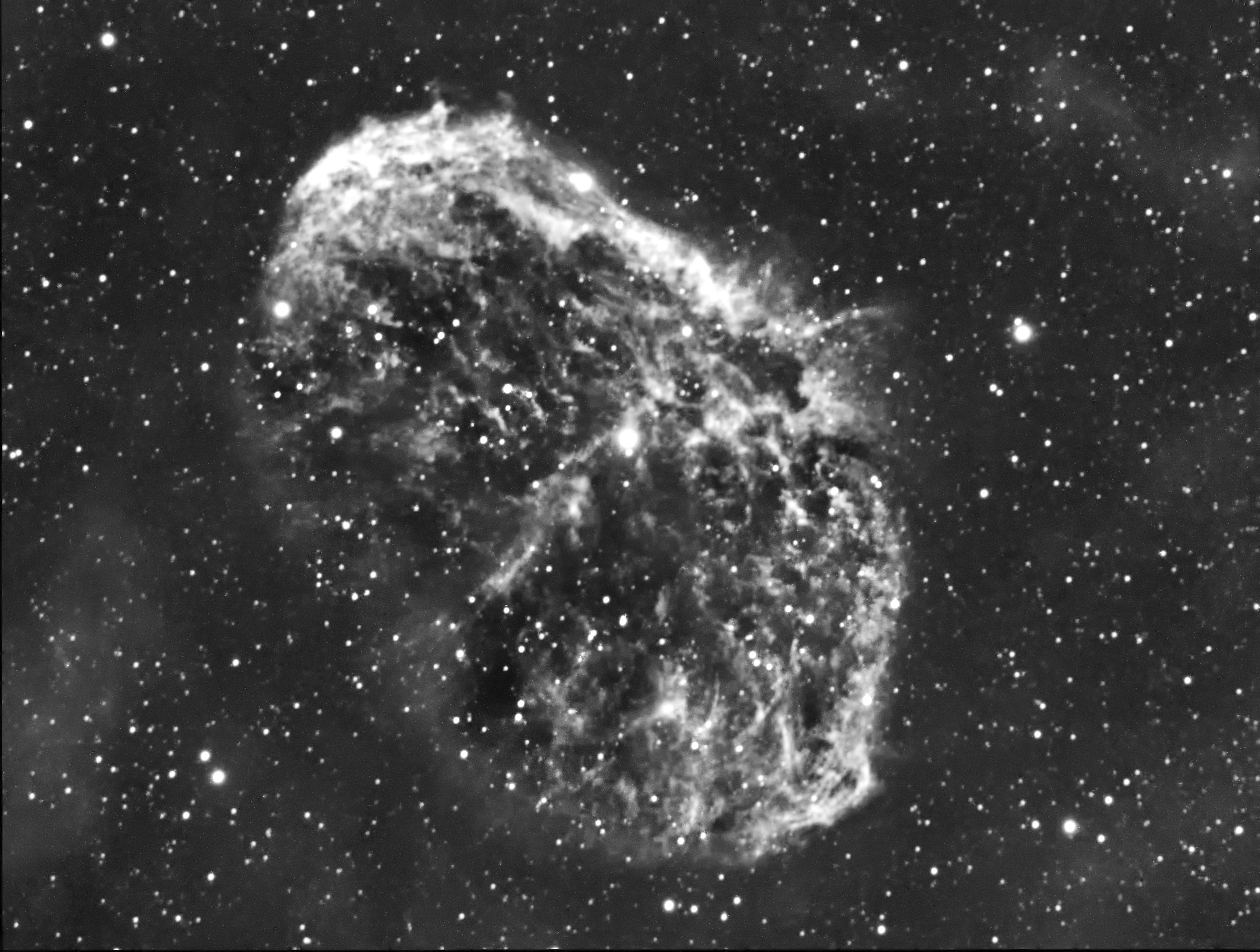
NGC 6888 - The Crescent Nebula in Ha
This second image is the Hydrogen Alpha. This was just one 30
minute image that was really noisy and took a lot of effort to
get cleaned up. That's why we take as many images of an object
as we can
|
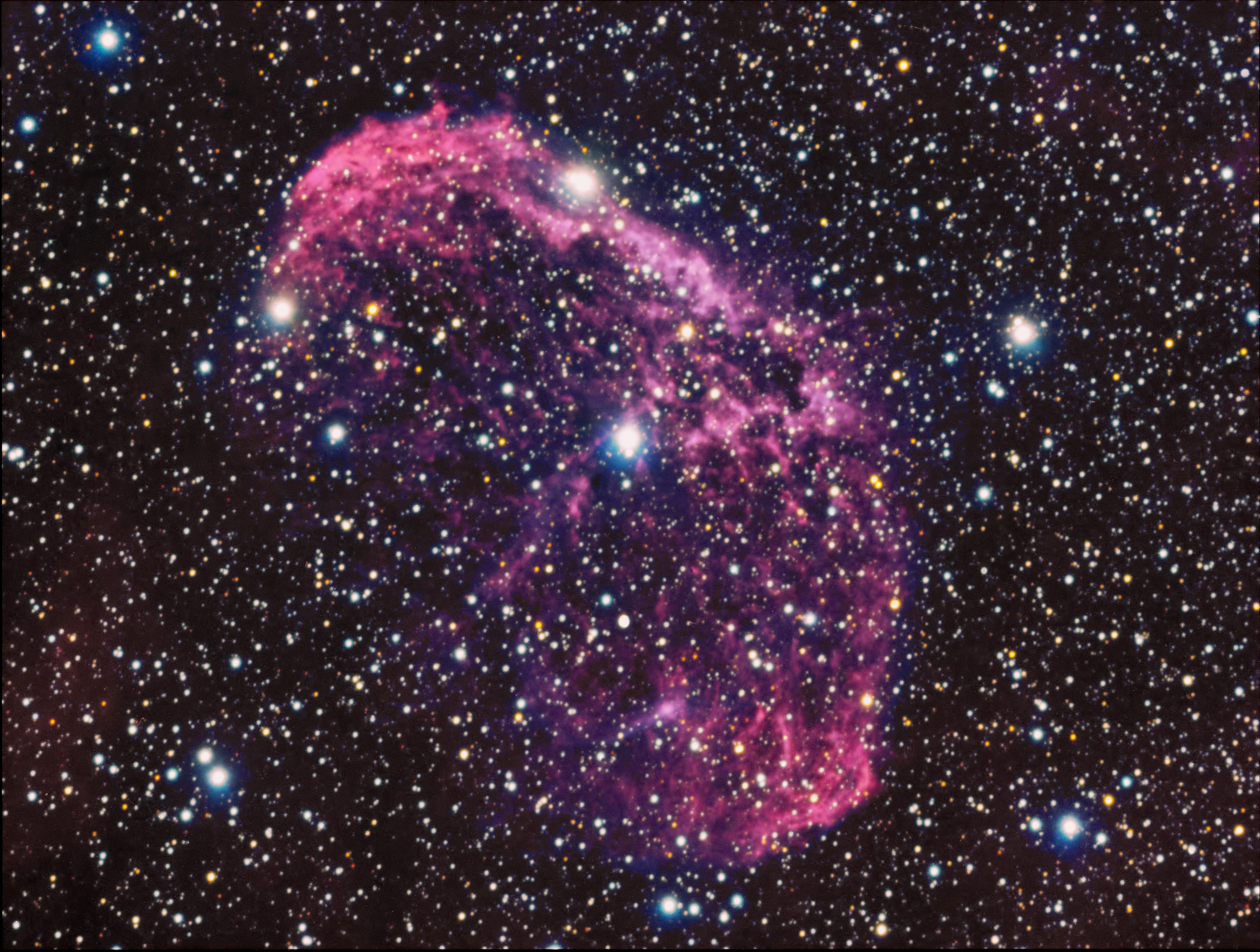
NGC 6888 - The Crescent Nebula LRGB + Ha
Here are the color and Ha images combined. The Ha really brings
a lot to the image and the new camera adds a tremendous amount
of resolution. This is a vast improvement over the One-Shot-Color
(OSC) camera. The trade-off is that it takes considerably longer
to acquire all the sub frames for a finished image
|
Barnard 33 - The Horsehead Nebula
The Horsehead Nebula is a dark nebula located right next to the
star Alnitak, which is the left-most star in Orion's belt. It is about 1200 light-years
away from us. More information is listed above with the wide-field view. This is the color
version with a B&W version next door to the right. The nighttime temps. were pretty warm,
so, even though I managed to get 4 hrs of exposure time there were considerable amounts
of noise to deal with in processing
|
- Location: Golden State Star Party, Adin, CA
- Date: June 20, 2017
- Mount: AP 900GTO
- Telescope: Celestron 9.25" f/10 Cassegrain
- Camera: SBIG ST-4000xcm OSC @-14c
- Exposure: 12x10 min RGB 6.0hrs
|
- Location: Golden State Star Party, Adin, CA
- Date: June 20, 2017
- Mount: AP 900GTO
- Telescope: Celestron 9.25" f/10 Cassegrain
- Camera: SBIG ST-4000xcm OSC @-14c
- Exposure: 1x30 min = 30min
|
- Location: Golden State Star Party, Adin, CA
- Date: June 20, 2017
- Mount: AP 900GTO
- Telescope: Celestron 9.25" f/10 Cassegrain
- Camera: SBIG ST-4000xcm OSC @-14c
- Exposure: Combined Color and Ha 6.5hrs
|
- Location: Borrego Springs, CA
- Date: March 9, 2015
- Mount: AP 900GTO
- Telescope: Celestron 9.25" f/10 Cassegrain
- Camera: SBIG ST-4000xcm OSC @-12c
- Exposure: 24x10 min RGB 4hr
|
|
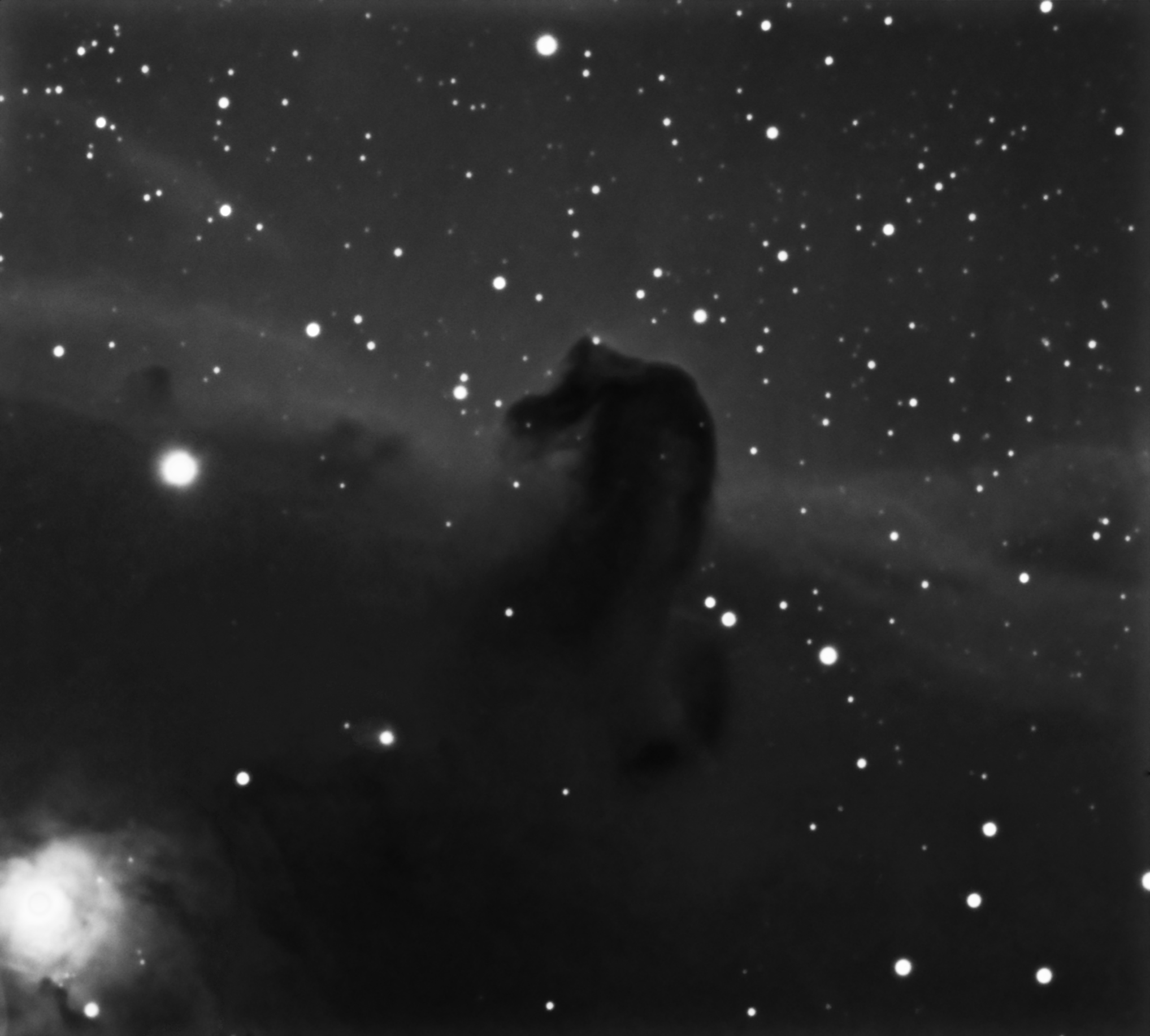
Barnard 33 in Ha
This is the B&W version. Sometimes a color image that has some
noise problems like the one to the left can be improved simply
by converting to grayscale. Which do you like better?
|
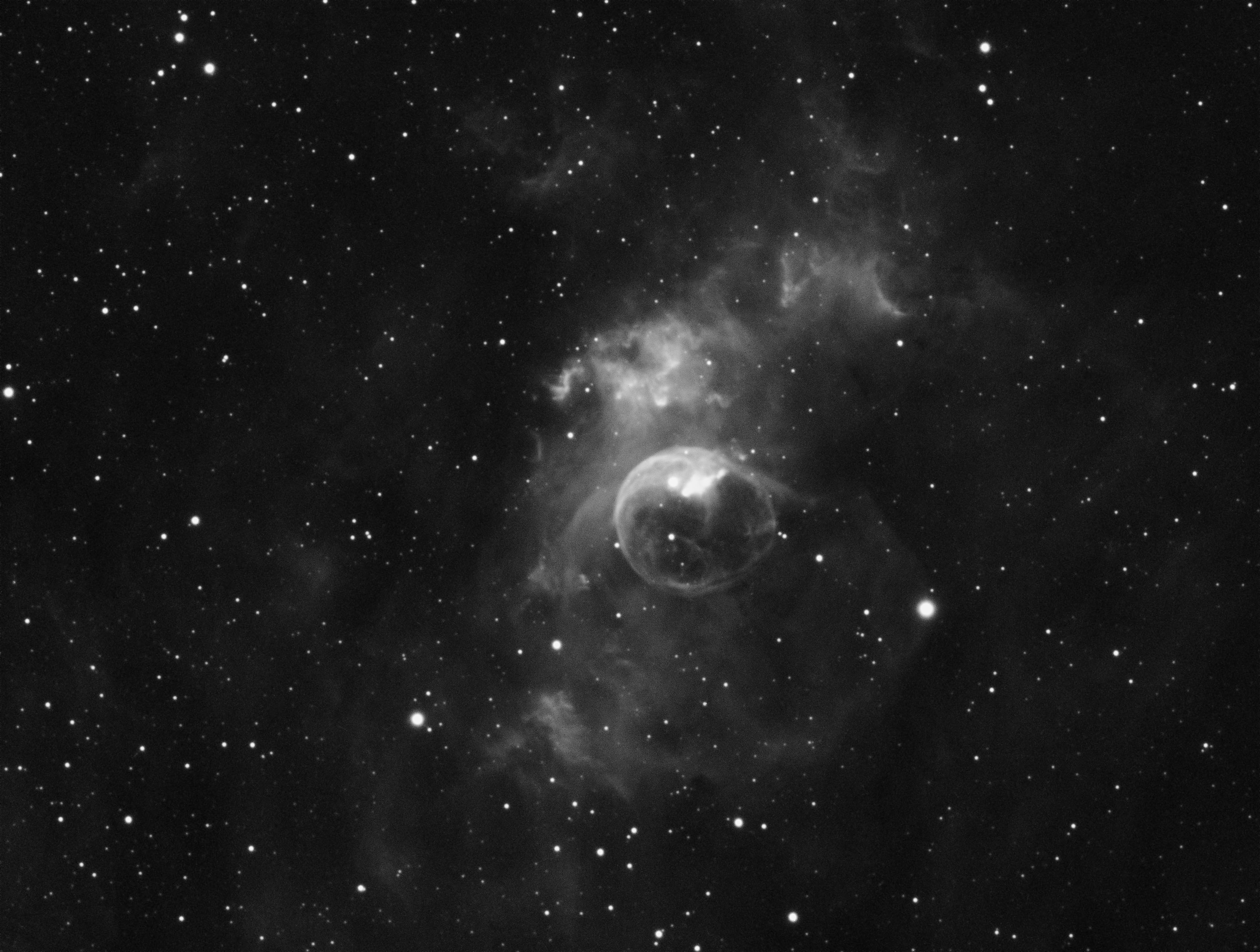
NGC 7635 - The Bubble Nebula RGB+Ha
This is a re-make of the Bubble Nebula - this time with my new
camera, the SBIG STF-8300m with a Hydrogen Alpha filter. This
is a one hour exposure. The next image is a combination of this
image and an RGB image (Red, Blue, Green). The Bubble Nebula is
an emission nebula that was discovered by William Herschel in 1787.
It is about 7800 light-years away
|
NGC 7635 - The Bubble Nebula in Ha
This is a combination of the preceding Hydrogen Alpha image
with an RGB image. I was only able to get 30 minutes of exposure
time on this object due to operator error with my guide scope.
Will do better next time
|
placeholder
|
- Location: Borrego Springs, CA
- Date: March 9, 2015
- Mount: AP 900GTO
- Telescope: Celestron 9.25" f/10 Cassegrain
- Camera: SBIG ST-4000xcm OSC @-12c
- Exposure: 24x10 min RGB 4hr
|
- Location: Borrego Springs, CA
- Date: October 17, 2017
- Mount: AP 900GTO
- Telescope: Celestron 9.25" f/10 Cassegrain
- Camera: SBIG ST-4000xcm OSC @-14c
- Exposure: 2x30 min Ha 1hr
|
- Location: Borrego Springs, CA
- Date: October 17, 2017
- Mount: AP 900GTO
- Telescope: Celestron 9.25" f/10 Cassegrain
- Camera: SBIG ST-4000xcm OSC @-14c
- Exposure: 2x30 min Ha 1hr
|
|