|
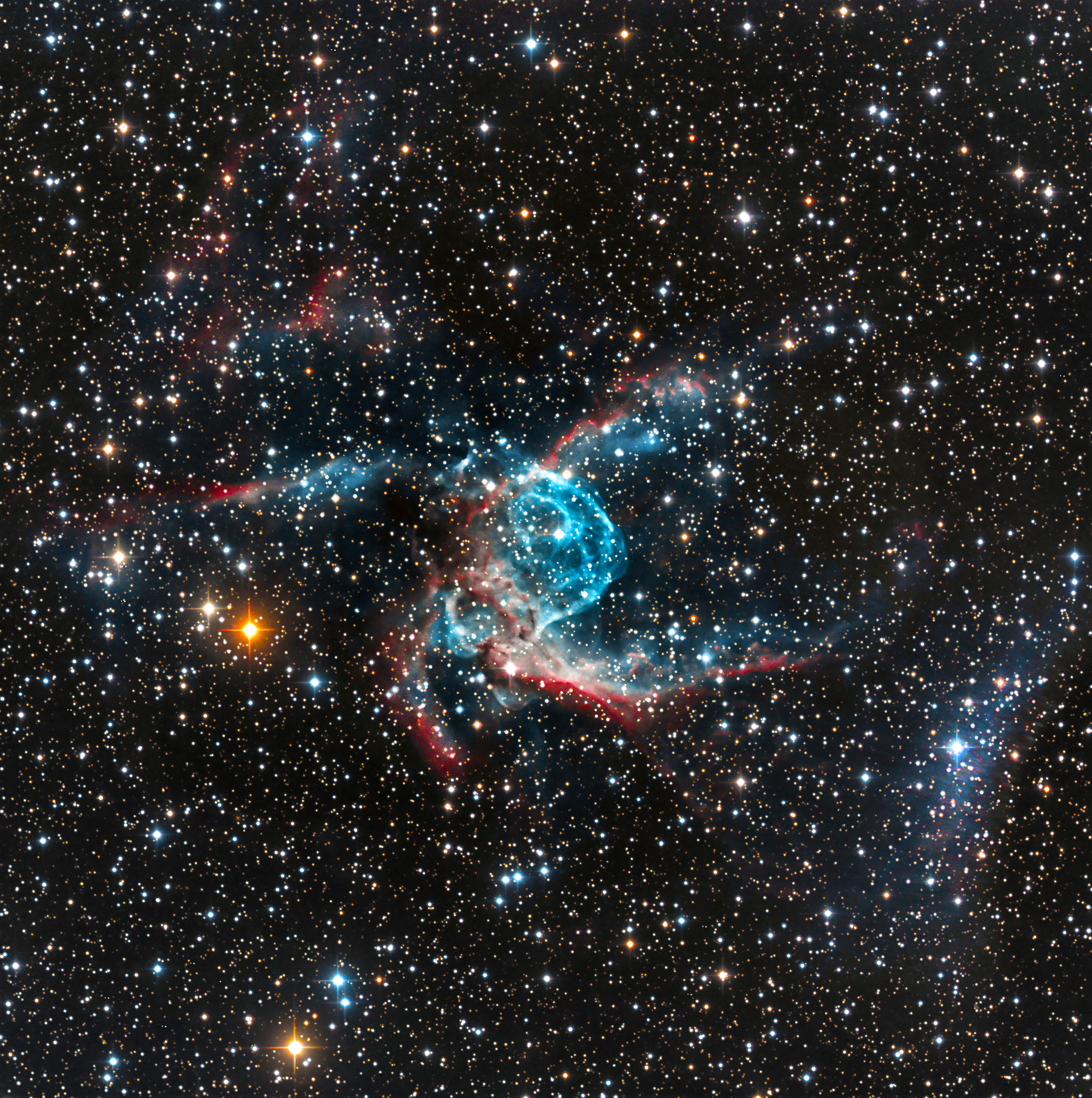
NGC 2359 - Thor's Helmet
Thor's Helmet is an emission nebula located in Canis
Major. It lies 12,000 light-years away from us and its
central star is a Wolf-Rayet star which is thought to be
in a pre-supernova stage of evolution. This image is my
first experience with using a remote rental telescope.
https://app.telescope.live has a number of telescopes
located around the world that you can sign up to use for
imaging sessions (for a fee of course). The rates are pretty
reasonable for the quality of the images. This object was
imaged from an observatory in Chile. For an image that
is only a total of 30 min long, I think it turned out great.
It was a lot of fun to process an image that came to me as
high quality raw data
|
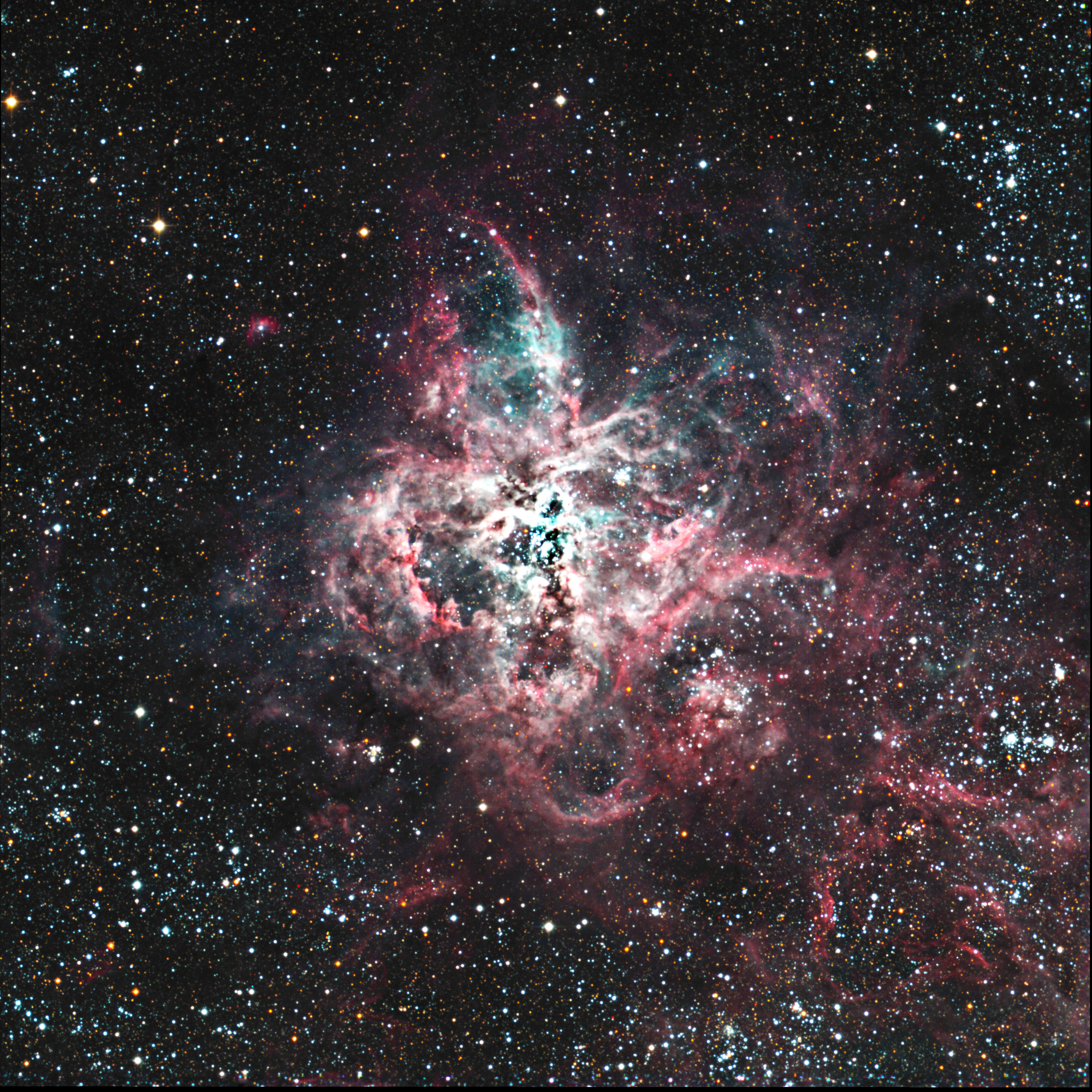
NGC 2070 - The Tarantula Nebula
In our local group of galaxies, the Tarantula Nebula is the
largest star-forming region as well as the largest Hydrogen
II region. It is so bright that if it were as close to us as
the Orion Nebula (1600 Ly), it would produce visible shadows
in daylight. It is 160,000 light-years away and is 931 light-years
in size. Processing this image was a bit difficult. The core
region is extremely bright while the outer regions are much dimmer.
To partially solve the exposure problem I used 10-minute exposures
for the outer region and 5-minute exposures for the core
|
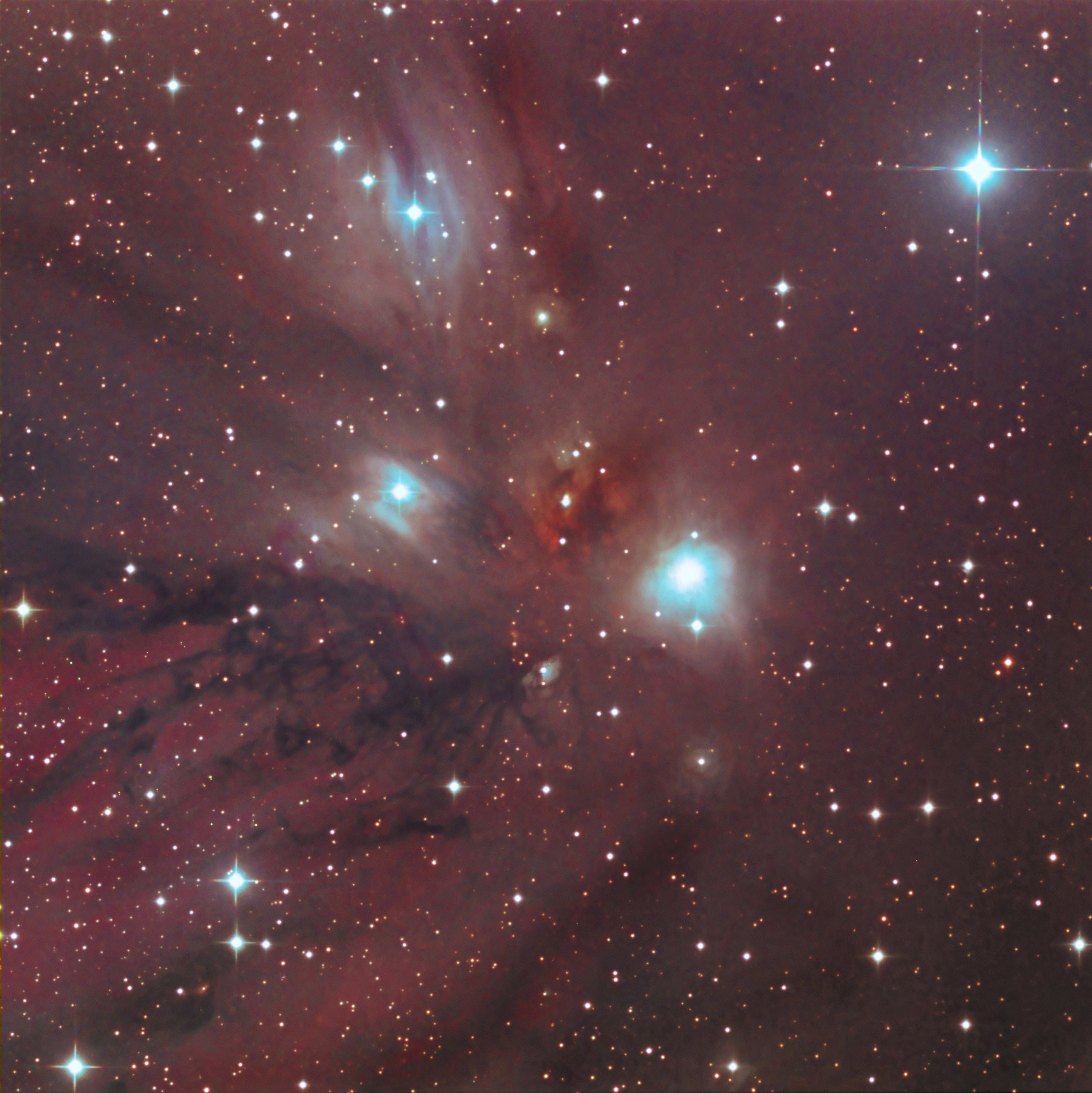
NGC 2170 - The Angel Nebula
There is a lot going on in this nebula. It was discovered by William
Herschel. Parts of the nebula include emission, reflection and dark nebulae
|
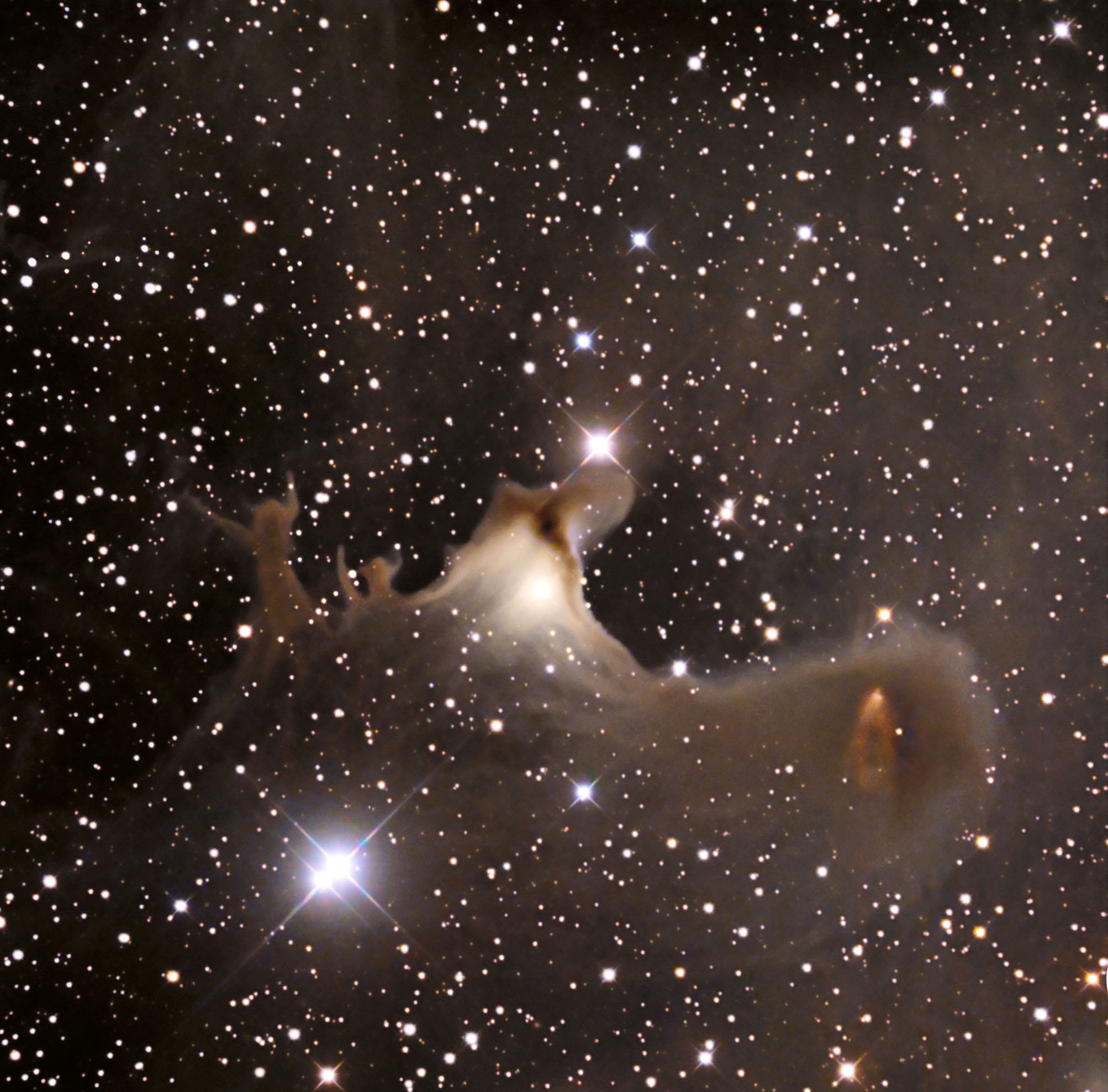
Sharpless 2-136 - The Ghost of Cepheus
The Ghost of Cepheus is a reflection nebula located in Cepheus on the
edge of the Cepheus Flare molecular cloud complex. There are several new stars embedded in the
nebula itself which give it a brownish color. It is usually referred to as a globule. This
nebula spans about 2 light-years across and lies about 1470 light-years away. The star right
in the middle of the nebula is a protostar
|
- Location: El Sauce Observatory, Chile
- Date: December 16, 2019
- Mount: Mathis MI-1000
- Telescope: Planewave CDK24 f/6.6
- Camera: FLI PL9000 @-25c CHI-1 CCD
- Exposure: 3x10 min LRGBHa 30min
|
- Location: El Sauce Observatory, Chile
- Date: March 22, 2020
- Mount: Mathis MI-1000
- Telescope: Planewave CDK24 f/6.6
- Camera: FLI PL9000 @-25c CHI-1 CCD
- Exposure: 9x10 min LRGB 90min
|
- Location: El Sauce Observatory, Chile
- Date: March 6, 2021
- Mount: Mathis MI-1000
- Telescope: Planewave CDK24 f/6.6
- Camera: FLI PL9000 @-25c CHI-1 CCD
- Exposure: 6x10 min Ha and OIII 1hr
|
- Location: IC Astronomy Obs, Spain
- Date: July 17, 2020
- Mount: OS EQ
- Telescope: Officina Stellare ProRC 700
- Camera: FLI PL16803 @-25C SPA-2 CCD
- Exposure: 6x10 min LRGB 1 hr
|
|
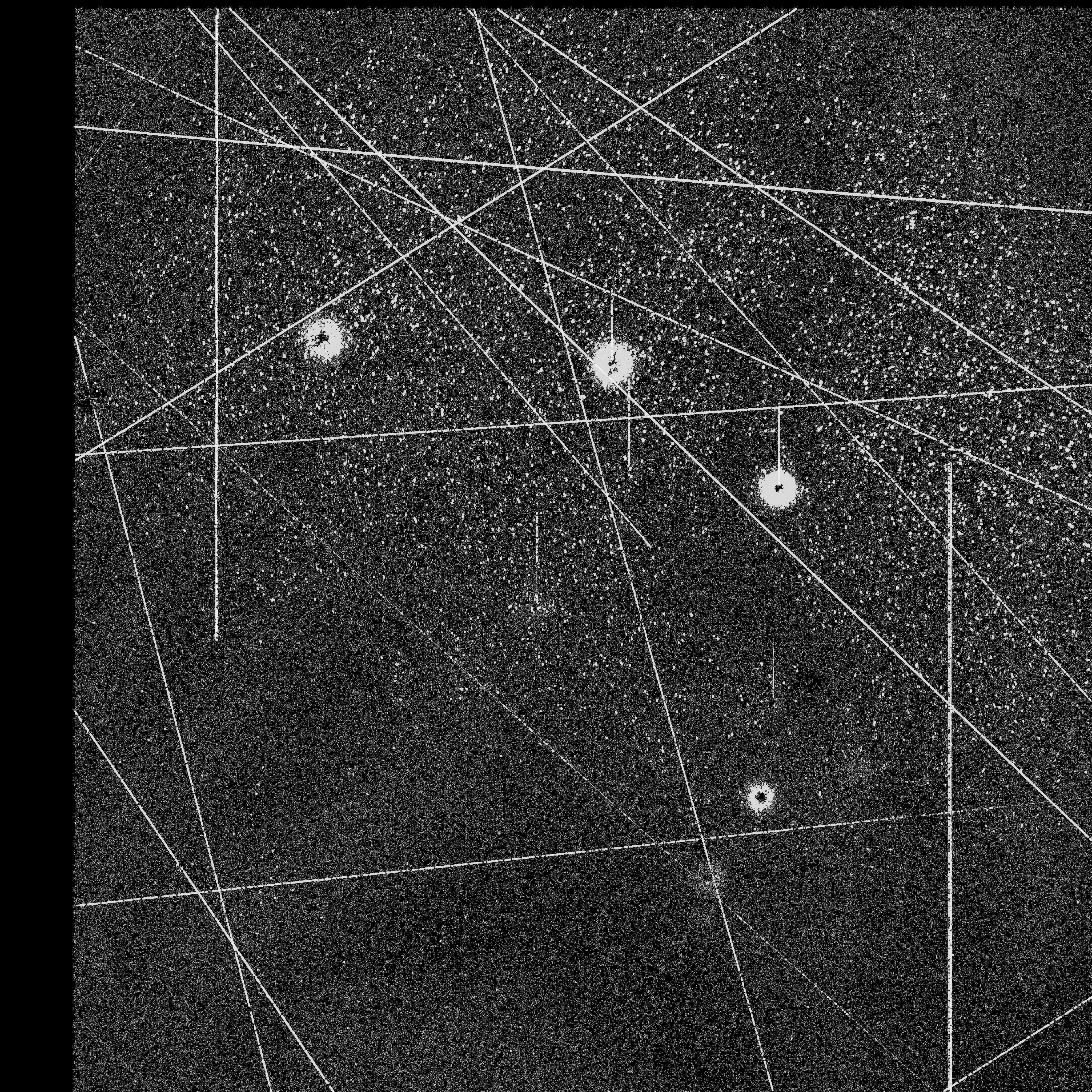
SpaceX Starlink Satellite Effects on Astrophotography
This was my first encounter with the Starlink satellites. The
night that these were taken, there had been three Starlink trains
of satellites released. This was the result of a series of six ten-minute images,
and the rejected pixels which were then stacked together into one image.
So, here you can see all of the satellite traffic
that I encountered in one hour. Software developers are going
to have to come up with some very powerful programs that can handle
these issues. Using CCDStack, it took almost three hours to get
this streak processed out enough to be able to use the image.
If the streak is so bright that it saturates the pixels in the
camera, then all of the data underneath the streak is lost.
That's the problem for both amateur and professional imagers
and astronomers
|
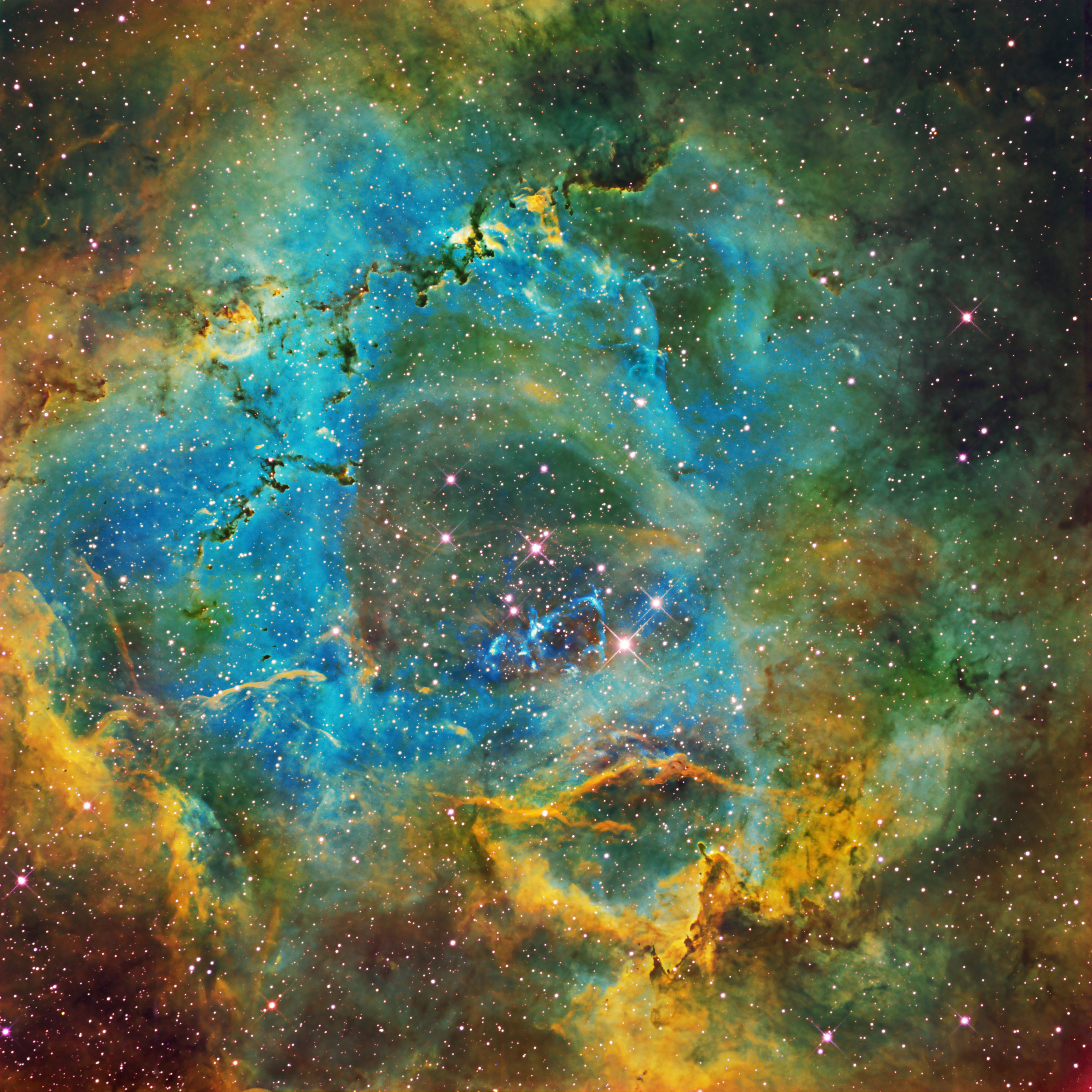
NGC 2239 - The Rosette Nebula
The Rosette Nebula is an HII region in Monoceros and lies about
5200 light-years away. It is 65 light-years in diameter which is
about half the diameter of our own Milky Way galaxy. The stars
in the center are an open cluster (NGC 2237) which is made up
of 36 new stars. If you zoom deep into this image and scroll
through it you'll find at least an additional 45 galaxies.
This image is different in that the colors are not what we
usually see in an image. This object, the Rosette Nebula is
very difficult to see in our normal visible light, but taken
through different filters, in this case - Hydrogen, Oxygen and
Sulfur, we can bring out details of an object that might not
normally be visible
|
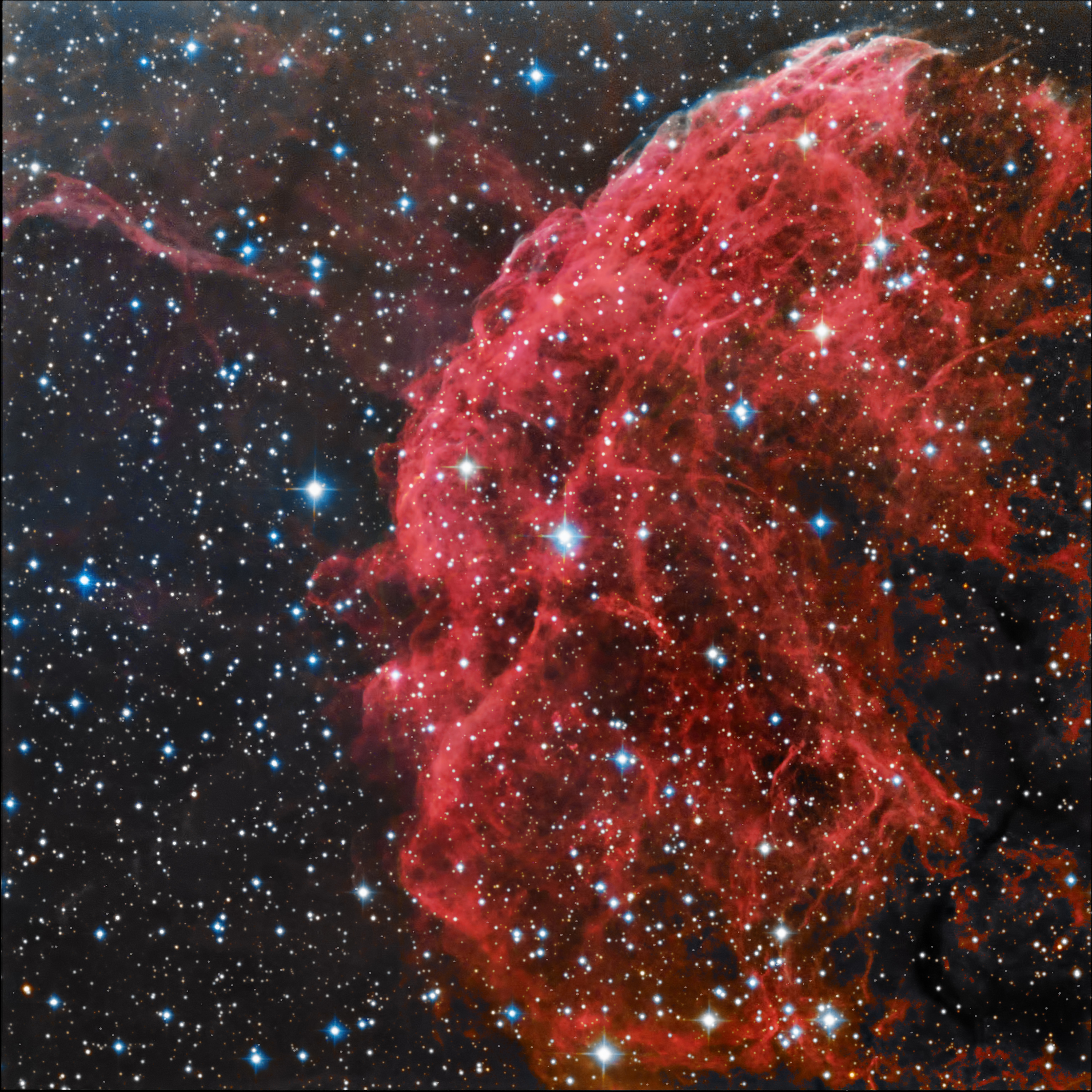
IC 443 - The Jellyfish Nebula
IC 443 also known as the Jellyfish Nebula and Sh2-248 is a
galactic supernova remnant (SNR) in the constellation Gemini.
It is located near the star Eta Geminorum. Its distance is roughly
5,000 light-years from Earth. IC 443 may be the remains of a
supernova that occurred 3,000 - 30,000 years ago. The same
supernova event likely created its neutron star, the collapsed
remnant of the stellar core. IC 443 is one of the best-studied
cases of supernova remnants interacting with its surrounding
molecular clouds. Another fun image taken with the wonderful
Telescope Live remotely operated telescopes in Chile. This
particular telescope - the Planewave 24" and the Finger Lakes
Instruments FLI PL 9000. This first image is the basic LRGB
|
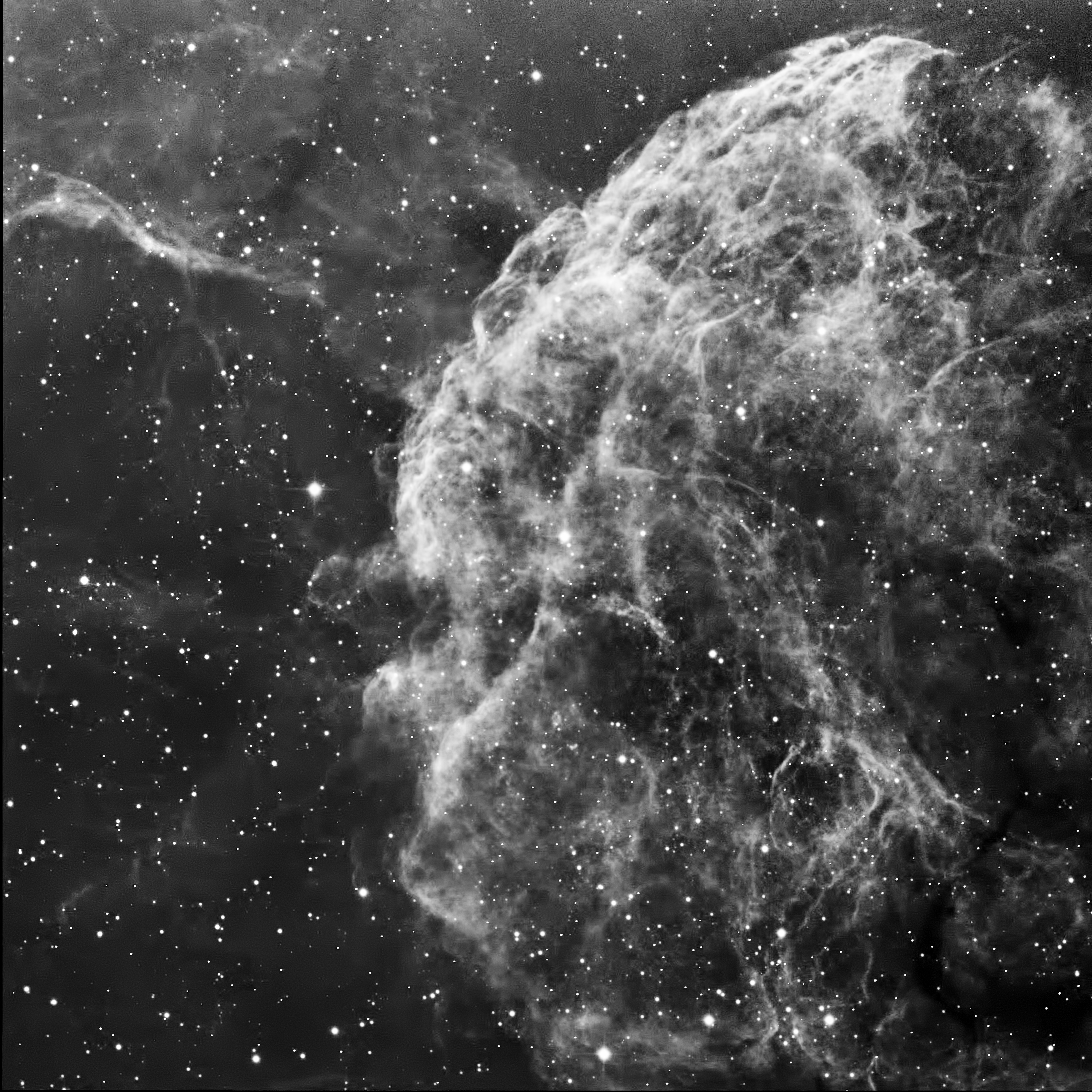
IC 443 - The Jellyfish Nebula
This second image in the Sh2-248 series was taken through just a
Hydrogen Alpha filter, commonly referred as narrowband imaging.
Sometimes with the color images it's really easy to lose the
details in the color. This image in Ha looks nice because black
and white gives a much better feel for the details in the many filaments
of hydrogen gas
|
- Location: El Sauce Observatory, Chile
- Date: February 20, 2021
- Mount: ASA DDM85
- Telescope: ASA 500N CHI-2
- Camera: FLI PL16803 @-30c
- Exposure: 6x10 min Red 1hr
|
- Location: El Sauce Observatory, Chile
- Date: February 20, 2021
- Mount: ASA DDM85
- Telescope: ASA 500N CHI-2
- Camera: FLI PL16803 @-30c
- Exposure: 6x10 min SHO 1hr
|
- Location: El Sauce Observatory, Chile
- Date: October 25, 2020
- Mount: Mathis MI-1000
- Telescope: Planewave CDK24 f/6.6
- Camera: FLI PL9000 @-25c CHI-1 CCD
- Exposure: 8x10 LRGBHa 1hr 20min
|
- Location: El Sauce Observatory, Chile
- Date: October 25, 2020
- Mount: Mathis MI-1000
- Telescope: Planewave CDK24 f/6.6
- Camera: FLI PL9000 @-25c CHI-1 CCD
- Exposure: 8x10 LRGBHa 1hr 20min
|
|
IC 443 - The Jellyfish Nebula
This third version of IC 443 is a combination of the LRGB and
Hydrogen Alpha (LRGB+Ha). In versions that other folks have
done this version might be much more red. I admit that I'm still
really new to Narrow Band (NB) processing, so I'm not quite as
aggressive as others with more experience will be. However, by
keeping the red slightly muted I feel that I can keep more of
the details
|
Gum 16
There are two schools of thought as to what this area actually
is. One is that it is a still expanding supernova remnant from
about 1 million years ago. The other is that it is an evolved HII
region. Either way, the consensus is that it is an emission nebula.
It lies about 1470 light-years away. These three images are my first
attempt at narrowband processing. Instead of taking the images in
the visual light band, these are taken through Hydrogen Alpha and
Oxygen III filters. The Ha or OIII filters were assigned to the
RGB channels in various combinations to get the different outcomes.
This first one was combined in OHH
|
Gum 16
This second image in this Gum 16 series was combined as HOO. I think
that this one is my favorite of the three. Somewhere in this huge
complex is the Vela Supernova Remnant. This region is named after its
discoverer, the Australian astronomer Colin Stanley Gum (1924–1960)
|
Gum 16
This third image was combined in OOH. This area of Hydrogen and Oxygen
gas contains about 32 cometary globules. These are areas of gas of
varying densities. The radiation pressures from nearby stars erode
the gas leaving globules that resemble comets. Along with ordinary Bok
globules they are associated with star formation
|
- Location: El Sauce Observatory, Chile
- Date: October 25, 2020
- Mount: Mathis MI-1000
- Telescope: Planewave CDK24 f/6.6
- Camera: FLI PL9000 @-25c CHI-1 CCD
- Exposure: 8x10 LRGB+Ha 1hr 20min
|
- Location: Heaven's Mirror Observatory, Australia
- Date: January 11, 2021
- Mount: Paramount MX+
- Telescope: FSQ-106ED AUS-2
- Camera: FLI PL16803 @-25c
- Exposure: 8x10 min Ha+OIII 1hr 20min
|
- Location: Heaven's Mirror Observatory, Australia
- Date: January 11, 2021
- Mount: Paramount MX+
- Telescope: FSQ-106ED AUS-2
- Camera: FLI PL16803 @-25c
- Exposure: 8x10 min Ha+OIII 1hr 20min
|
- Location: Heaven's Mirror Observatory, Australia
- Date: January 11, 2021
- Mount: Paramount MX+
- Telescope: FSQ-106ED AUS-2
- Camera: FLI PL16803 @-25c
- Exposure: 8x10 min Ha/OIII 1hr 20min
|
|
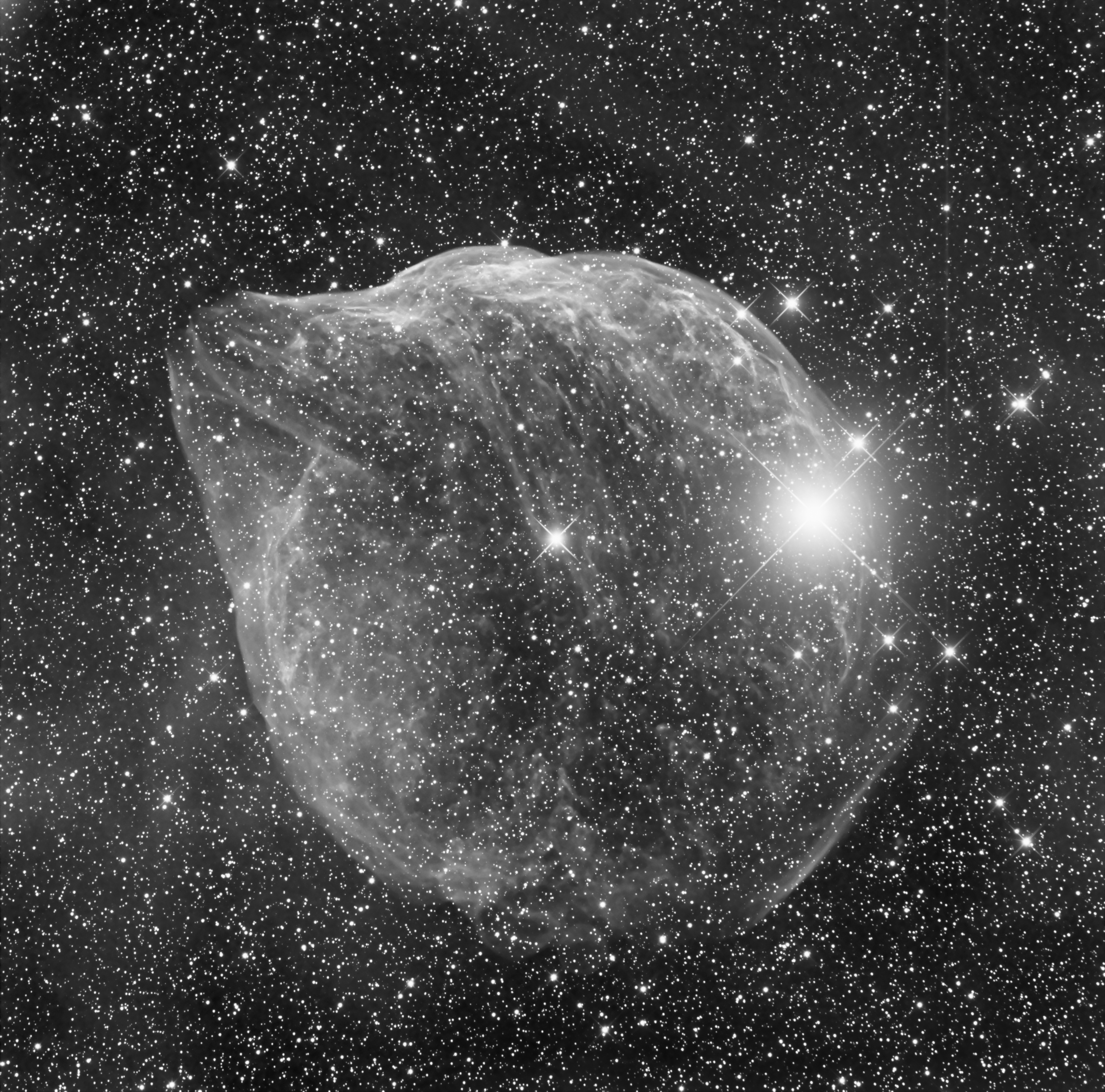
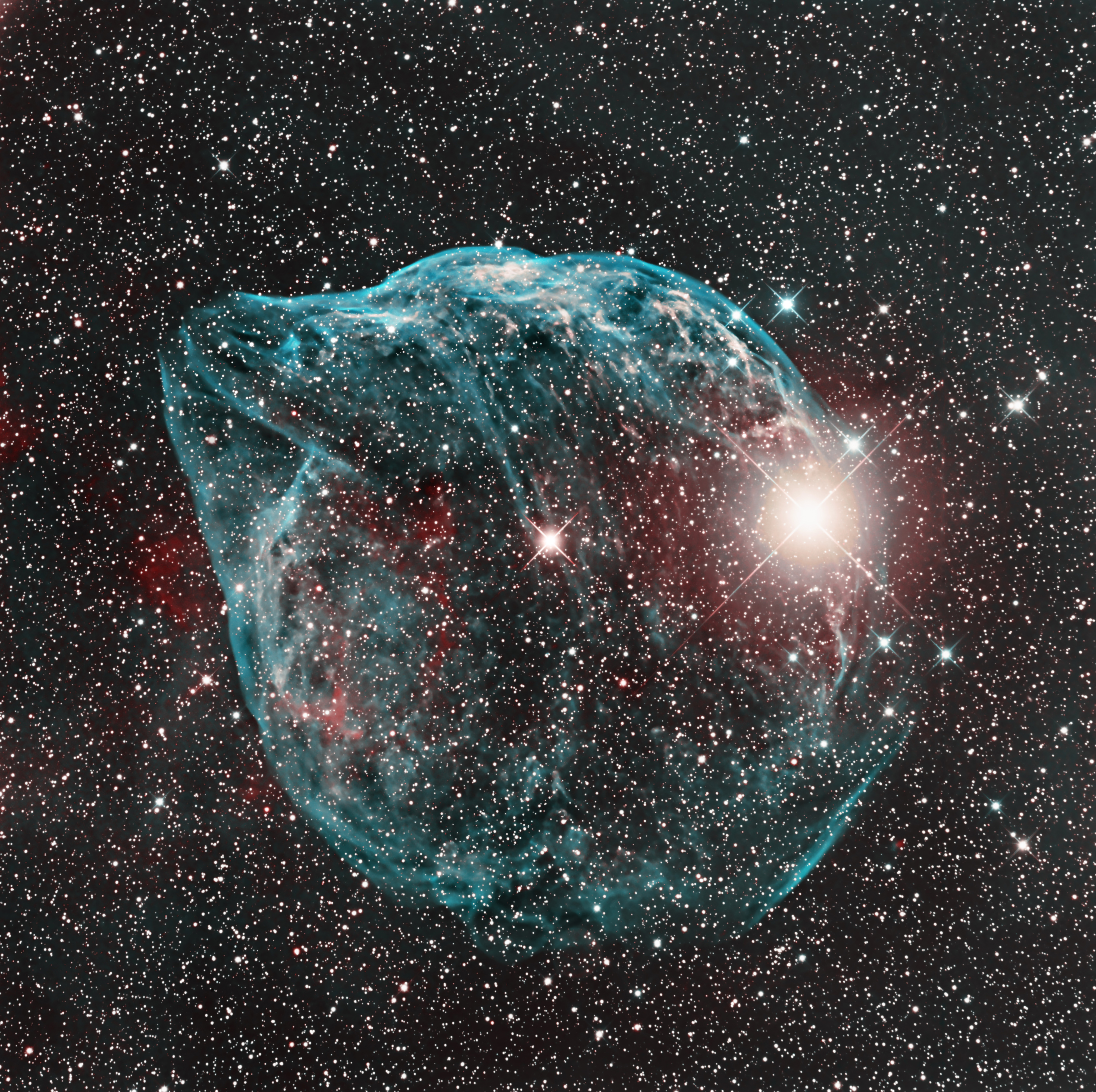
Sh2-308 - The Dolphin Nebula
This nebula is a Hydrogen II region. It was first formed about
70,000 years ago from the Wolf-Rayet star EZ Canis Majoris in
the center. These gases are traveling outward at around 3.8 million
mph as a result of the star throwing off its outer hydrogen layers
in pre-supernova fits. Eventually this star will explode as a
supernova and wipe out the nebula. Distance from earth is estimated
at between 1800 to 6000 light-years from Earth. Its diameter is around
60 light-years. This image was taken through an Oxygen III filter
|
Sh2-308 - The Dolphin Nebula
This version of the Dolphin Nebula is a combination of Oxygen III and
Hydrogen Alpha filters
|
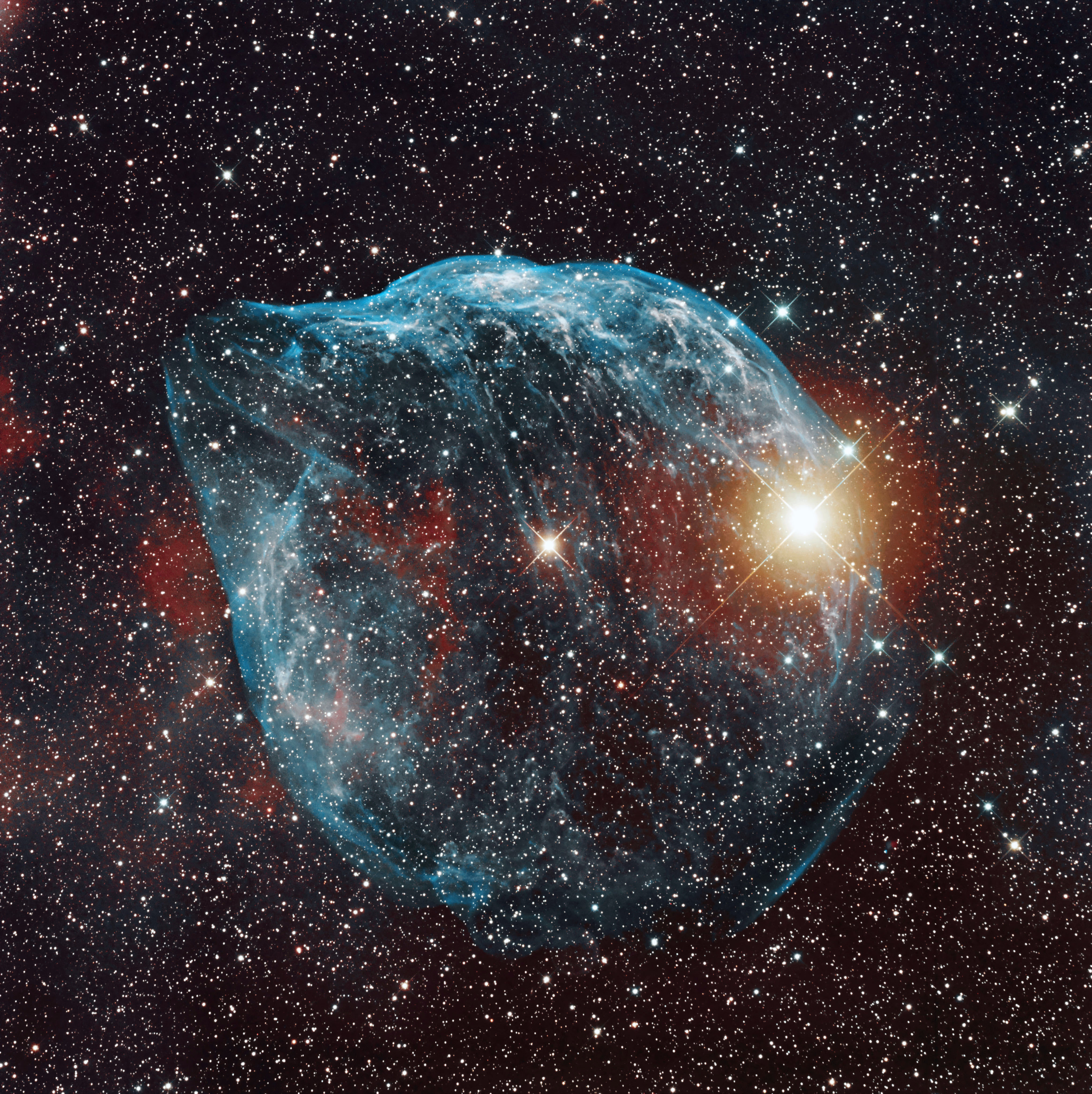
Sh2-308 - The Dolphin Nebula
Here is another version of the Dolphin Nebula. The interesting thing
about processing an astro image is that it's very difficult to
replicate how you did it the first time. This one has a bit more blue
than cyan, and the red Ha regions have been accentuated a bit more
|
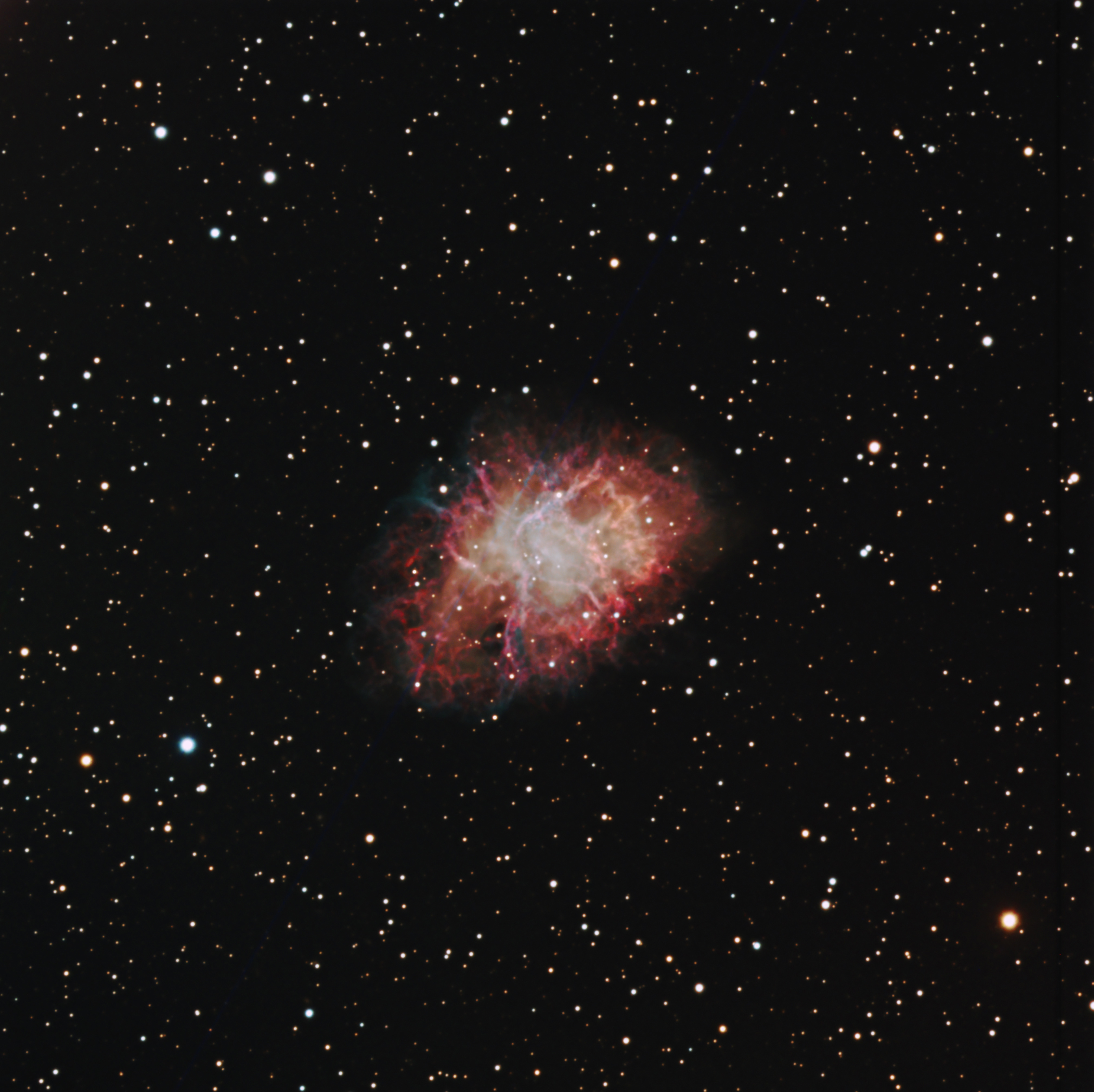
Messier 1 - The Crab Nebula (WB)
The Crab Nebula (Messier 1) is a supernova remnant in the constellation
Taurus. At its heart is a neutron star that is also a pulsar that is
almost 20 miles in diameter and spins at a rate of 30.2 rotations per
second. It corresponds with a bright supernova recorded by Chinese
astronomers in 1054. This nebula was the first object identified that
corresponds with a historical supernova explosion. Scientists are still
trying to figure out why this SN remnant has such an unusually irregular
shape. Usually, SN remnants have a much more symmetrical, spherical shape.
This version of the image is in the visible RGB spectrum
|
- Location: El Sauce Observatory, Chile
- Date: December 17, 2020
- Mount: ASA DDM85
- Telescope: ASA 500N CHI-2
- Camera: FLI PL16803 @-30c
- Exposure: 6x10 min Ha 1hr
|
- Location: El Sauce Observatory, Chile
- Date: December 17, 2020
- Mount: ASA DDM85
- Telescope: ASA 500N CHI-2
- Camera: FLI PL16803 @-30c
- Exposure: 6x10 min Ha and OIII 1hr
|
- Location: El Sauce Observatory, Chile
- Date: December 17, 2020
- Mount: ASA DDM85
- Telescope: ASA 500N CHI-2
- Camera: FLI PL16803 @-30c
- Exposure: 6x10 min Ha and OIII 1hr
|
- Location: El Sauce Observatory, Chile
- Date: January 9, 2021
- Mount: ASA Alt-Az Direct Drive
- Telescope: 1000 (39" RC) CHI-3
- Camera: FLI PL16803 @-25c
- Exposure: 8x10 min LRGB 1hr 20min
|
|
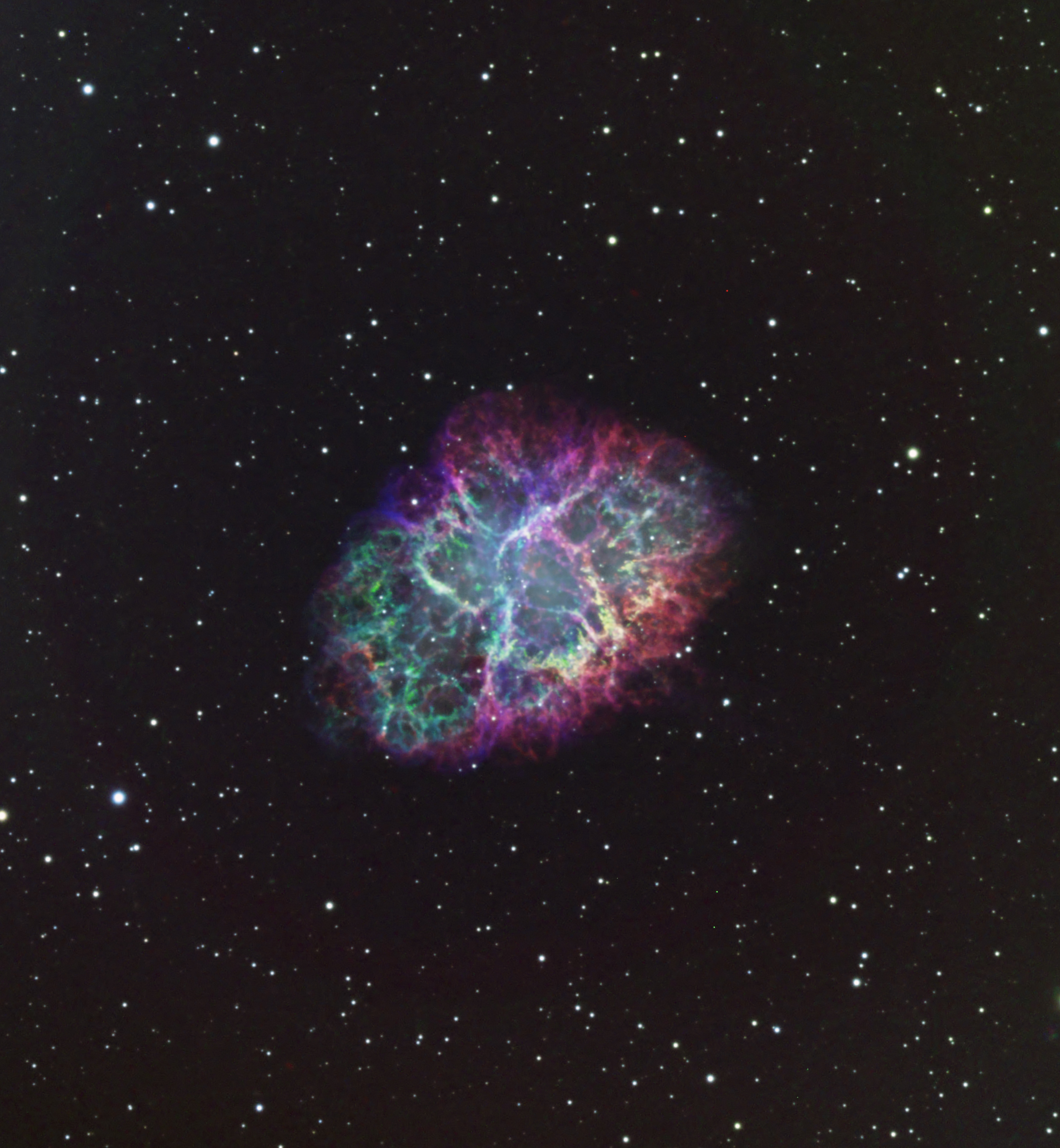
Messier 1 - The Crab Nebula (HSO)
This version of the Crab Nebula is a narrowband image
taken through Hydrogen Alpha, Oxygen III and Sulphur II
filters. I tried different combinations of assigning the
filters to the RGB channels and this one seemed to turn out
the best. Red = Ha, Green = Sulphur II, Blue = Oxygen III
|
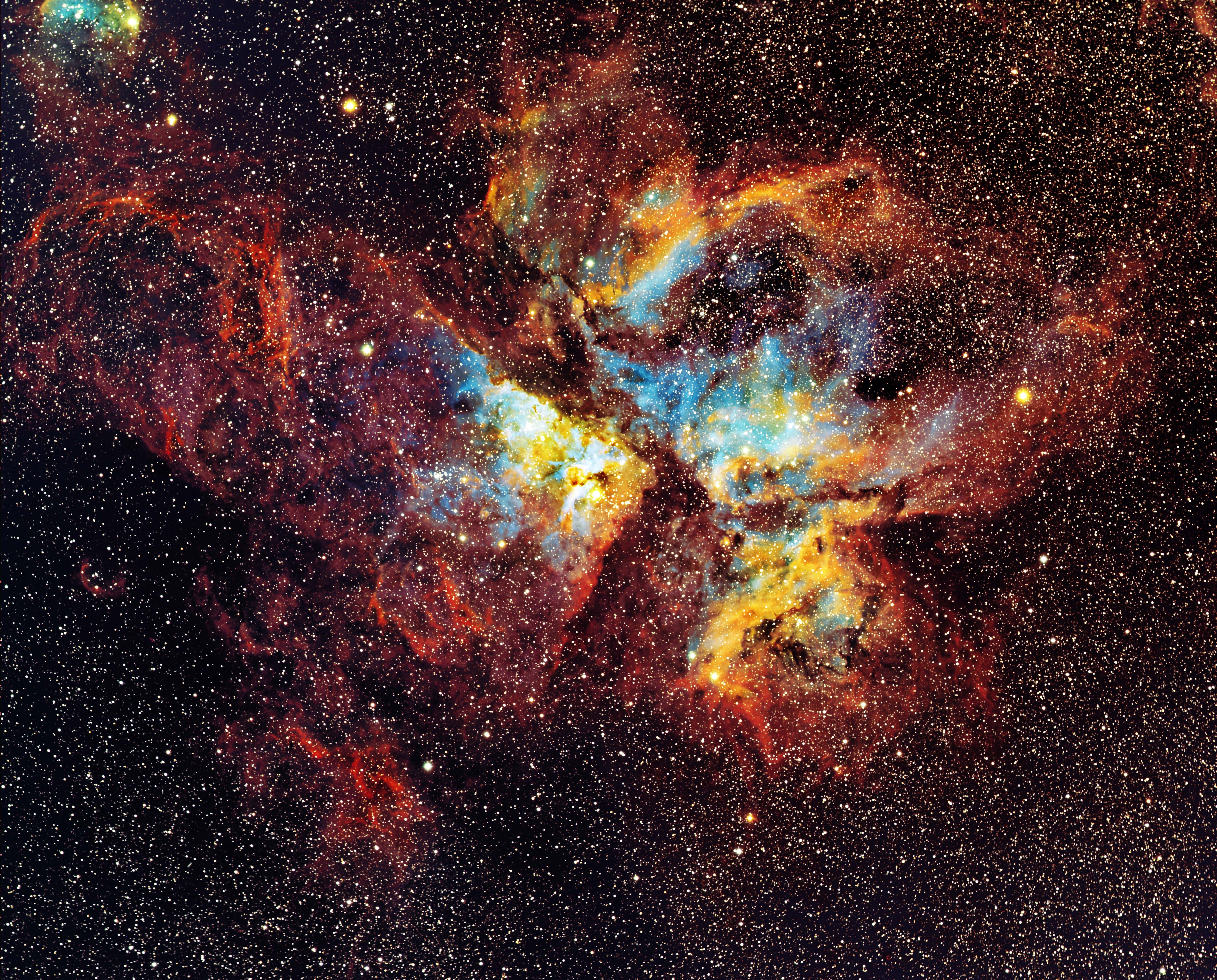
NGC 3372 - The Carina Nebula (SHO)
The Carina Nebula was discovered by Nicolas-Louis de Lacaille in
1752 from the Cape of Good Hope. It is four times the size and even
brighter than the Great Orion Nebula. It lies about 8,500 light-years
from Earth and includes both bright and dark areas of nebulosity as
well as numerous other objects. This image was taken with a wide-field
camera.
Sulphur II = Red, Hydrogen Alpha = Green, Oxygen III = Blue
|
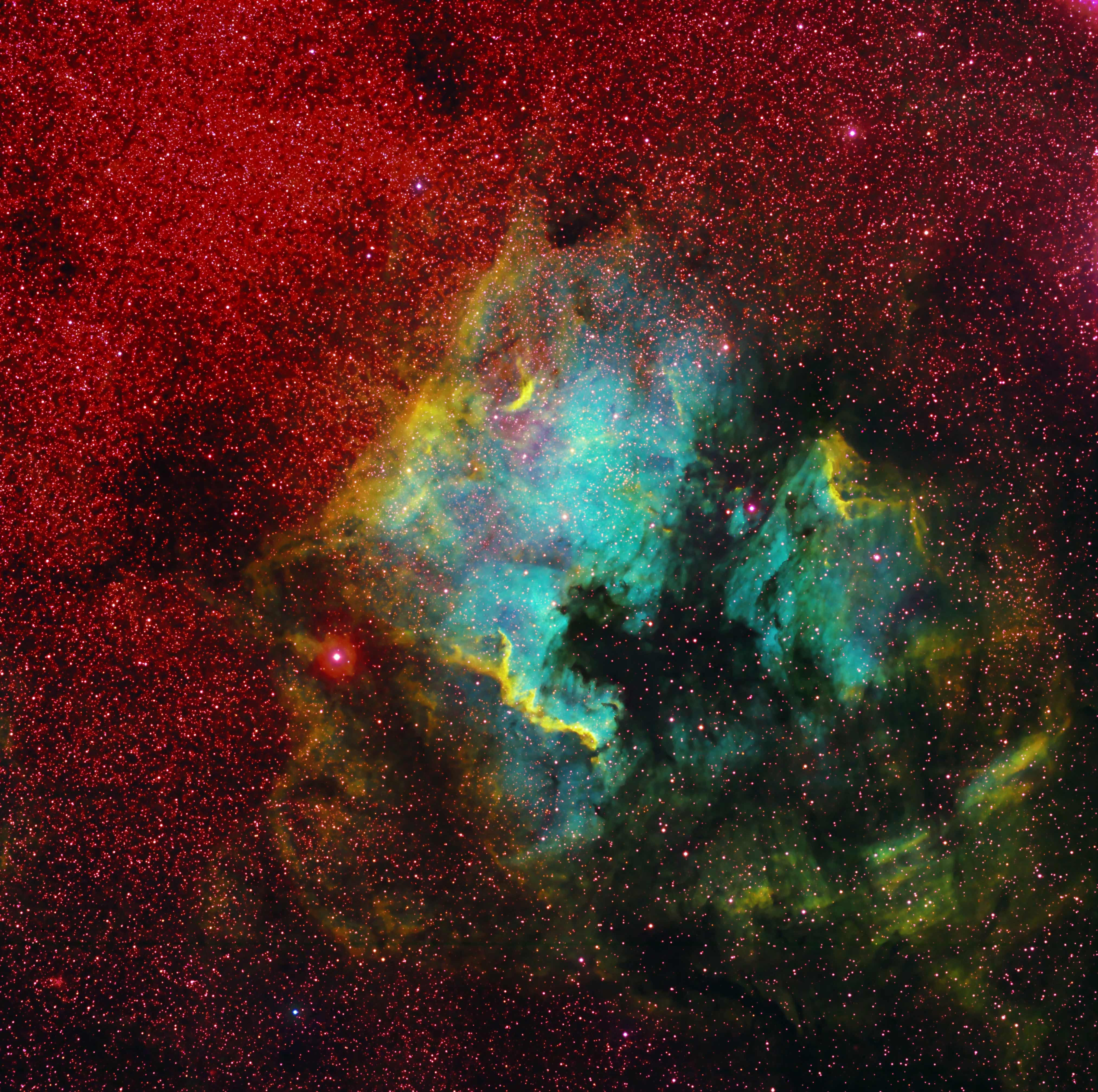
NGC 7000 - The North America Nebula
This nebula was discovered by William Herschel in 1786. It was
cataloged again and photographed by Max Wolf, a pioneer in astrophotography, in 1860.
He noticed that the nebula resembled the shape of North America. Covering a huge amount
of sky, it is about 140 light-years across, 90 light-years north to south and about 2500
light-years distant. I processed this image in two different ways. This version was combined in the SHO mode. Sulphur assigned to the Red Channel, Ha to the Green Channel and OIII to the Blue Channel. The yellow areas are regions of intense star formation
|
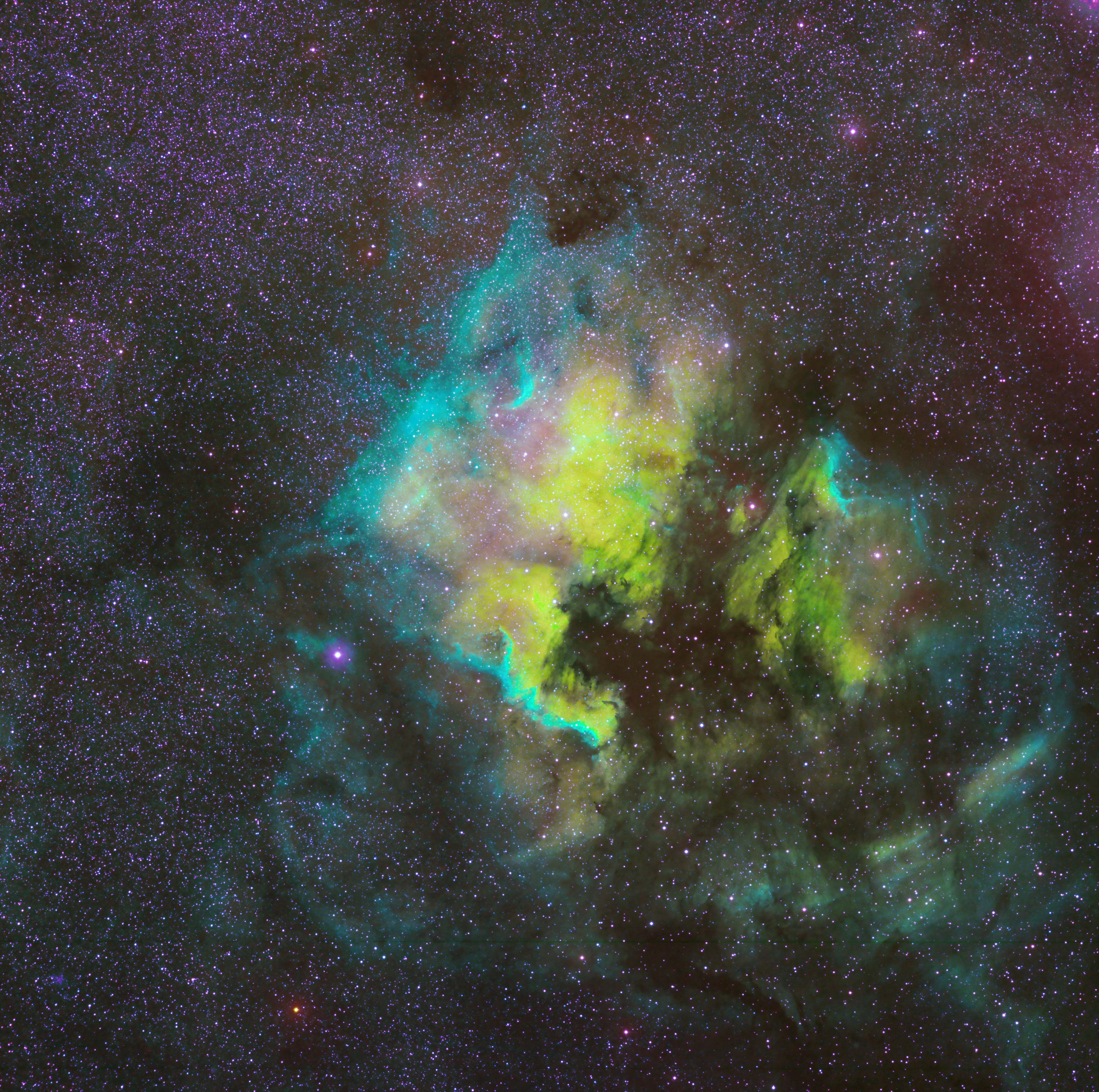
NGC 7000 - The North America Nebula
This version was processed in a different way from the previous image.
In this one OIII is assigned to the Red Channel, Ha to the Green Channel
and SII to the Blue Channel
|
- Location: El Sauce Observatory, Chile
- Date: January 9, 2021
- Mount: ASA Alt-Az Direct Drive
- Telescope: 1000 (39" RC) CHI-3
- Camera: FLI PL16803 @-25c
- Exposure: 8x10 min LRGB 1hr 20min
|
- Location: El Sauce Observatory, Chile
- Date: May 11, 2021
- Mount: Astro-Physics 1600
- Telescope: Officina Stellare RH 200 CHI-6
- Camera: FLI ML16200 @-20c
- Exposure: 5x10 min SII, Ha and OIII 50 min
|
- Location: IC Astronomy Observatory, Spain
- Date: October 29, 2020
- Mount: Paramount MX+
- Telescope: FSQ-106EDX4 SPA-3
- Camera: FLI PL16083
- Exposure: 6x10 min Ha, OIII and SII 1hr
|
- Location: IC Astronomy Observatory, Spain
- Date: October 29, 2020
- Mount: Paramount MX+
- Telescope: FSQ-106EDX4 SPA-3
- Camera: FLI PL16083
- Exposure: 6x10 min Ha, OIII and SII 1hr
|
|
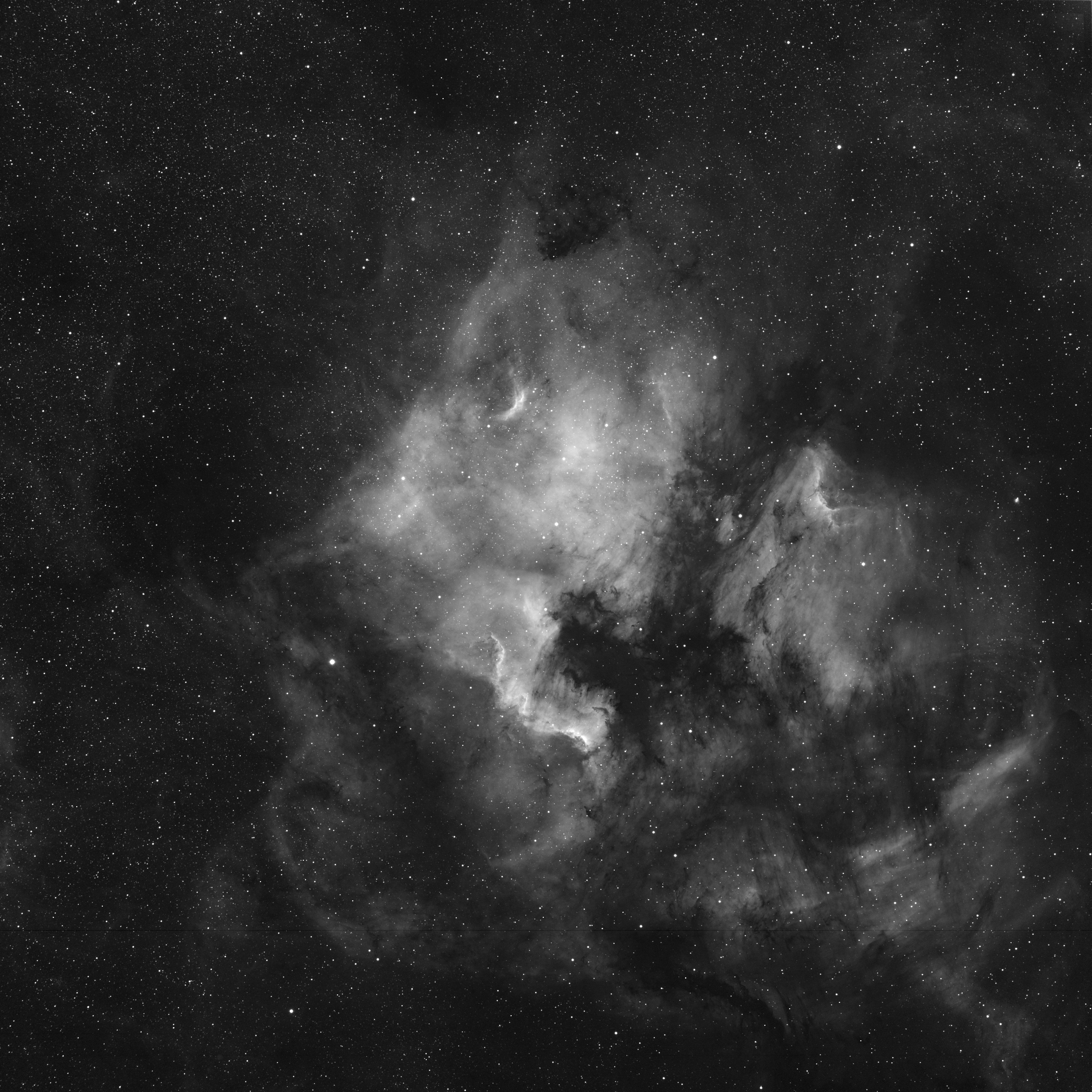
NGC 7000 - The North America Nebula
This version is what the North America Nebula looks like when taken through
just the Hydrogen Alpha filter
|
NGC 6188 - The Dragons of Ara Nebula (SHO)
The Dragons of Ara is just a small part of a much larger molecular
cloud. This part of the nebula is an emission nebula that includes
some dark nebulae as well. It lies about 4000 light-years away from
us and is about 300 light-years in diameter
|
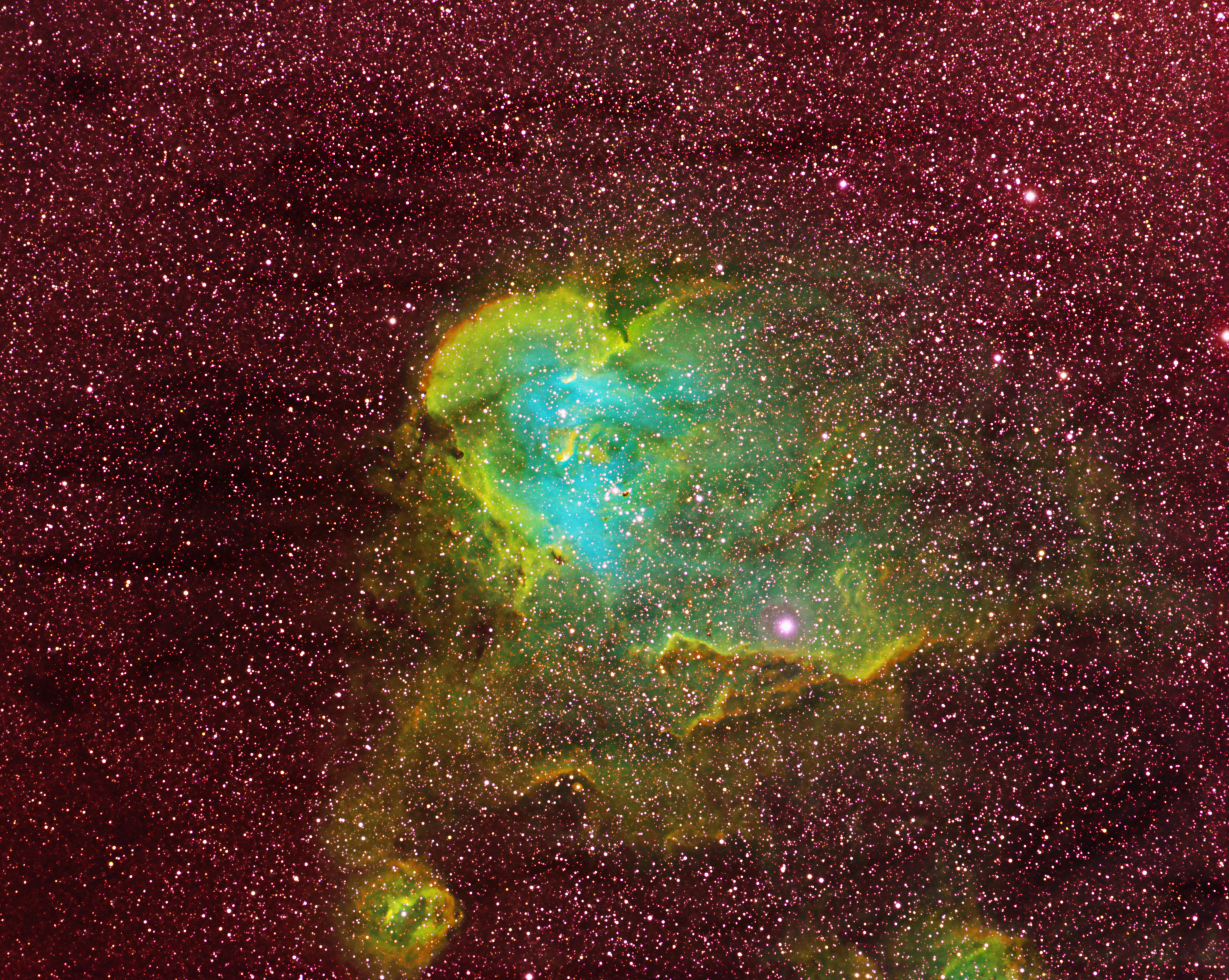
IC 2944 - The Running Chicken Nebula (SHO)
The Running Chicken Nebula is an emission nebula located in the
constellation Centaurus. It features a number of Bok globules,
although there is no evidence of star formation in any of them.
This image is a wider field view of the nebula than the one to the
right which is a more zoomed-in look at the same region
|
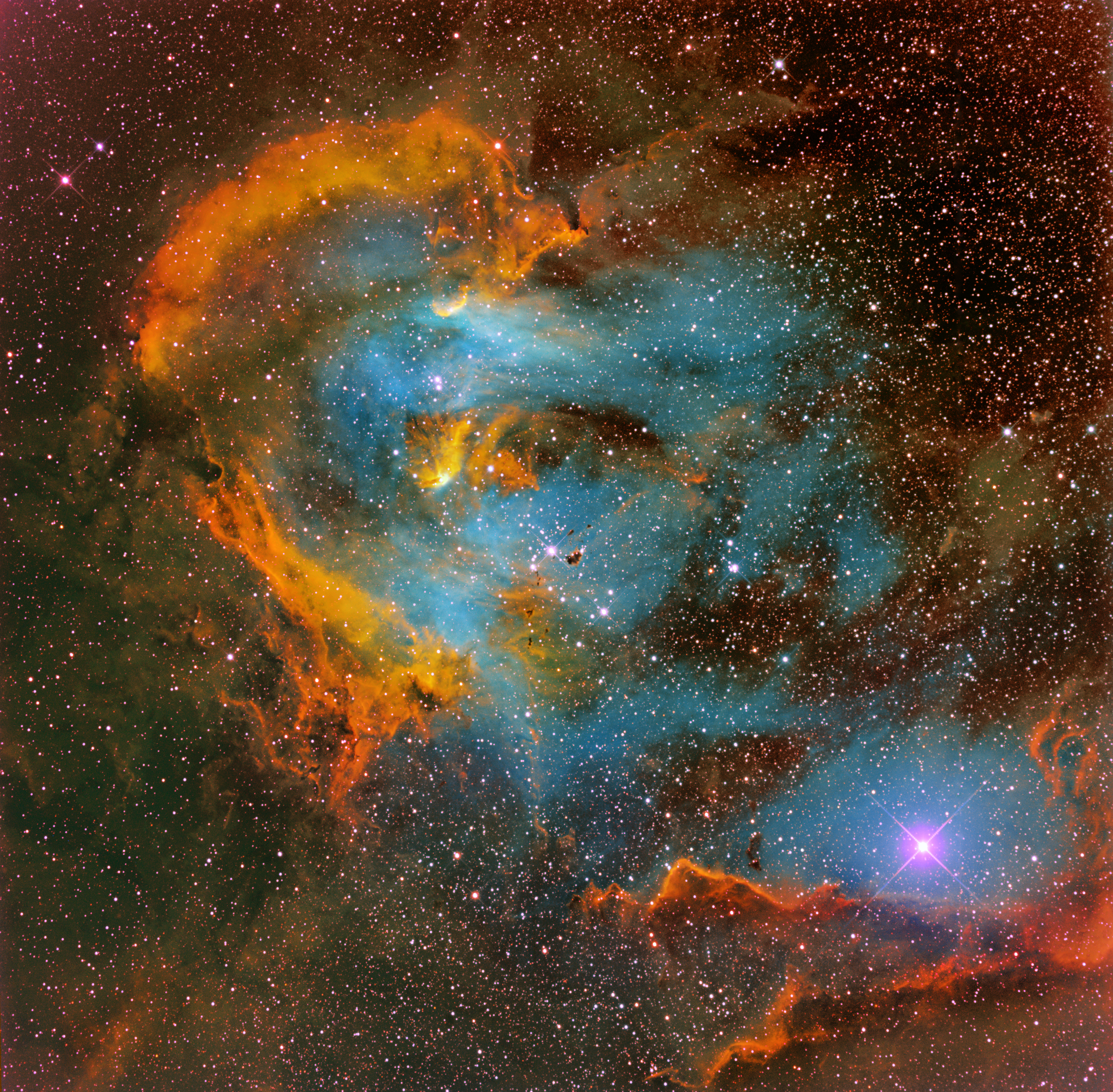
IC 2944 - The Running Chicken Nebula (SHO)
This image is a more zoomed-in look at the same nebula. Both images
used Sulfur, Hydrogen and Oxygen filters instead of the traditional
Red, Green and Blue
|
- Location: IC Astronomy Observatory, Spain
- Date: October 29, 2020
- Mount: Paramount MX+
- Telescope: FSQ-106EDX4 SPA-3
- Camera: FLI PL16083
- Exposure: 6x10 min Ha, OIII and SII 1hr
|
- Location: IC Astronomy Observatory, Spain
- Date: July 7, 2021
- Mount: OS EQ
- Telescope: Officina Stellare ProRC 700
- Camera: FLI PL16803 @-25C (SPA-2) (CCD)
- Exposure: 6x10 min Ha, OIII, SII, Lum 1hr
|
- Location: El Sauce Observatory, Chile
- Date: July 12, 2021
- Mount: Astro-Physics 1600
- Telescope: Officina Stellare RH 200 CHI-6
- Camera: FLI FL16200 @-20c
- Exposure: 3x10 min OIII, SII, and Lum 30min
|
- Location: El Sauce Observatory, Chile
- Date: July 12, 2021
- Mount: Astro-Physics 1600
- Telescope: Officina Stellare RH 200 CHI-6
- Camera: FLI FL16200 @-20c
- Exposure: 7x10 min Ha, OIII, SII 1hr 10min
|
|
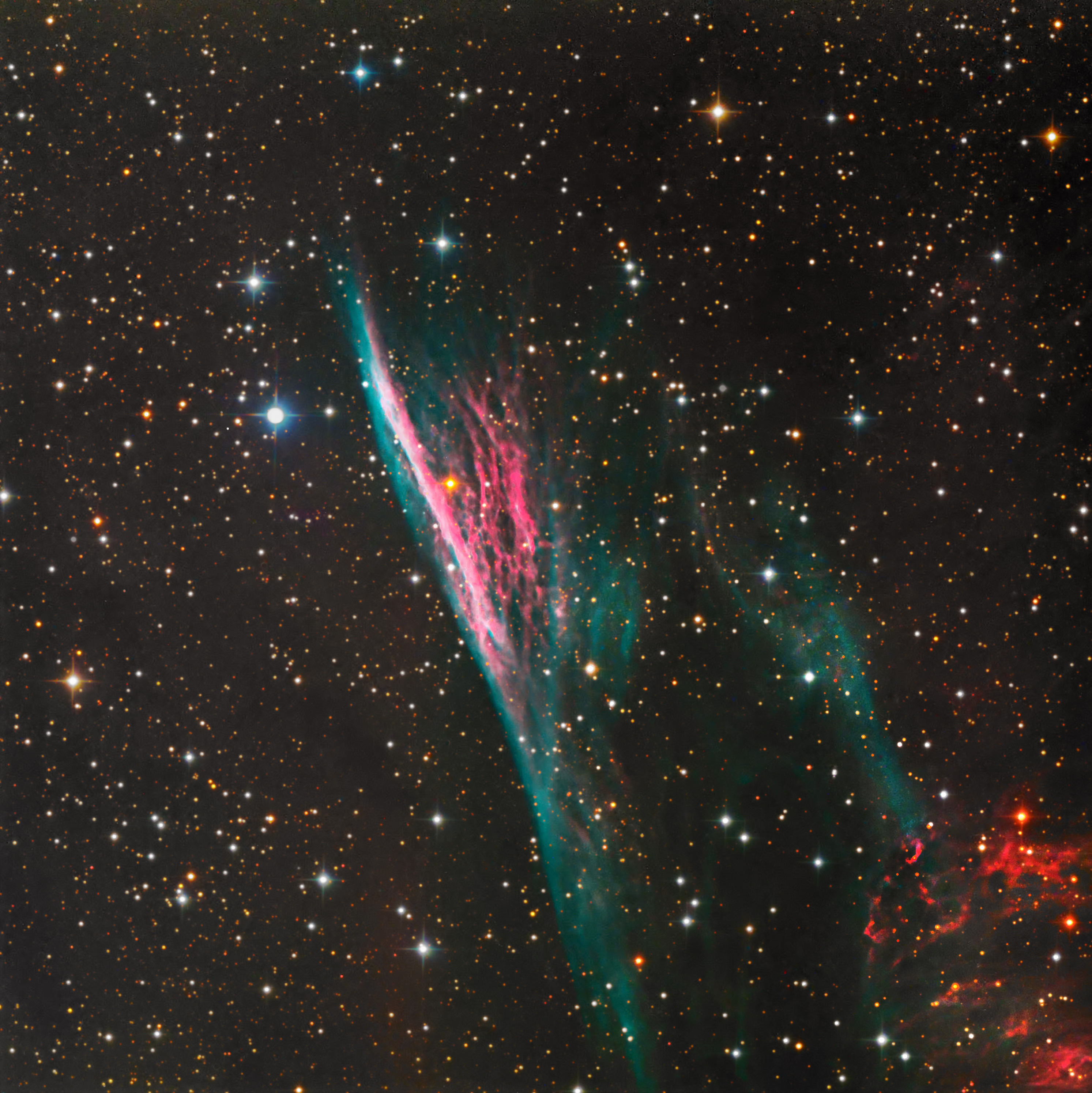
NGC 2736 - Pencil Nebula / Herschel's Ray
Part of the Vela Supernova remnant, it is thought to have been
formed by the shockwave of the greater Vela Supernova. It lies
about 815 light-years away from us and is moving along at 400,000 MPH
|
Astronomy Now Magazine Ad
Back in 2019, shortly after I signed up as a customer, I submitted
my first image to their gallery - NGC 5128 (Centaurus A). Shortly
after that, their director of marketing sent me an email asking
if they could use that image in an advertisement in an English
astronomy magazine. Of course I said yes. Here is a link to the
article. I have been officially published - YAY!
|
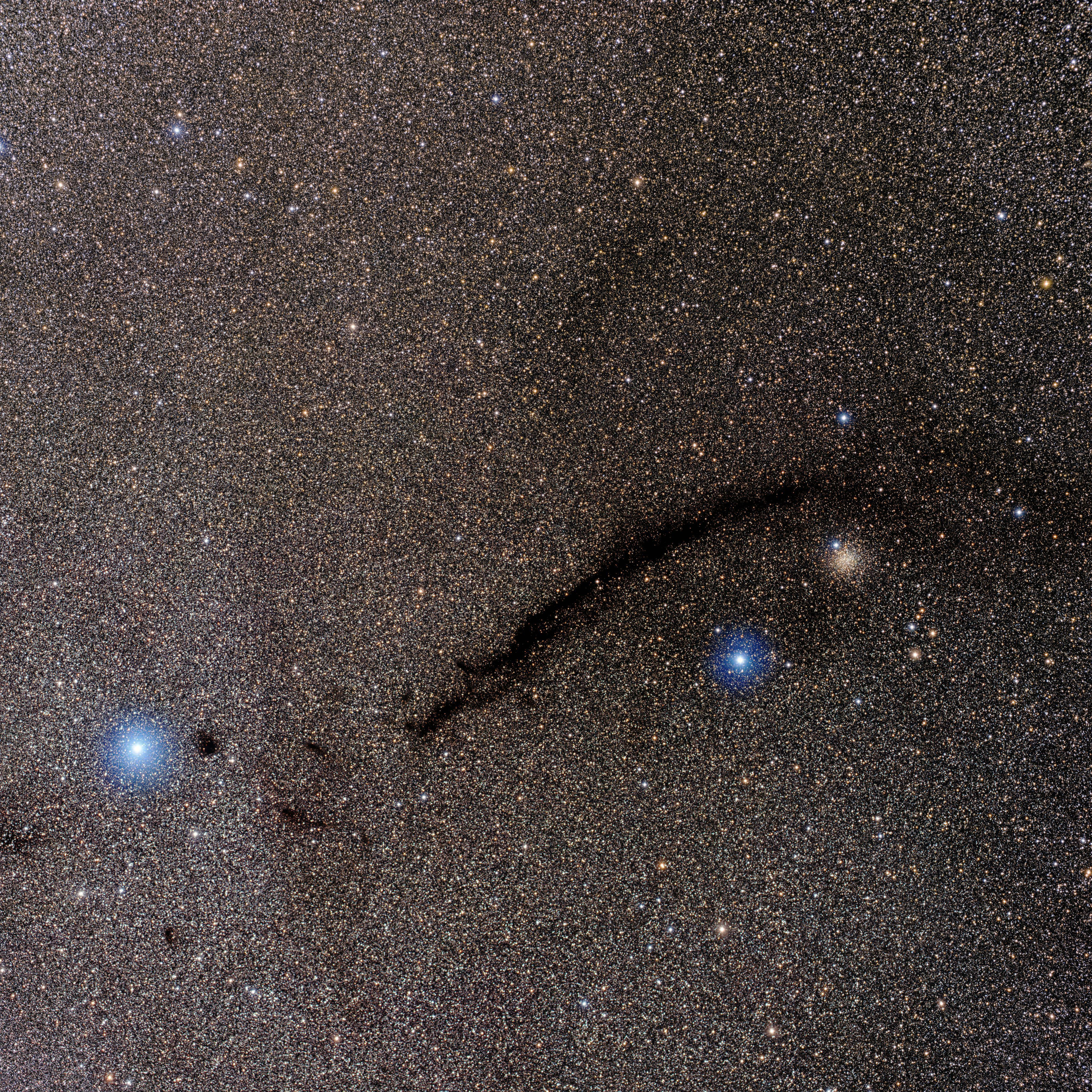
The Doodad Nebula
This dark nebula is commonly known as the Doodad Nebula. It's a
long, cold molecular cloud in the constellation Musca (The Fly).
Right near the right end of the nebula is NGC 4372, a globular
cluster. Processed with PixInsight
|
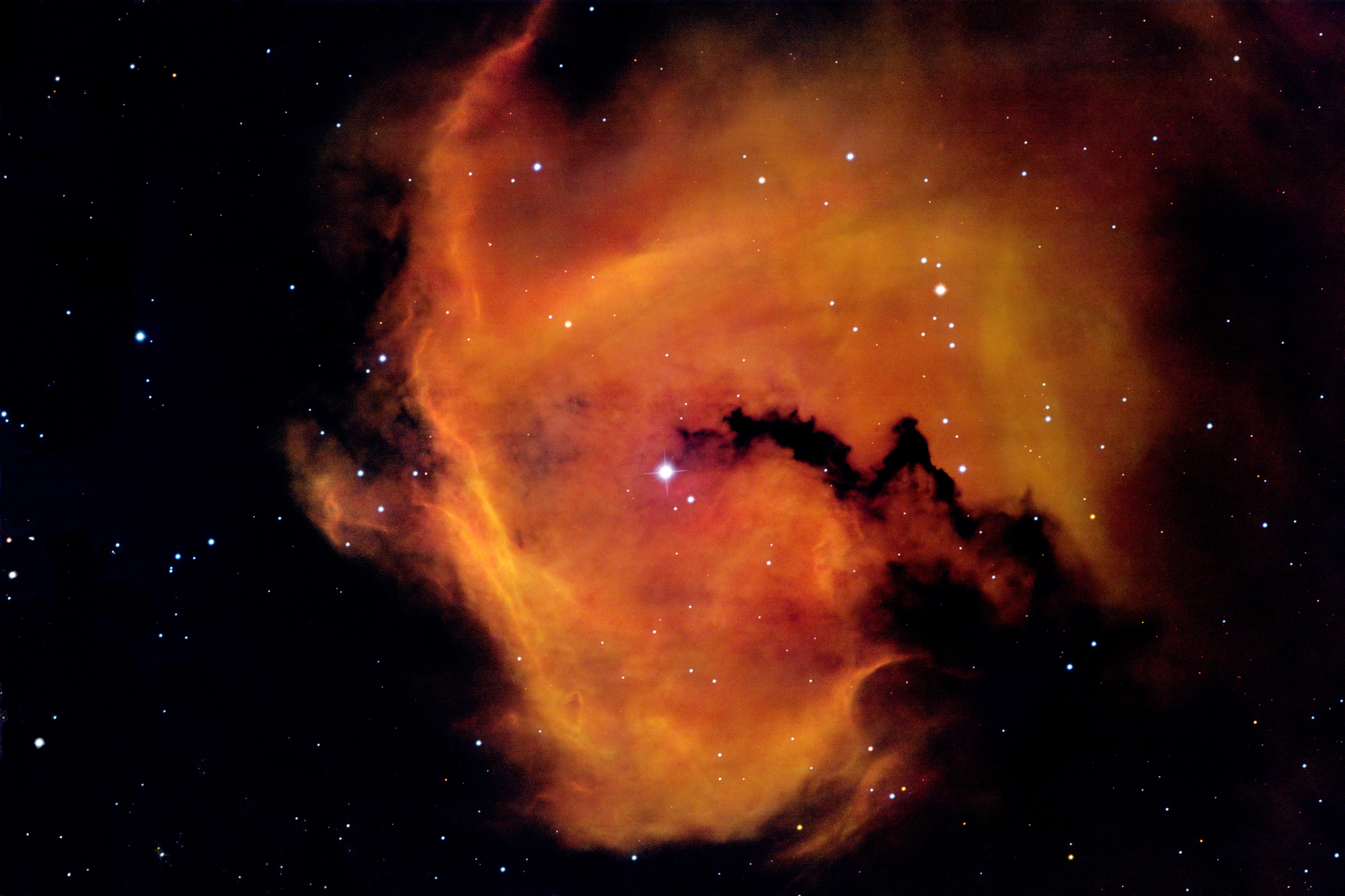
Sh2-311 - Skull and Crossbones Nebula
This nebula is located in the constellation Puppis. Puppis being
the poop deck of the ship Argo, sailed by Jason and the Argonauts
of Greek mythology. If you tilt your head 45 degrees to the left,
it looks like the face of a mandrill. It is a region of gases that
form a large star factory. Recent studies have detected at least 45
proto-stars (stars in the process of being formed). The region is
dominated by a massive young star (the large blue one on the left side)
|
- Location: El Sauce Observatory, Chile
- Date: December 16, 2020
- Mount: Paramount MX+
- Telescope: FSQ-106ED AUS-2
- Camera: FLI PL16083 @ -25c
- Exposure: 6x10 min Ha + LRGB 1hr
|
- Location: Remote / Telescope Live
- Date: 2022 Feature
- Mount: N/A
- Telescope: N/A
- Camera: N/A
- Type: Video Interview
|
- Location: Heaven's Mirror Observatory, Australia
- Date: April - May 2022
- Mount: Paramount MX+
- Telescope: FSQ-106ED (AUS-2)
- Camera: QHY600m @-25c CMOS
- Exposure: 15x10 min RGB 2hrs 30min
|
- Location: Heaven's Mirror Observatory, Australia
- Date: April - May 2022
- Mount: Paramount MX+
- Telescope: FSQ-106ED (AUS-2)
- Camera: QHY600m @-25c CMOS
- Exposure: 16x10 min RGB 2hrs 40min
|
|
Sh2-185 (Sharpless 2-185)
This region of faint nebulosity is dominated by the star Gamma Cas,
commonly referred to as Navi, in the constellation Cassiopeia,
and is part of the greater Gamma Cas Nebula Complex. Just below
the star is IC 63, a denser cloud of gas that looks like an arrowhead
that is pointed at Navi. It is commonly referred to as The Ghost of
Cassiopeia. I tried to image IC 63 a few years ago down in Borrego
Springs, but its close proximity to Navi overwhelmed the sensitivity
of the chip in my camera. This image was processed with both PixInsight
and Photoshop
|
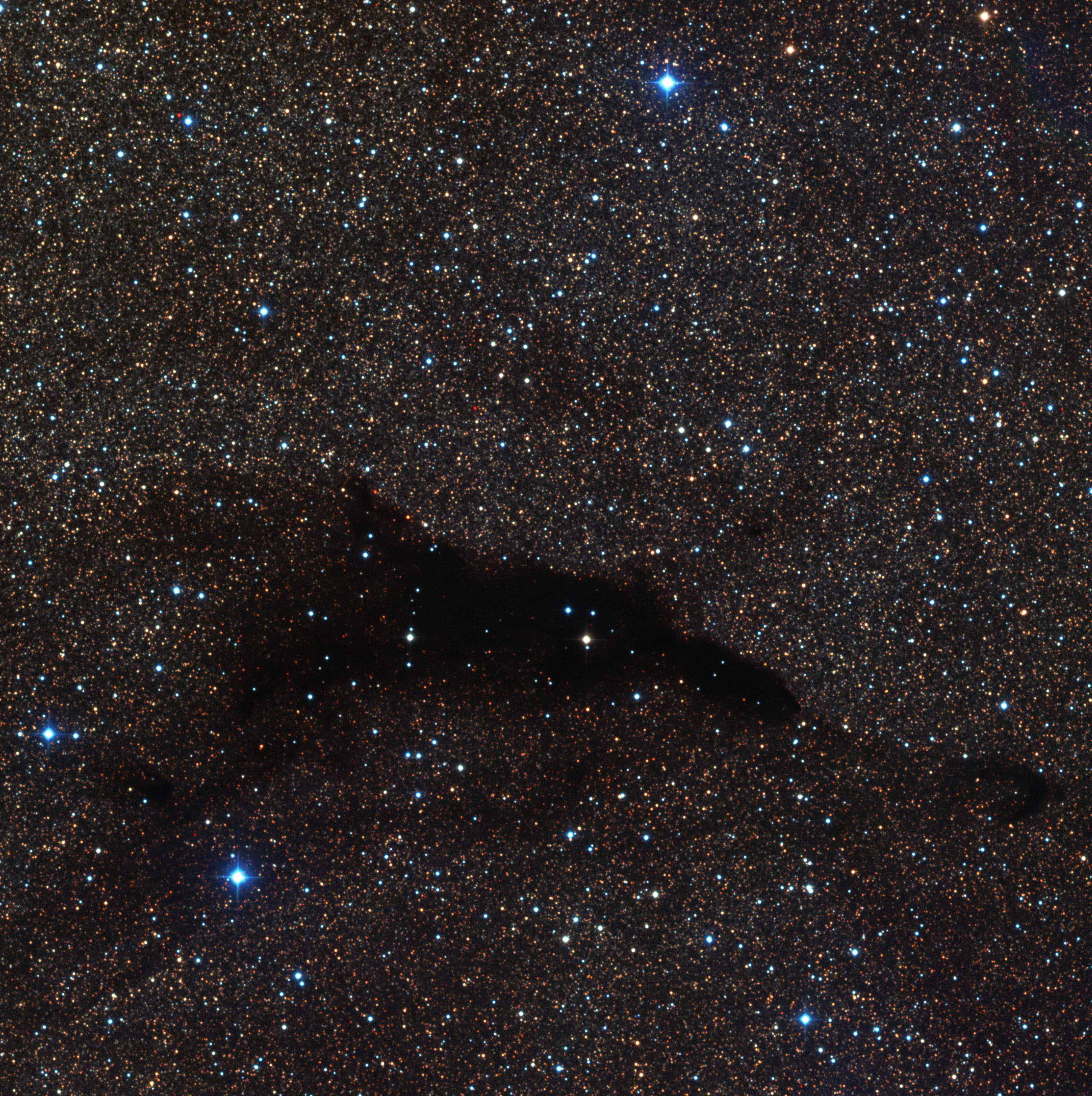
Barnard 252 (B252) The Dolphin Nebula
Barnard 252 is a region of cloud and gas and dust. Its density, and the
fact that there are no nearby stars to make it a reflection or emission
nebula make it what is called a dark nebula. This one is located in our
southern constellation, Scorpius. My processing software, PixInsight,
tells me that there are over 4000 stars in this field
|
IC 4812 - The Anteater Nebula
Down in our southern constellation of Crux lies The Coalsack,
another dark nebula. It is about 600 light-years away and is about 50 light-years
across. It was first reported to Europeans in 1499 by the Spanish
Explorer Vicente Yañez Pinzón, although its existence was known to
peoples of the southern hemisphere since our ancient ancestors first
looked up to the night sky. Scientists forecast that this entire region
is eventually going to be a star-making factory as the dust particles
come together through the force of gravity, eventually igniting into
brand-new stars
|
NGC 3199
This image is my second full-blown attempt at processing with
PixInsight. The data was provided by Mike Selby to Adam Block who in turn made it available
for download on his website (AdamBlockStudios.com) in conjunction with his Cosmic Canvas
tutorial series. The Cosmic Canvas series is definitely more advanced than what I was
prepared for, although I'm glad I made the attempt. Processing consisted of merging the
color data from one telescope with the narrow band data from a different size telescope.
It took me a month of following along with Adam on his tutorial. This is a nebula that was
imaged with narrowband filters (HSO), the stars removed, processed and then merged with
the stars from a different image of a different scale. Sounds complicated—and it was!
|
- Location: IC Astronomy Observatory, Spain
- Date: Multiple nights in August 2022
- Mount: Paramount MX+
- Telescope: FSQ-106EDX4 SPA-3
- Camera: FLI PL16083
- Exposure: 11x10 min LRGB 1hr 50min
|
- Location: El Sauce Observatory, Chile
- Date: March - September 2021
- Mount: Mathis MI-1000
- Telescope: Planewave CDK24 f/6.6
- Camera: FLI PL9000 @-25c CHI-1 CCD
- Exposure: 13x10 min LRGB 2hrs 10min
|
- Location: Heaven's Mirror Observatory, Australia
- Date: July - August 2022
- Mount: Paramount MX+
- Telescope: FSQ-106ED AUS-2
- Camera: FLI PL16083 @-25c
- Exposure: 10x10 min LRGB 1hr 50min
|
- Location: Dataset provided via Adam Block Studios
- Date: August 2022
- Mount: Remote Dataset
- Telescope: Various (Processed in PixInsight)
- Camera: Various CMOS/CCD
- Exposure: Narrowband + LRGB Combined
|
|
Sh2-126 - The Great Lacerta Nebula
This is an emission nebula located in the constellation Lacerta
(The Lizard). It has the same angular size as the Andromeda Galaxy.
Because it is so large and diffuse, it can only be seen with long
exposure imaging. The nearby hot and bright main sequence blue star
10 Lacertae, gives off enough energy to heat the red hydrogen gas
enough that it begins to glow. It is located about 1200 light-years
away from us
|
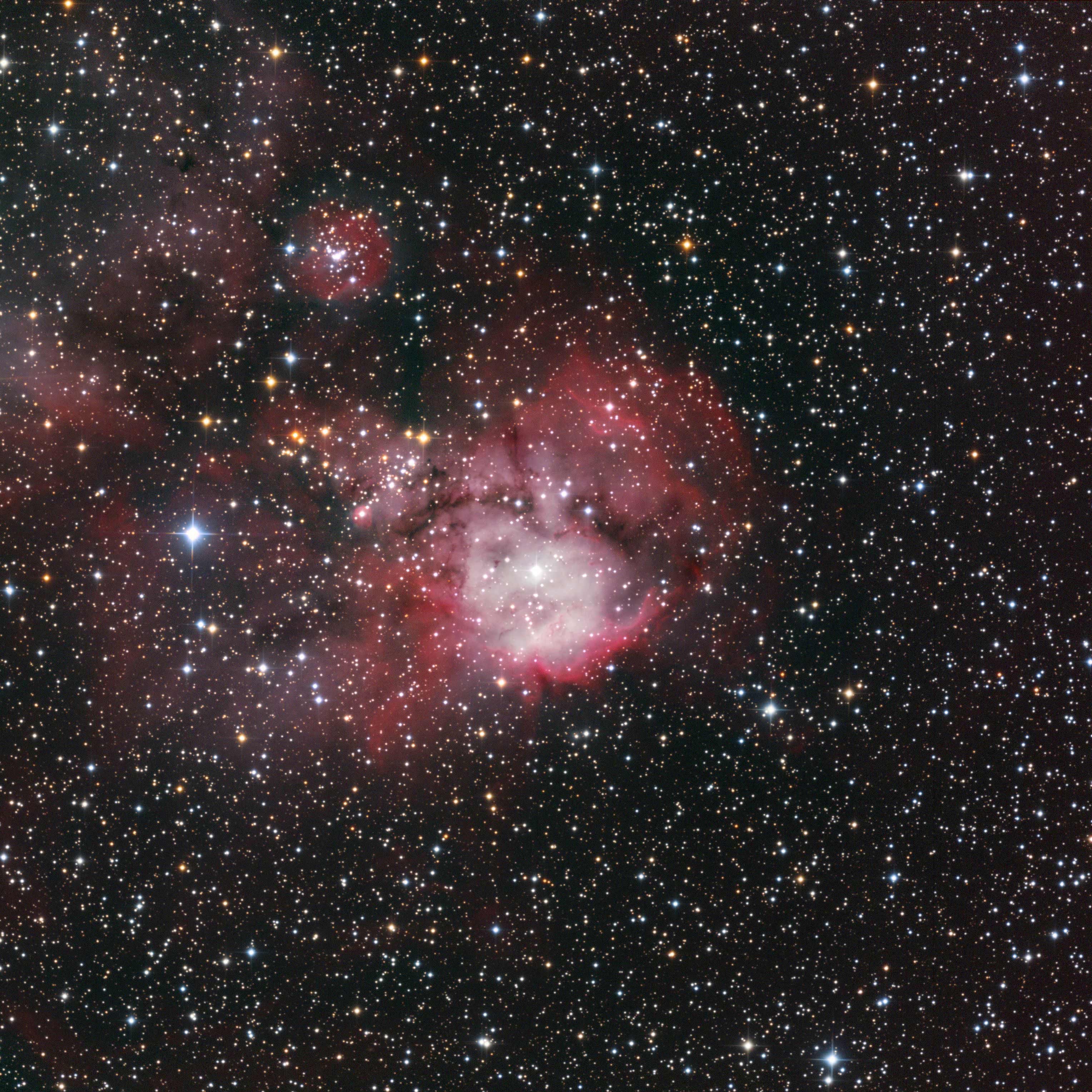
NGC 6559 - The Loreta Nebula
This nebula is in Sagittarius and lies along the edge of a large
molecular cloud that also contains Messier 8, The Lagoon Nebula.
It is also an active star-forming region. There are two types of
nebulae working here - the reddish areas are emission nebulae and
the bluish areas are reflection nebulae. The dark lanes are dark
nebulae - cold dust and gas that blocks the light coming from
behind. It lies about 5000 light-years from Earth
|
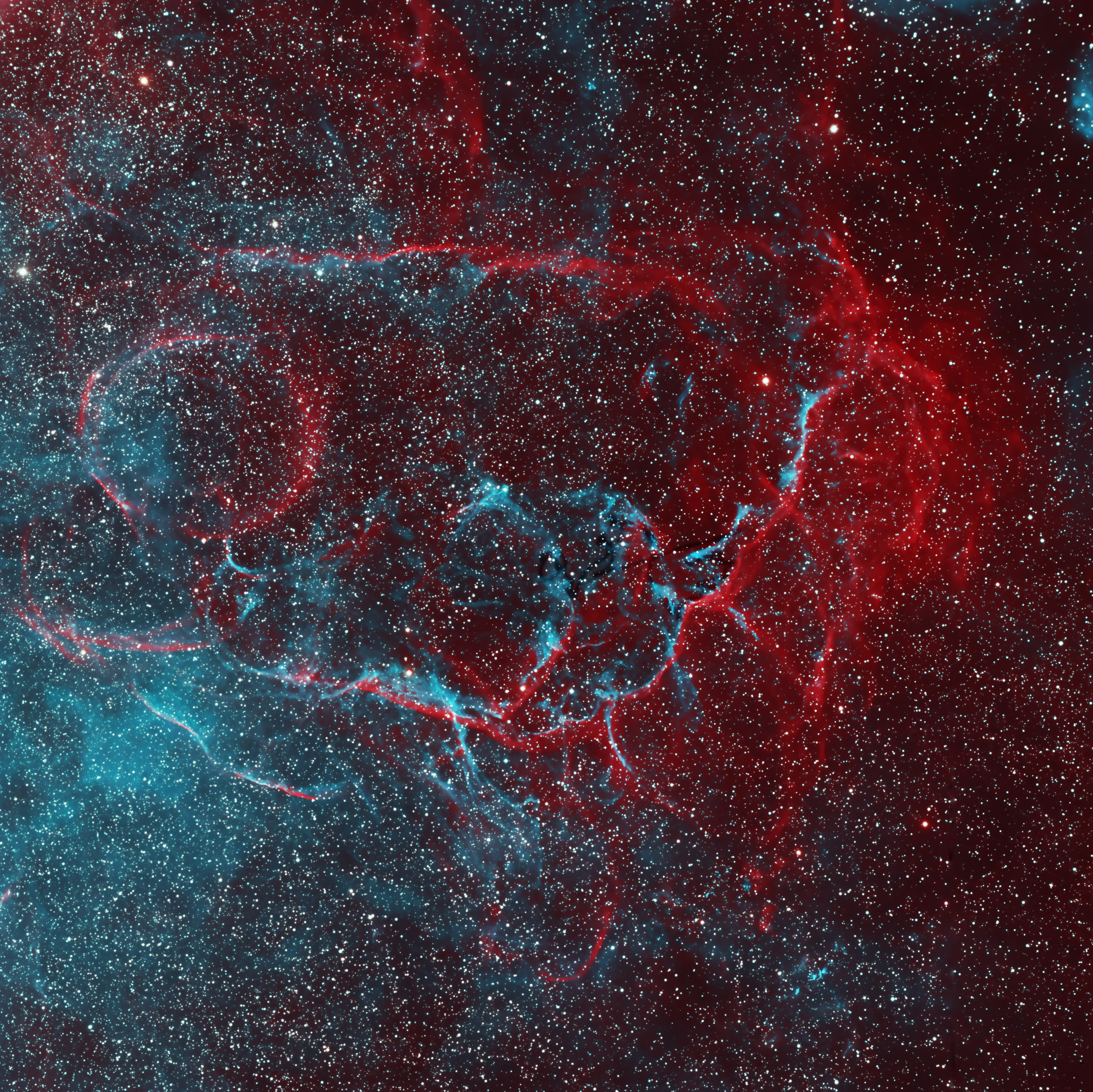
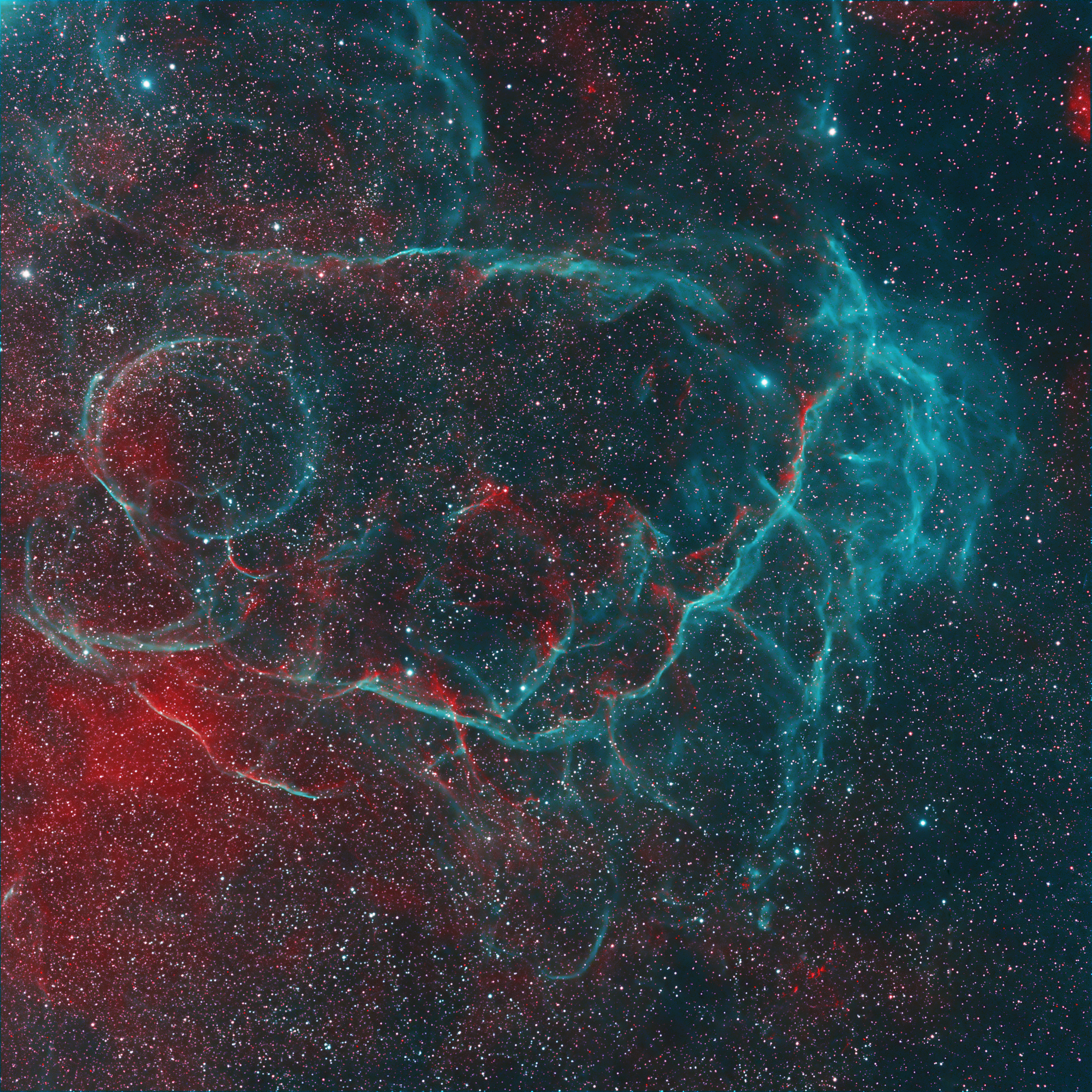
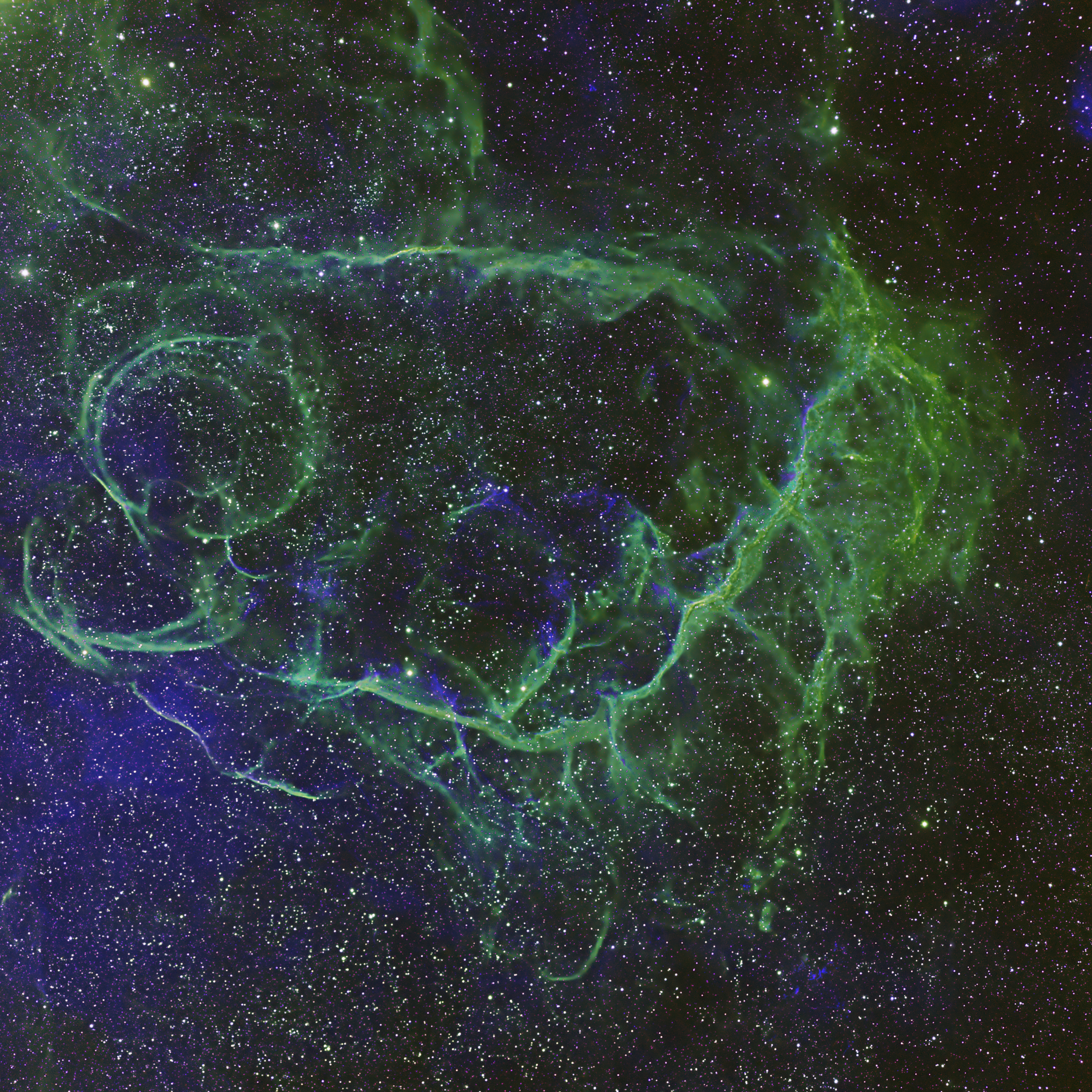
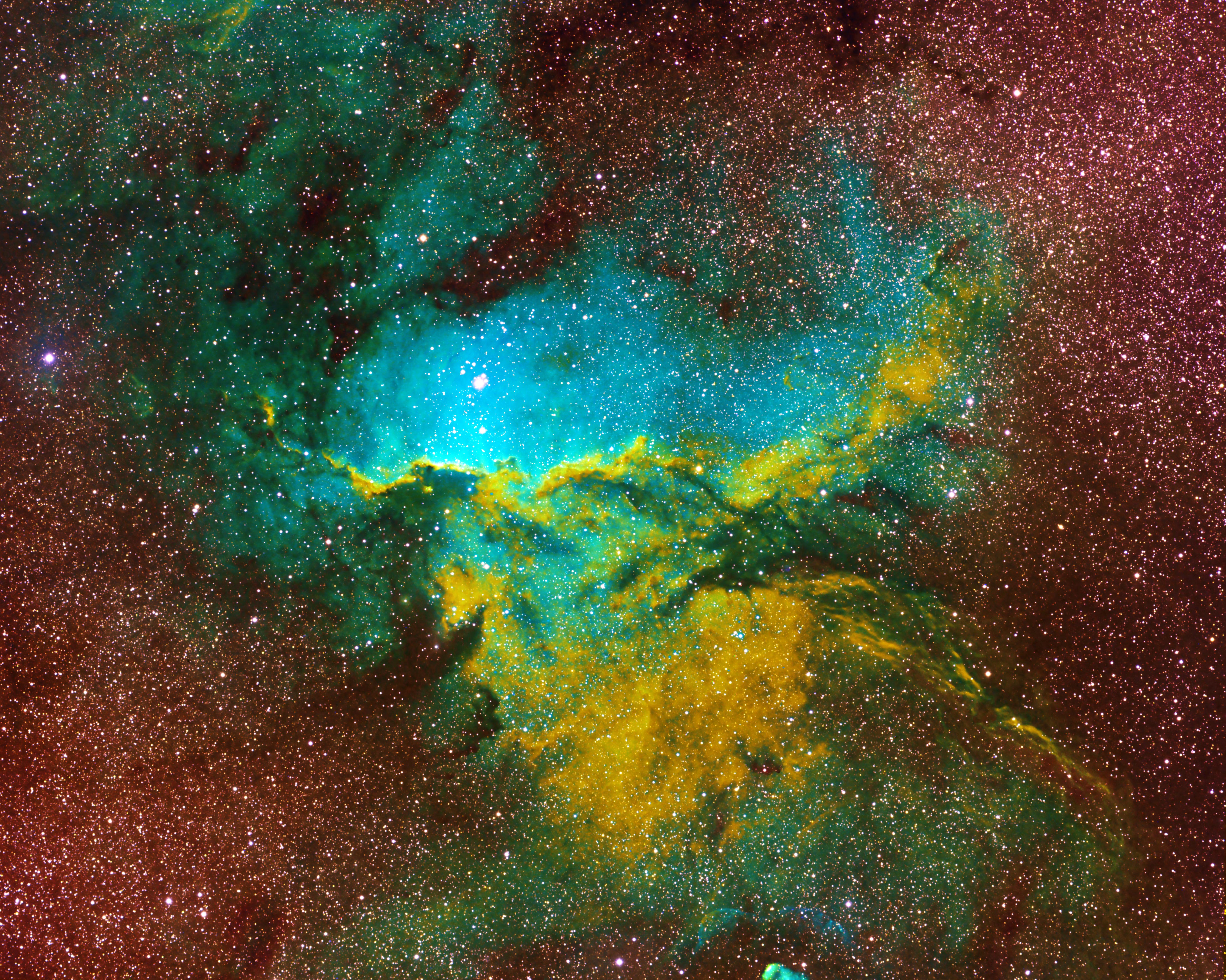
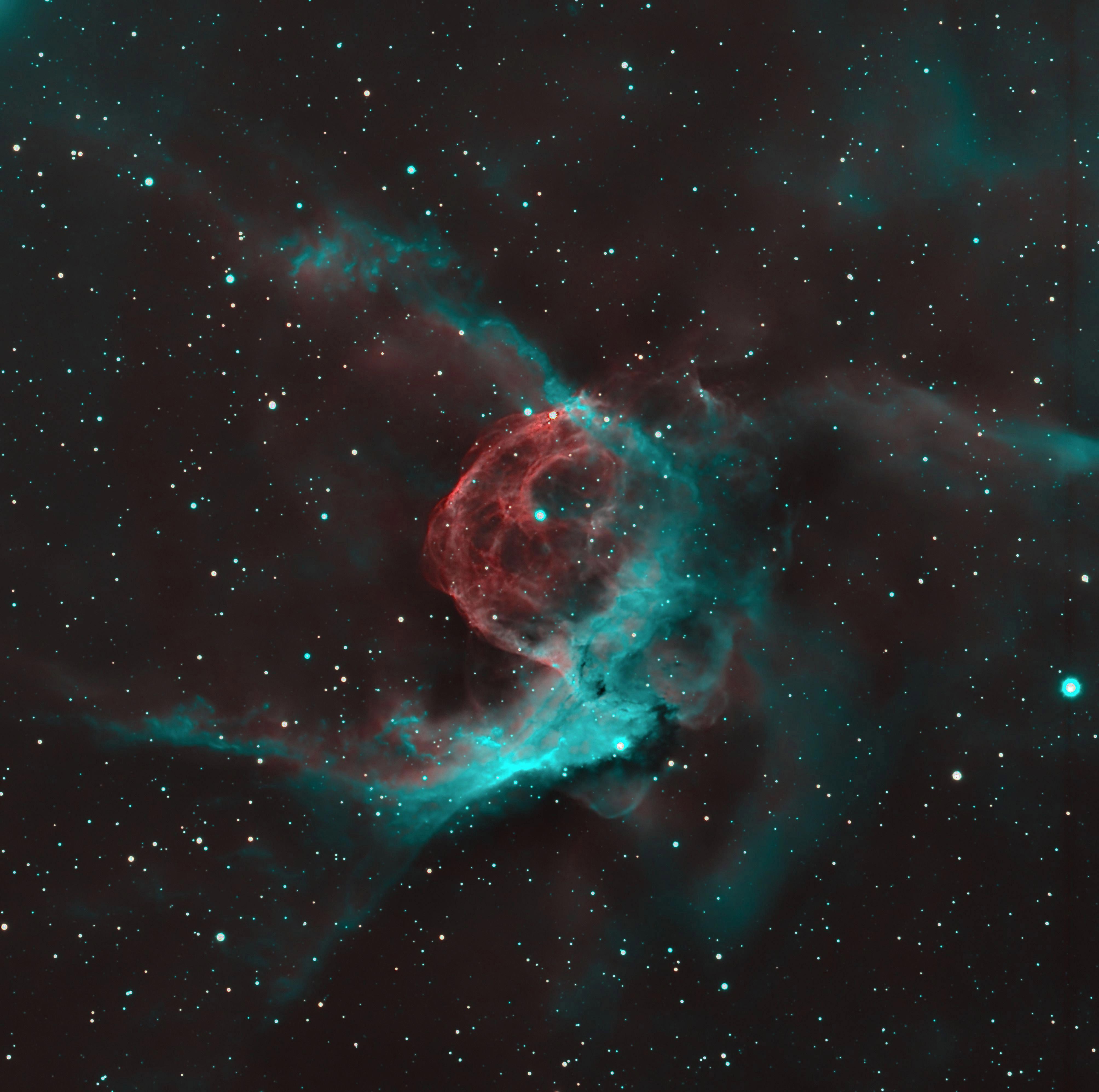
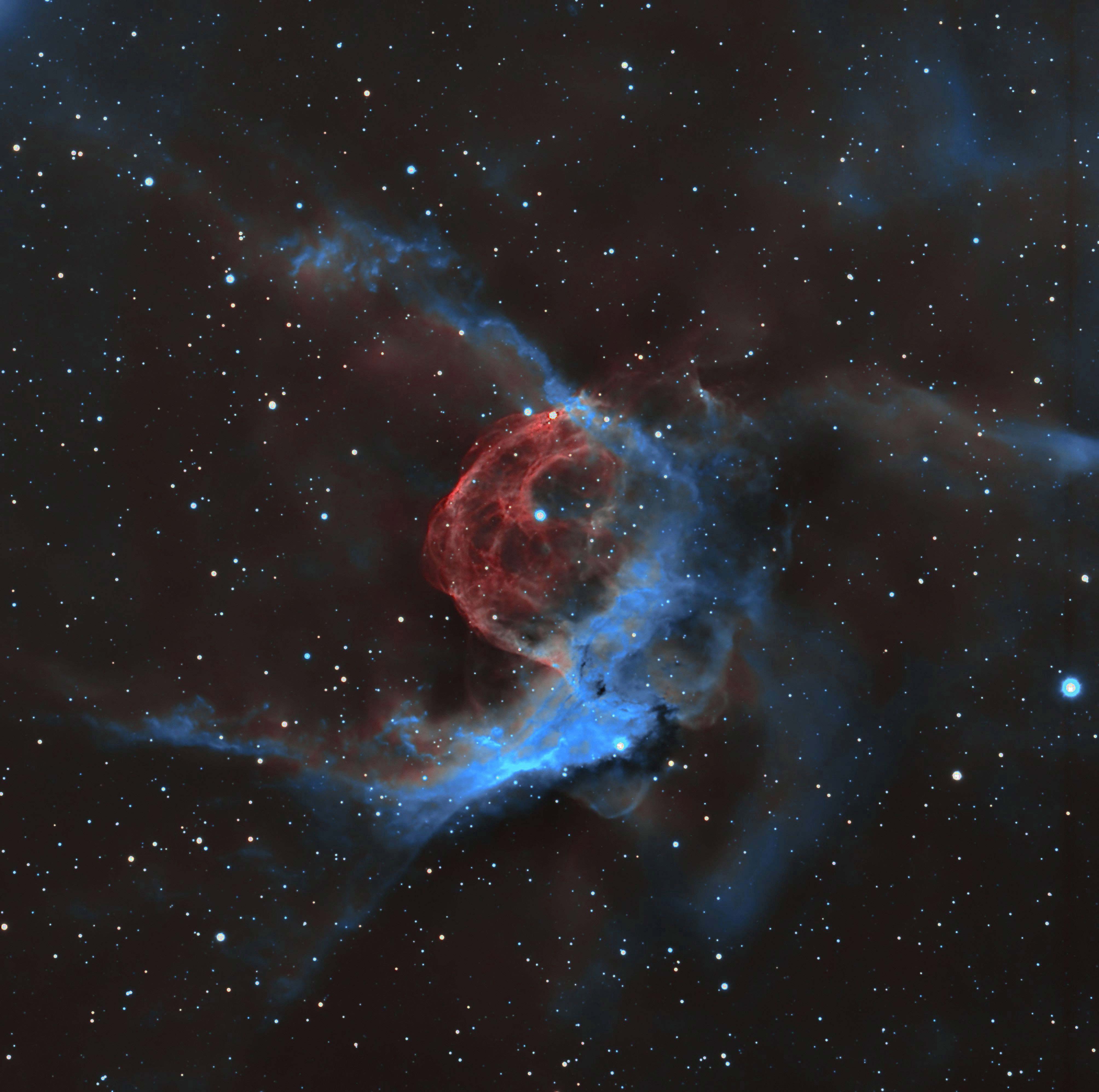
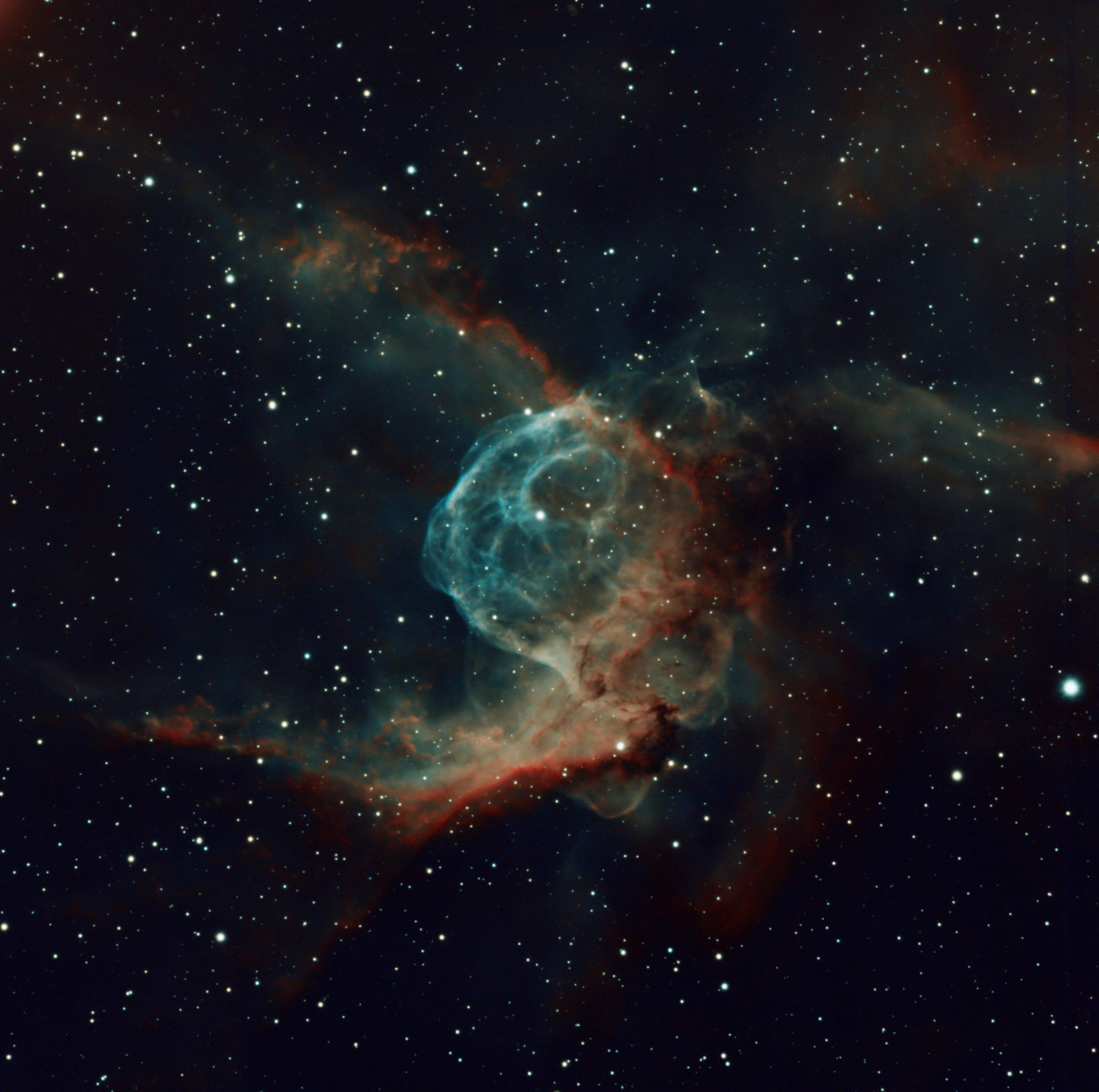
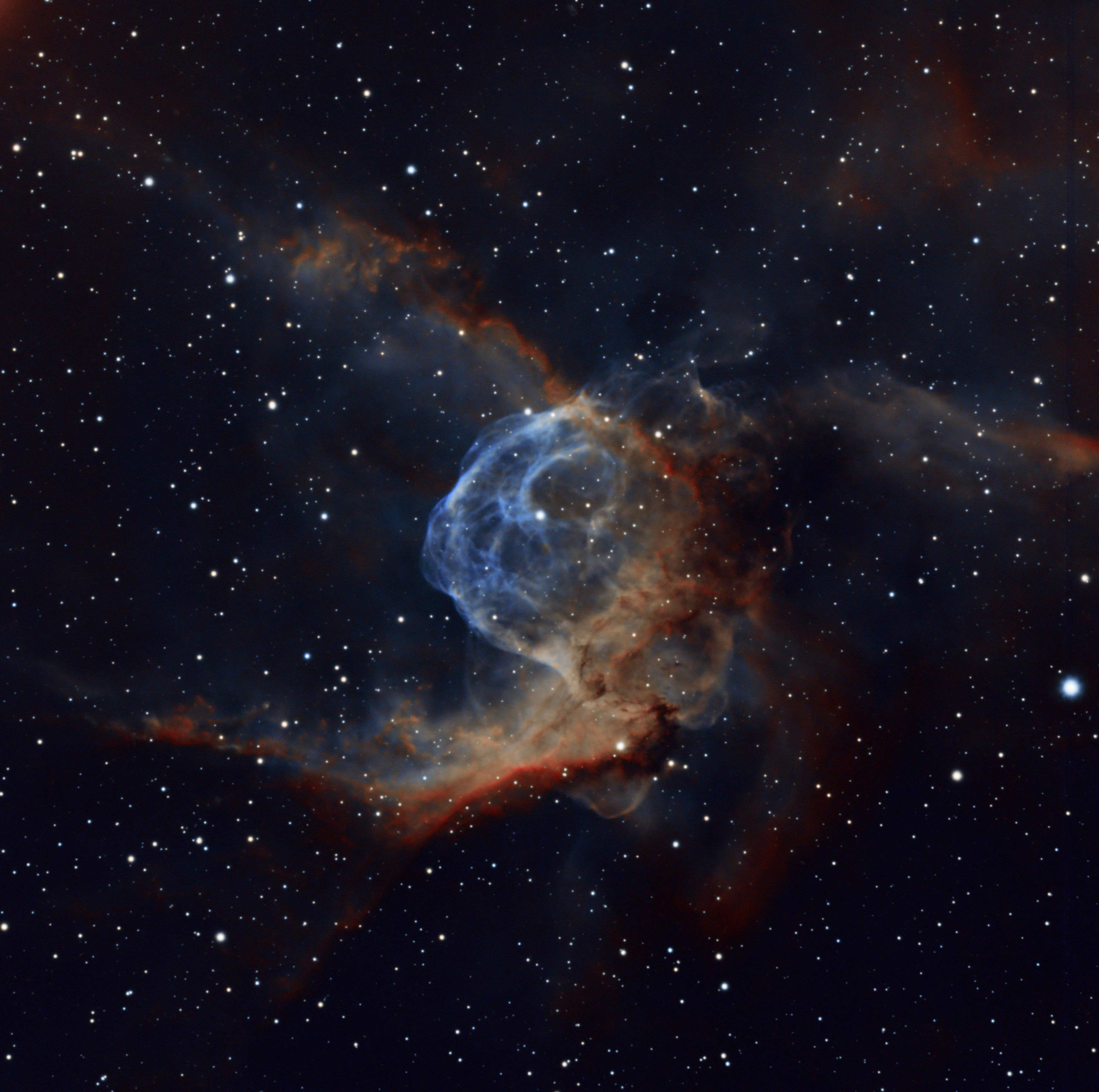
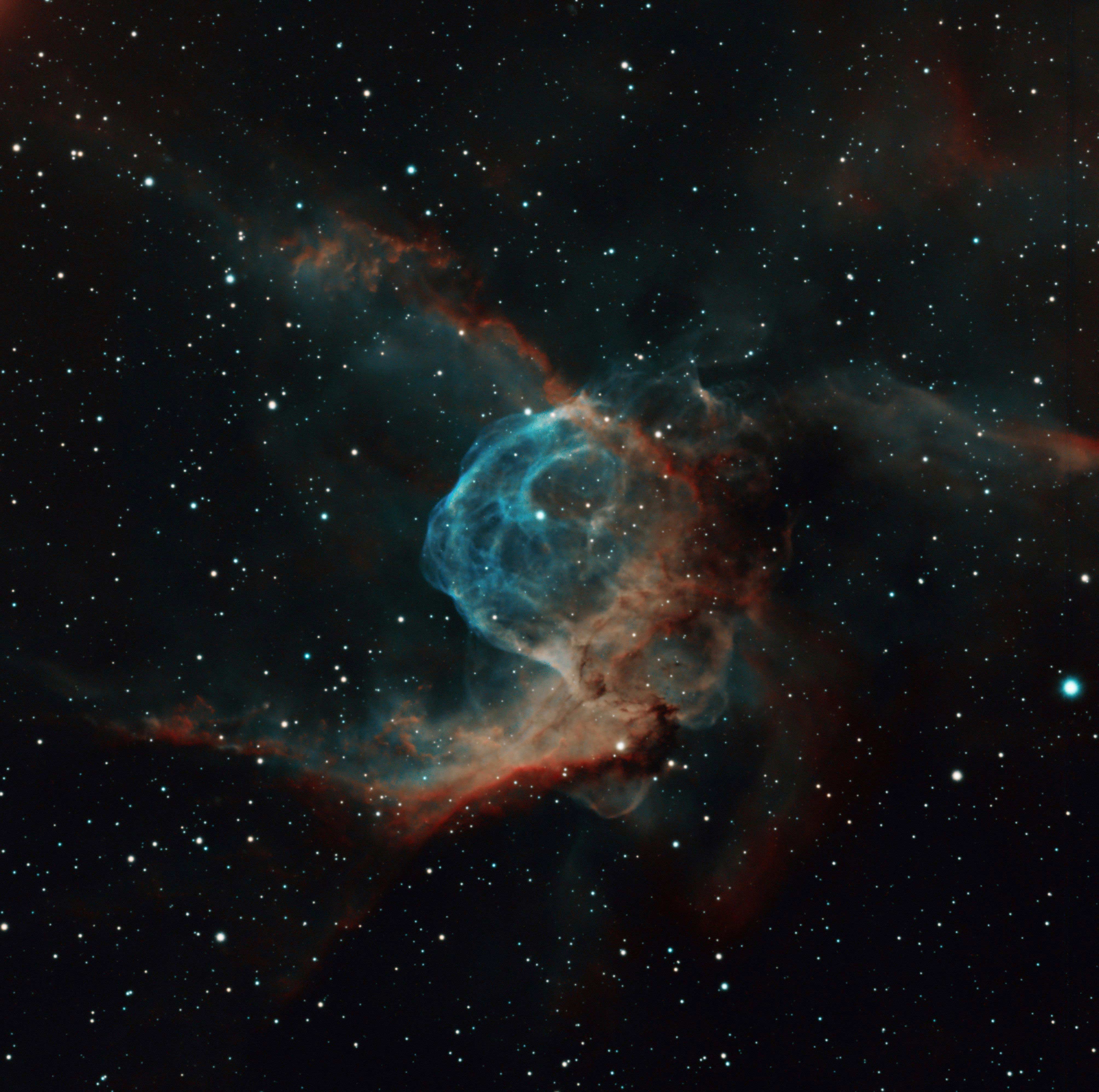
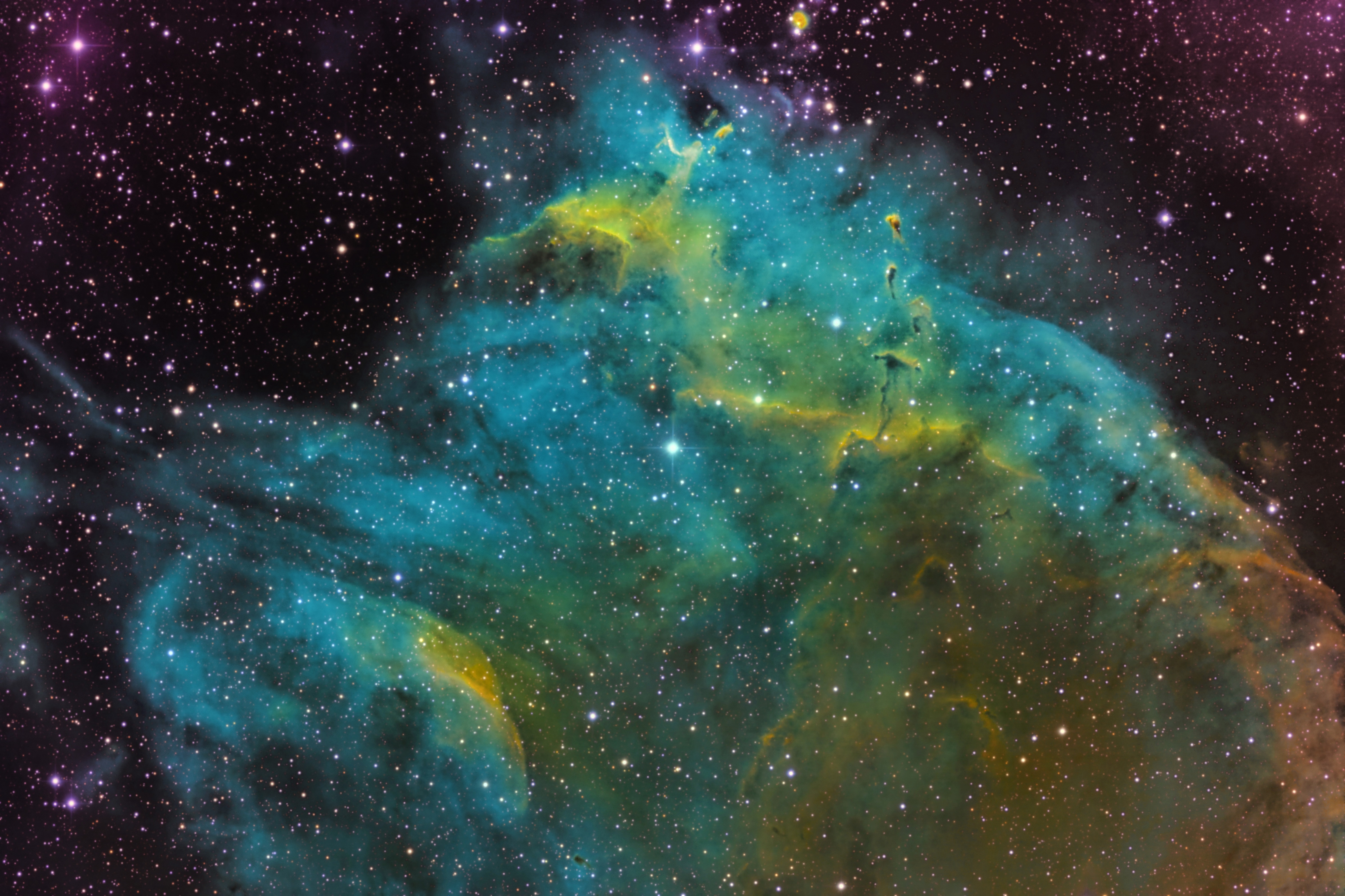
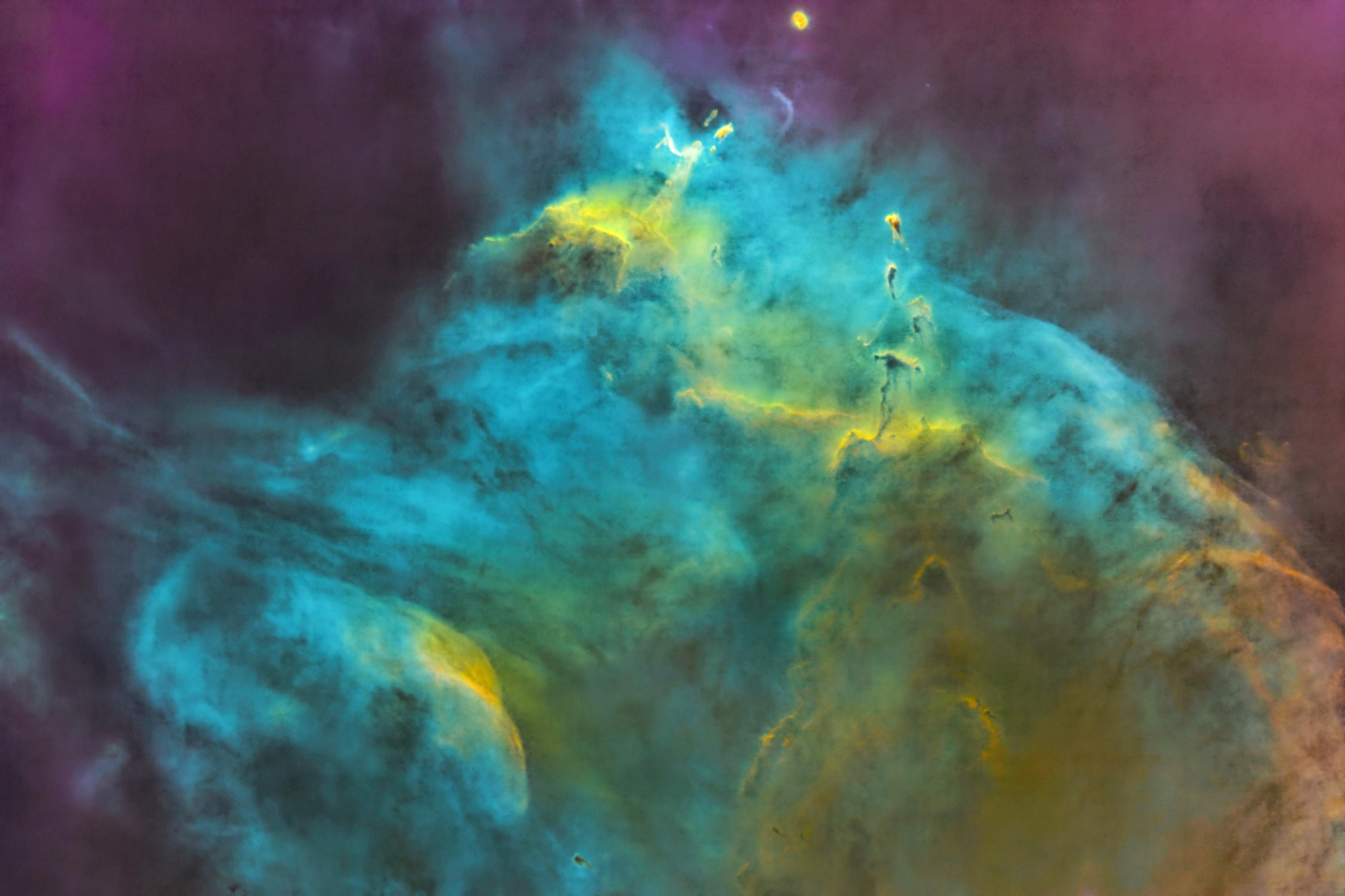
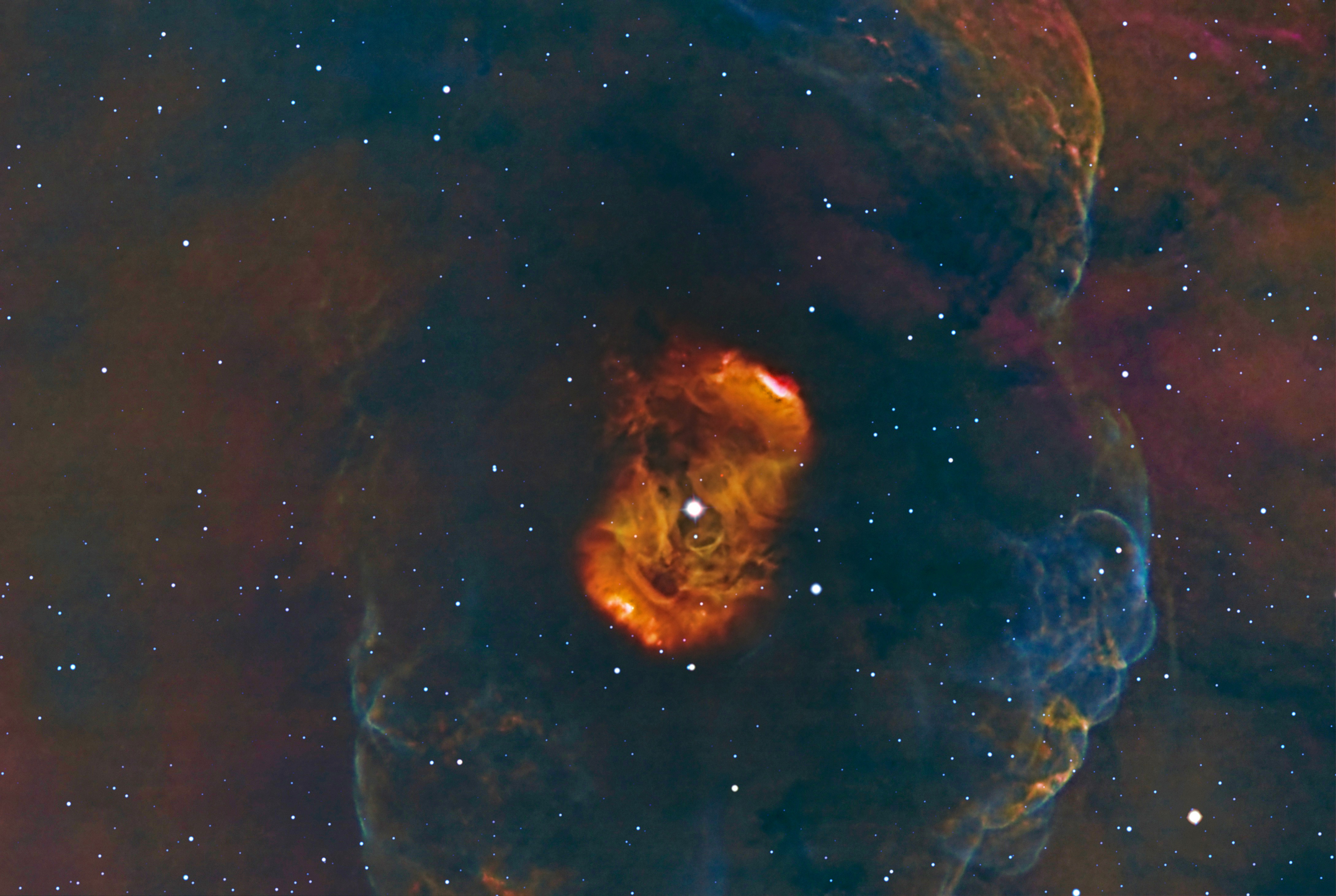
NGC 2359 - Thor's Helmet
Here is a series of five images of Thor's Helmet. They were processed
in HSO and SHO. The Hydrogen and Sulphur channels were swapped and
then some green removed. It's just a cool study in how the exact
same image can turn out so completely different based on the processor's
sense of artistry. Thor's Helmet is an emission nebula located in
Canis Major. It lies 12,000 light-years away from us and its central
star is a Wolf-Rayet star which is thought to be in a pre-supernova
stage of evolution
|
NGC 2359 - Thor's Helmet
|
- Location: IC Astronomy Observatory, Spain
- Date: July 1, 2022
- Mount: Paramount MX+
- Telescope: Takahashi FSQ-106ED SPA-1
- Camera: FLI PL16083 @-25c
- Exposure: 20x3min HLRGB 33x10min 5.5 hrs
|
- Location: El Sauce Observatory, Chile
- Date: Apr-Jul 2022
- Mount: Mathis MI-1000
- Telescope: Planewave CDK24 f/6.6
- Camera: QHY600m @-25c (CHI-1)
- Exposure: 24x10 min LRGB 4hrs
|
- Location: El Sauce Observatory, Chile
- Date: Nov 2020 - Mar 2023
- Mount: ASA Alt-Az Direct Drive
- Telescope: 1000 (39" RC) CHI-3
- Camera: FLI PL16803 @-25c
- Exposure: 14x3min HSO 42min
|
- Location: El Sauce Observatory, Chile
- Date: Nov 2020 - Mar 2023
- Mount: ASA Alt-Az Direct Drive
- Telescope: 1000 (39" RC) CHI-3
- Camera: FLI PL16803 @-25c
- Exposure: 14x3min HSO 42min
|
|
NGC 2359 - Thor's Helmet
|
NGC 2359 - Thor's Helmet
|
NGC 2359 - Thor's Helmet
|
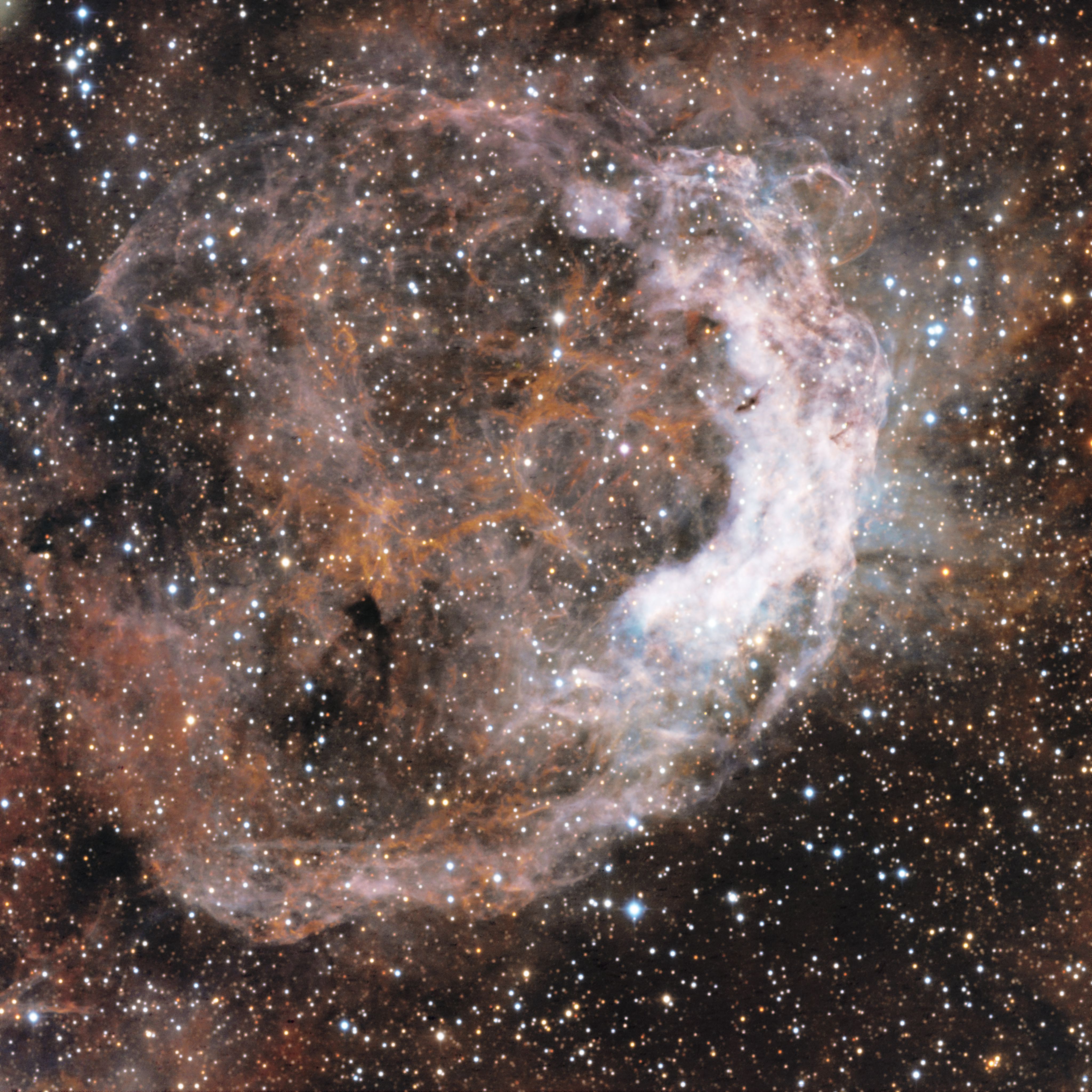
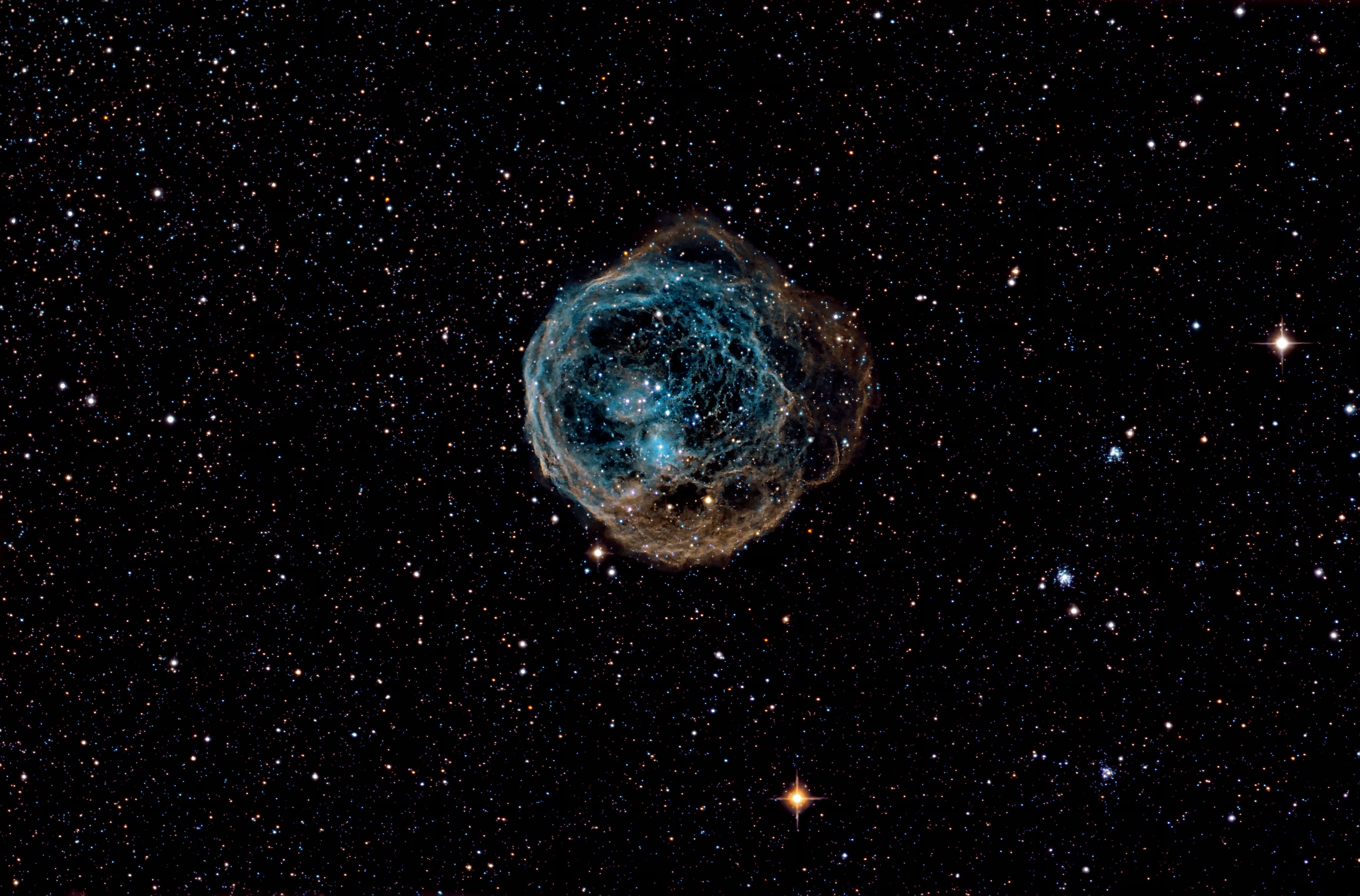
Henize 70 - Super-Bubble
Description quoted from Ann's Astronomy News:
"Henize 70 is a bright superbubble about 300 light-years across
within the Large Magellanic Cloud (a satellite galaxy to our Milky
Way galaxy), located some 160,000 light-years away in the southern
constellation of Dorado. Superbubbles are large bubbles of interstellar
gas, blown by winds from hot, massive stars and supernova explosions,
and their interiors are filled with tenuous, hot expanding gas.
At the center of Henize 70 is a small group of extremely hot and
massive stars."
|
- Location: El Sauce Observatory, Chile
- Date: Nov 2020 - Mar 2023
- Mount: ASA Alt-Az Direct Drive
- Telescope: 1000 (39" RC) CHI-3
- Camera: FLI PL16803 @-25c
- Exposure: 14x3min HSO 42min
|
- Location: El Sauce Observatory, Chile
- Date: Nov 2020 - Mar 2023
- Mount: ASA Alt-Az Direct Drive
- Telescope: 1000 (39" RC) CHI-3
- Camera: FLI PL16803 @-25c
- Exposure: 14x3min HSO 42min
|
- Location: El Sauce Observatory, Chile
- Date: Nov 2020 - Mar 2023
- Mount: ASA Alt-Az Direct Drive
- Telescope: 1000 (39" RC) CHI-3
- Camera: FLI PL16803 @-25c
- Exposure: 14x3min HSO 42min
|
- Location: El Sauce Observatory, Chile
- Date: February - March 2023
- Mount: Mathis MI-1000
- Telescope: Planewave CDK24 f/6.6
- Camera: QHY600m @-25c (CHI-1)
- Exposure: 15x10min SHO 2hrs 30min
|
|
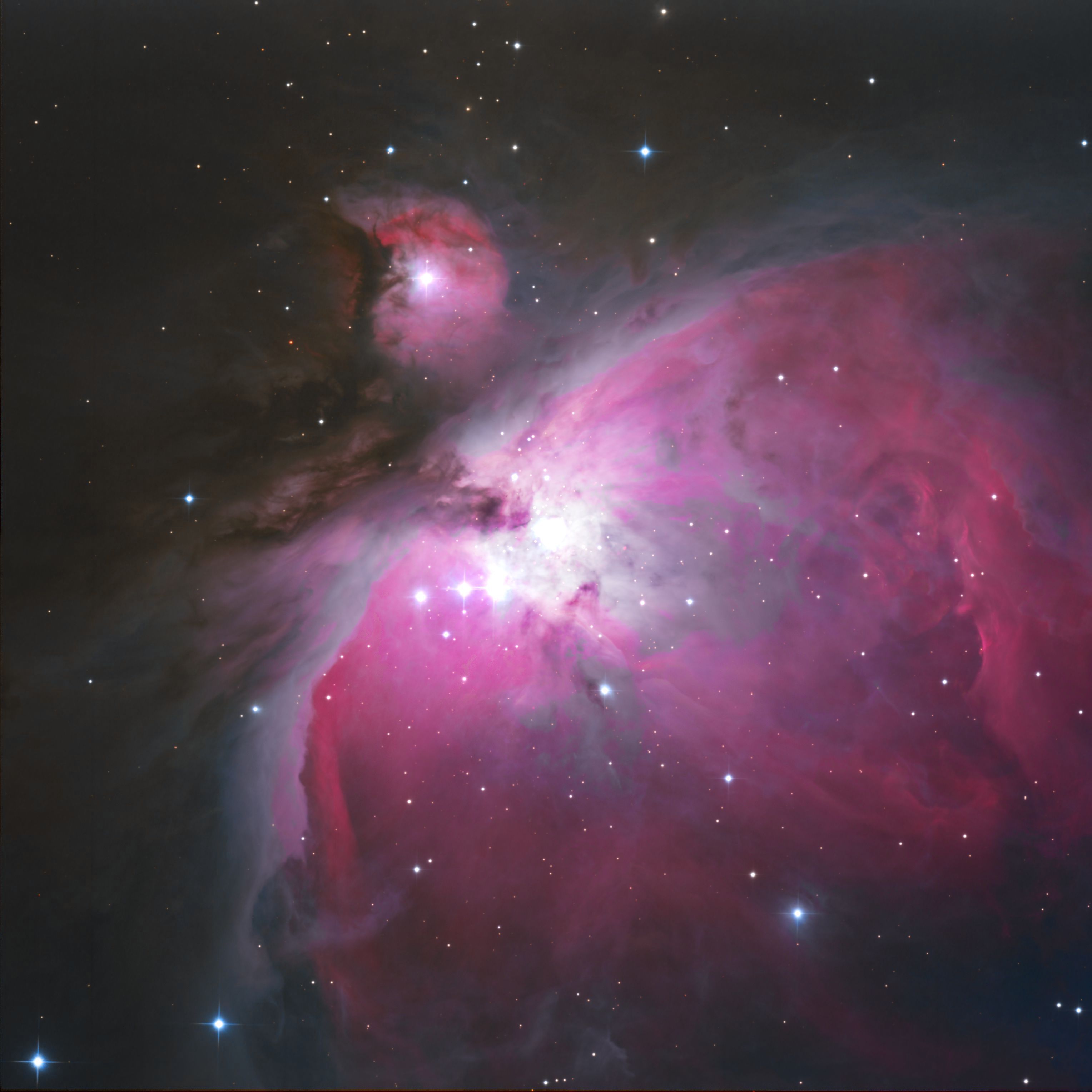
Messier 42 (M42) The Great Orion Nebula
The Orion Nebula is a diffuse nebula located about 1600 light-years
away and is about 24 light-years across. The bright central region
known as the Trapezium is an active star-making area. The Trapezium
consists of four hot, young stars. If you're observing from a good
dark-sky site there are two additional stars that can be resolved
with a good telescope which make the Trapezium an open star cluster.
This nebula is just part of a larger cloud of gas and dust that
encompasses most of the constellation Orion
|
NGC 3372 - The Carina Nebula (SHO)
This is another version of the Carina Nebula. The first version is
a couple of rows above this one. The first version was done back in
2021 and was processed with Photoshop. This version used a different
telescope and was processed with PixInsight. Certain areas of processing
in PS always seemed to be just beyond me. With PixInsight I've put in
a ton of time with tutorials. At first look, PixInsight looks like
it's beyond comprehension, but with time and effort it turns out
to be one heck of a powerful software suite. Glad I made the leap.
This version was processed in the Hubble Palette (SHO). The Carina
Nebula was discovered by Nicolas-Louis de Lacaille in 1752 from
the Cape of Good Hope. It is four times the size and even brighter
than the Great Orion Nebula. It lies about 8,500 light-years from
Earth and includes both bright and dark areas of nebulosity as well
as numerous other objects
|
Image Slide Show with Music - May 2023
This was a fun project to do. I selected some of my favorite images
(both from my own rig as well as from Telescope Live) and added a soundtrack
of original music. I hope you enjoy it
|
The Great Lacerta Nebula - Sh2-126
This is a slightly different version of the Lacerta Nebula than
the one a couple of rows above this one. The first image was shot
with a 24-inch telescope and this one was taken with a wider-field
scope. This is an emission nebula located in the constellation Lacerta
(The Lizard). It has the same angular size as the Andromeda Galaxy.
Because it is so large and diffuse, it can only be seen with long
exposure imaging. The nearby hot and bright main sequence blue star
10 Lacertae, gives off enough energy to heat the red hydrogen gas
enough that it begins to glow. It is located about 1200 light-years
away from us
|
- Location: El Sauce Observatory, Chile
- Date: Dec 20 - Feb 21
- Mount: Mathis MI-1000
- Telescope: Planewave CDK24 f/6.6
- Camera: FLI PL9000 @-25c CHI-1 CCD
- Exposure: 30x30 RGB 15min
|
- Location: El Sauce Observatory, Chile
- Date: February - March 2023
- Mount: ASA DDM85
- Telescope: ASA 500N CHI-2
- Camera: FLI PL16803 @-30c
- Exposure: 43x5 min SHO 3hrs 35min
|
|
- Location: IC Astronomy Observatory, Spain
- Date: July - September 2022
- Mount: Paramount MX+
- Telescope: Takahashi FSQ-106EDX4 SPA-3
- Camera: QHY600m @-25c
- Exposure: 16x10 min HLRGB 2hrs 40min
|
|
Cygnus North
Cygnus, The Swan, was known and listed by the second-century astronomer,
Ptolemy. Cygnus is one of the easiest constellations in northern skies
to spot since it is right in the middle of the Summer Triangle made up
of Deneb, Vega and Altair. It is also the home of many of the nebulae that
we love to observe and image. This image is of the northern section of the
greater nebula which also includes supernova remnants and numerous open
clusters
|
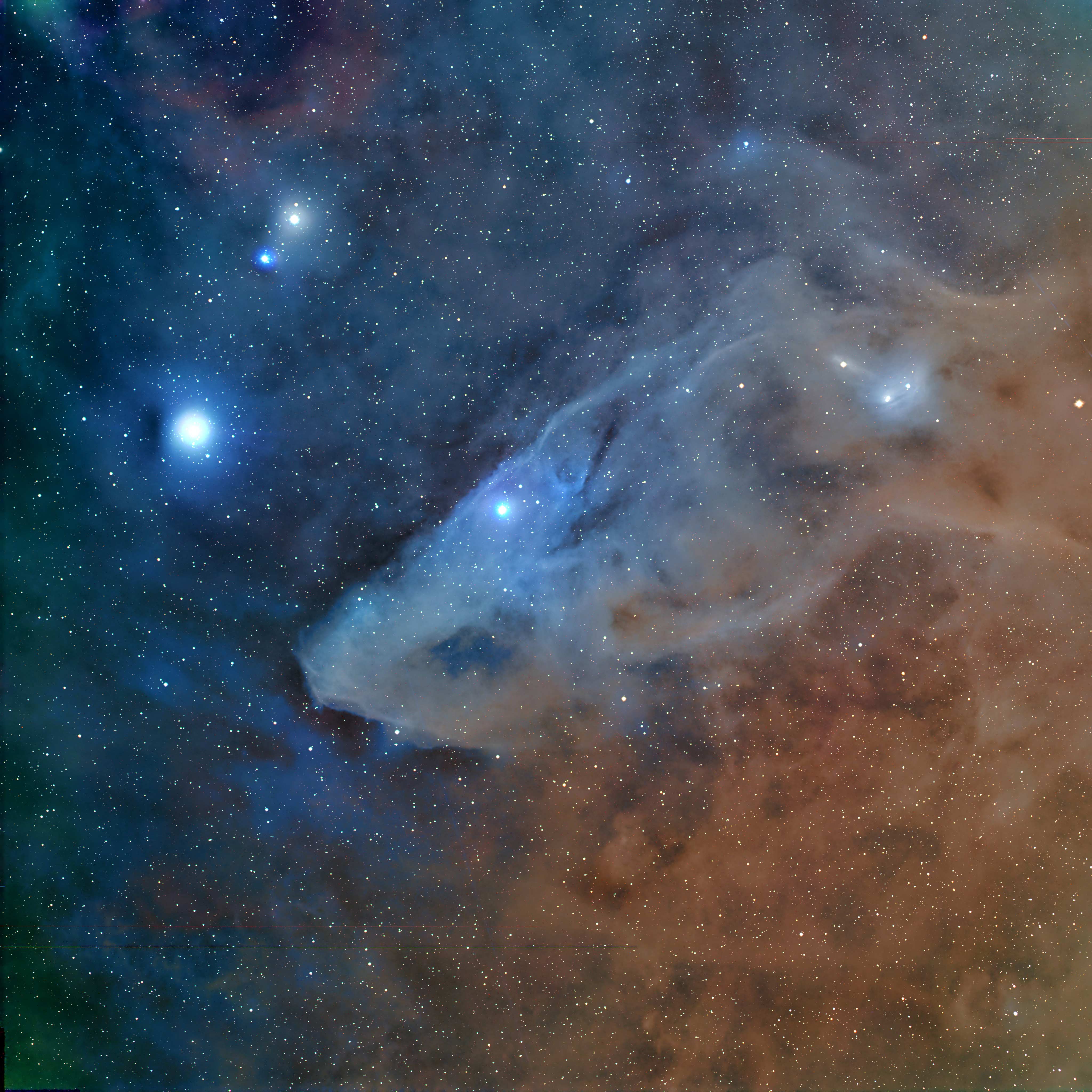
IC 4592 - The Blue Horsehead Nebula
This beautiful nebula is a reflection nebula lit by Nu Scorpii in the
constellation Scorpius. It is about 400 light-years away from us
|
IC 4592 - The Blue Horsehead Nebula
This second image of the Blue Horsehead is the same one as the one just
to the left except that all of the stars have been removed. This is a normal part of the process
when processing images with PixInsight. By separating the stars from the main object it is much
easier to make changes to one or the other. If, for example, you're just about finished with the
image but it has a bit too much green in the sky, you can make that adjustment without affecting
the rest of the image. Pretty cool!
|
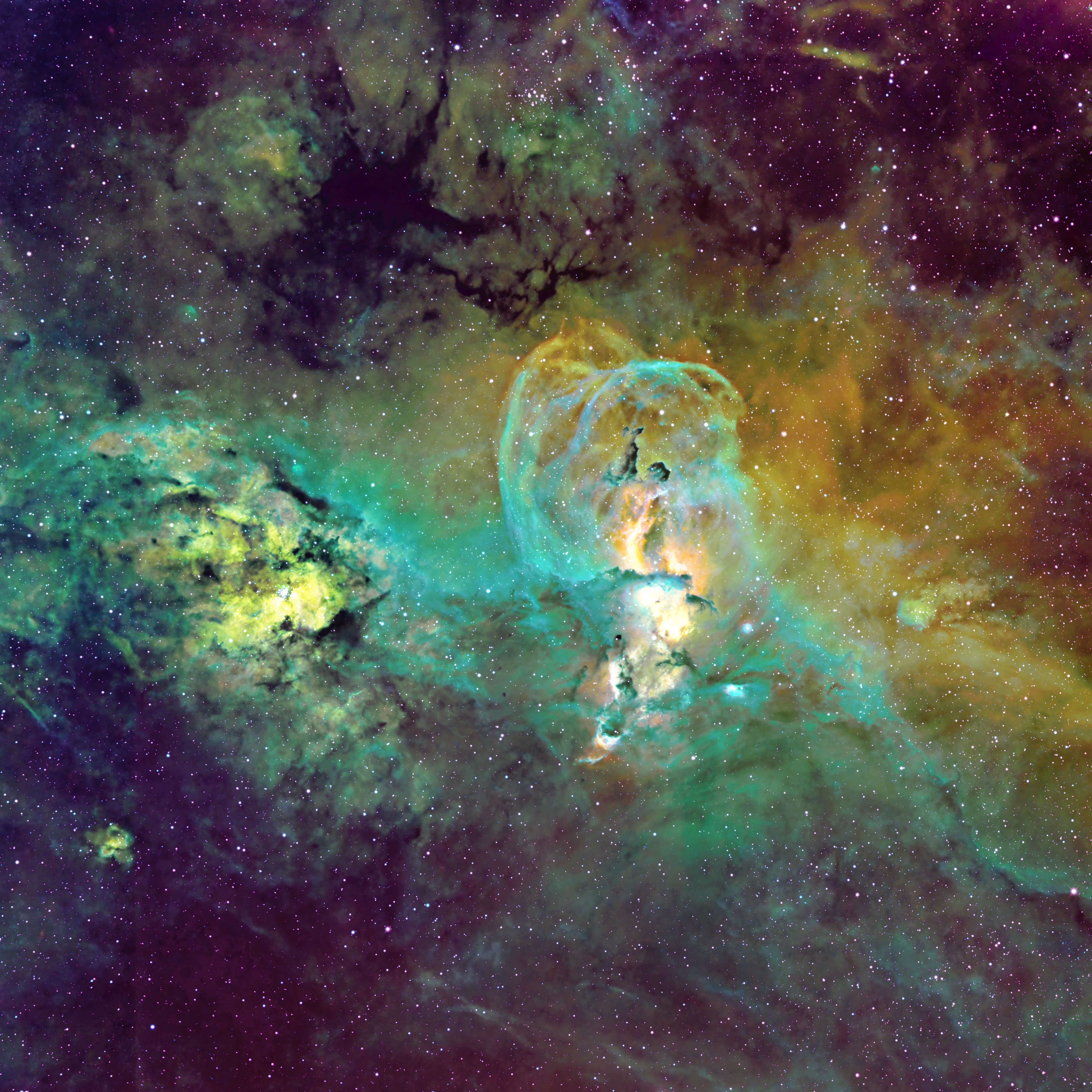
NGC 3576 - The Statue of Liberty Nebula
This wonderful nebula is situated in the constellation of Carina, in the
southern hemisphere, and lies about 9000 light-years away from Earth. Inside
this nebula there are numerous hot, young stars. These stars give off powerful
solar winds that, over time, erode the gases into interesting shapes. This
image has the stars included. The next image is a version without stars that
gives it a completely different look
|
- Location: IC Astronomy Observatory, Spain
- Date: November - December, 2022
- Mount: Paramount MX+
- Telescope: Takahashi FSQ-106EDX4 (SPA-3)
- Camera: QHY600m @-25c
- Exposure: 12 x SHO (CCD) Total: 2 hrs
|
- Location: Heaven's Mirror Observatory, Australia
- Date: July 10, 2021
- Mount: Paramount MX+
- Telescope: FSQ-106ED AUS-2
- Camera: FLI PL16083 @-25c
- Exposure: 8x10 min LRGB 1hr 20min
|
- Location: Heaven's Mirror Observatory, Australia
- Date: July 10, 2021
- Mount: Paramount MX+
- Telescope: FSQ-106ED AUS-2
- Camera: FLI PL16083 @-25c
- Exposure: 8x10 min LRGB 1hr 20min
|
- Location: Heaven's Mirror Observatory, Australia
- Date: January 5, 2022 - January 5, 2023
- Mount: Paramount MX+
- Telescope: FSQ-106ED AUS-2
- Camera: FLI PL16083 @-25c
- Exposure: 68x5 min SHO 4hrs 20min
|
|
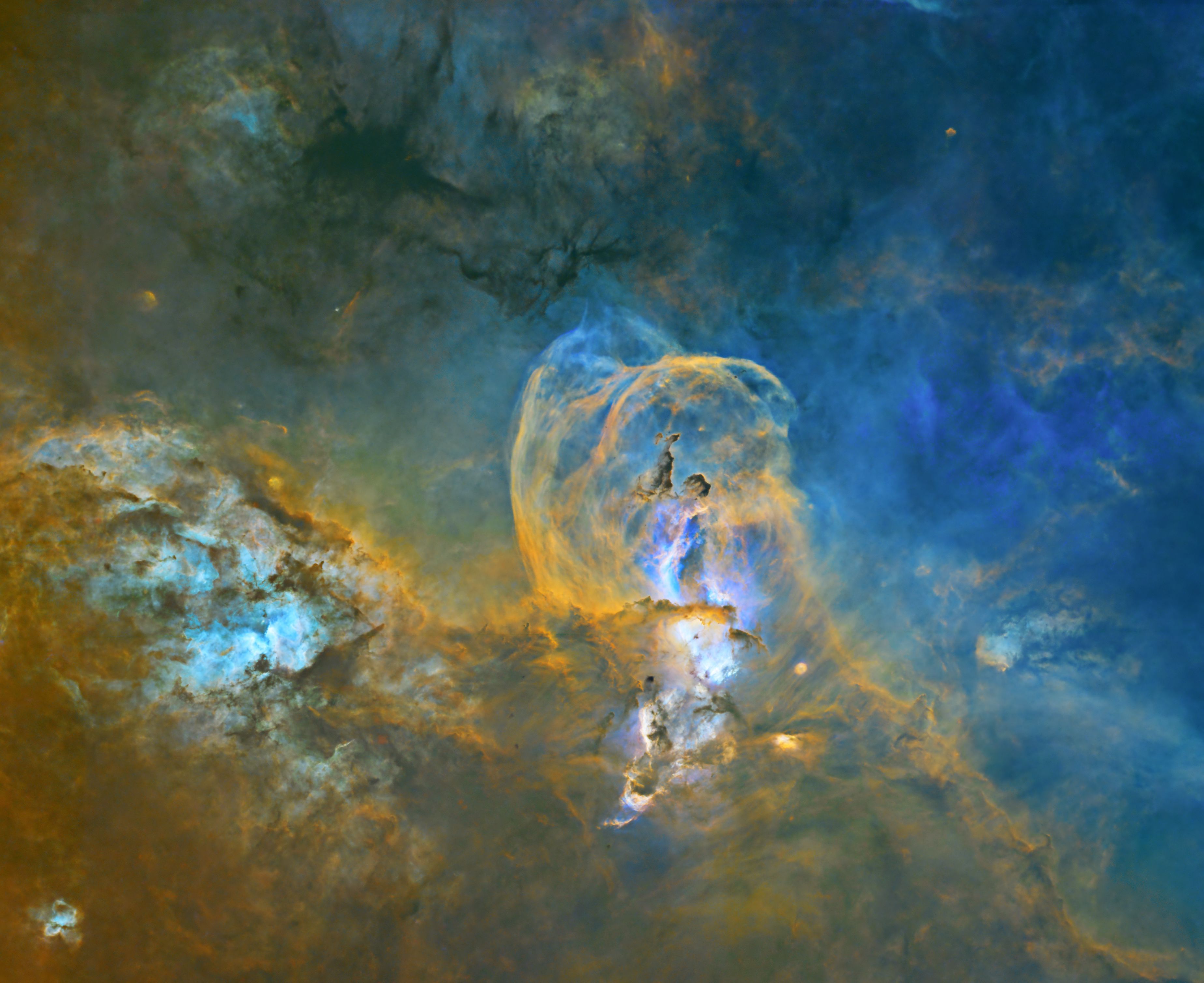
NGC 3576 - The Statue of Liberty Nebula
This is the same as the preceding image, but this one has had the
stars removed. The object is separated from the original image into
stars-only and starless images. This is done to make it easier to
process different components of the overall image separately.
Sometimes the image without the stars ends up being just as
interesting as the one with the stars. This image was taken using Hubble
Palette narrowband filters. The combination was HSO
|
GUM 37 - The Southern Tadpole Nebula
9500 light-years away in the constellation Carina is the Southern
Tadpole Nebula. This image was taken with the 24-inch Planewave telescope
in Chile. It's a fairly large telescope, so we're only able to see
the very end of the tadpole in this image. This image was taken with
Hydrogen, Oxygen and Sulphur filters, also known as the Hubble
Palette. This particular combination was HSO
|
GUM 37 - The Southern Tadpole Nebula
Again, this image is the same as the one to the left, except that
the stars have been removed
|
RCW-2 (Rodgers, Campbell and Whiteoak)
RCW 2 is the head of the Seagull Nebula in the constellation
Monoceros. The Seagull Nebula is an emission nebula, near Sirius,
the brightest star in our night sky. This makes it pretty easy
to find in a telescope. This image of the head of the seagull is
just a small part of the rest of the nebula which is 3,800 light-years
away and about 100 light-years across. Taken in the Hubble Palette
HSO
|
- Location: Heaven's Mirror Observatory, Australia
- Date: January 5, 2022 - January 5, 2023
- Mount: Paramount MX+
- Telescope: FSQ-106ED AUS-2
- Camera: FLI PL16083 @-25c
- Exposure: 68x5 min SHO 4hrs 20min
|
- Location: IC Astronomy Observatory, Spain
- Date: July - September 2022
- Mount: Paramount MX+
- Telescope: Takahashi FSQ-106EDX4 SPA-3
- Camera: QHY600m @-25c
- Exposure: 16x10 min HLRGB 2hrs 40 min
|
- Location: IC Astronomy Observatory, Spain
- Date: July - September 2022
- Mount: Paramount MX+
- Telescope: Takahashi FSQ-106EDX4 SPA-3
- Camera: QHY600m @-25c
- Exposure: 16x10 min HLRGB 2hrs 40 min
|
- Location: El Sauce Observatory, Chile
- Date: April 2023
- Mount: Mathis MI-1000
- Telescope: Planewave CDK24 f/6.6
- Camera: QHY600m @-25c CHI-1
- Exposure: 20x5 min HSO 1hr 40min
|
|
Messier 20 - The Trifid Nebula
Charles Messier discovered the Trifid Nebula back in 1764. He
thought that it had three lobes—thus the Trifid name. This
nebula is an interesting one. It has something for everyone.
It contains an open star cluster, emission and reflection nebulae,
as well as dark material. It lies about 4100 light-years away from us
|
NGC 246 - The Cetus Bubble
The Cetus Bubble is a planetary nebula located in the constellation
Cetus. It lies about 1600 light-years away
|
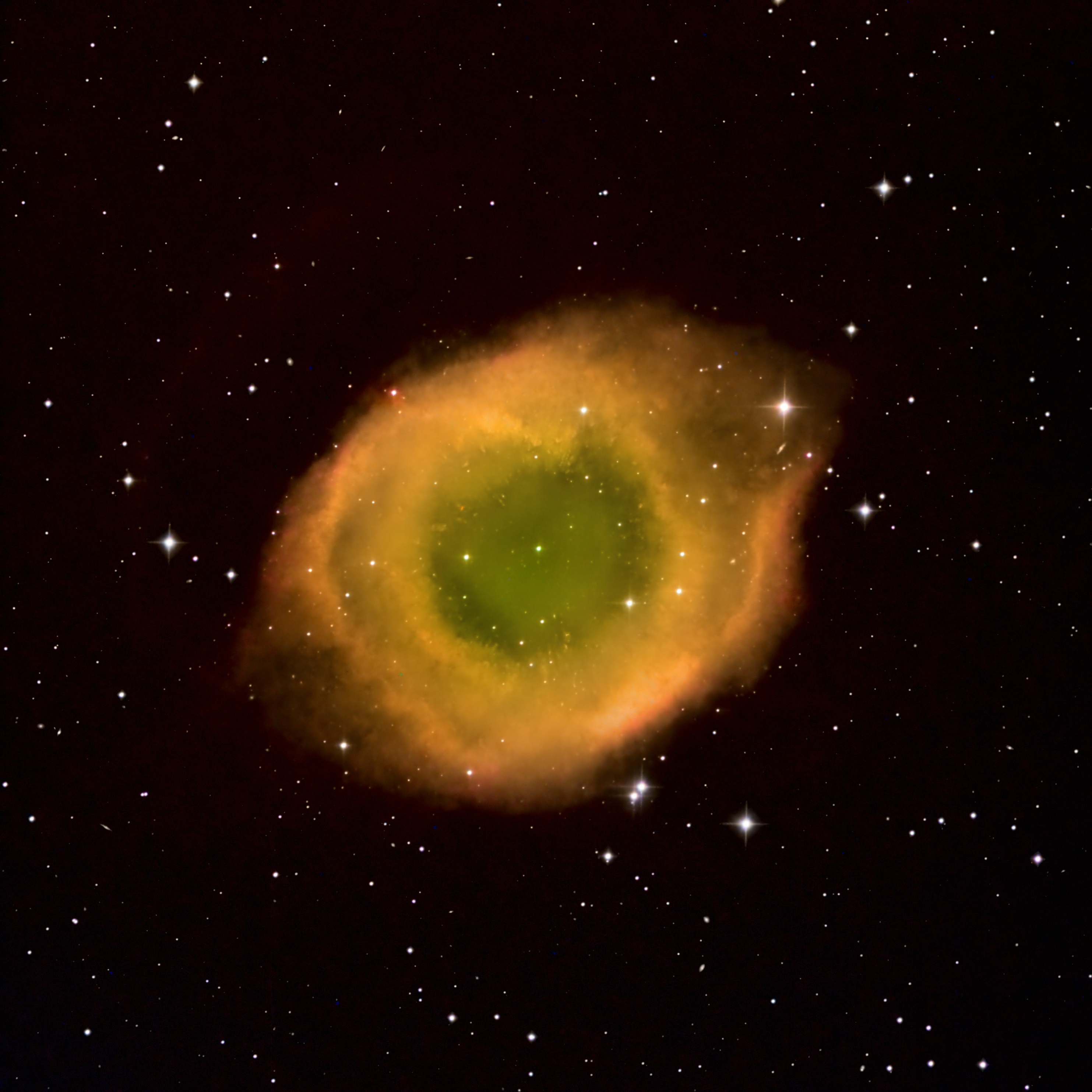
NGC 7293 - The Helix Nebula (The Eye of Sauron)
When a star sheds off its outer atmosphere it comes out looking like
just a disc of gas. Actually it is a sphere of gas that is expanding
in all directions at the same time. These are called planetary nebulae.
And what is left at the center is a white dwarf star. This one is
about 650 light-years away in Aquarius
|
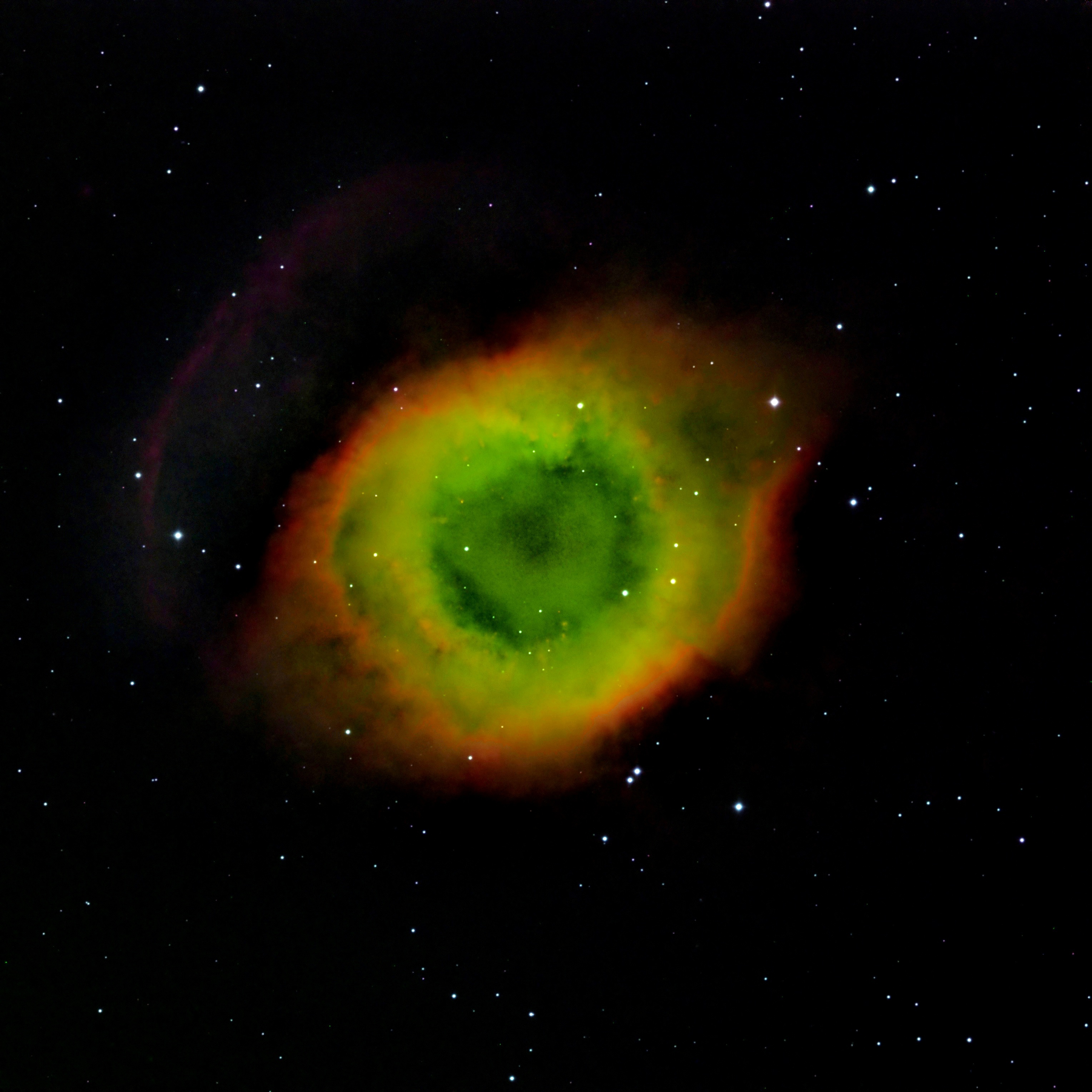
NGC 7293 - The Helix Nebula (The Eye of Sauron)
Here is a different version of the Helix Nebula. Using the same
data set as the image to the left, I was able to bring out a bit
more detail as well as more pleasing colors. Remember that when
processing in The Hubble Palette, you can assign the colors to
the red, blue and green channels to make a completely unique image
|
- Location: Heaven's Mirror Observatory, Australia
- Date: May 2023
- Mount: Paramount MX+
- Telescope: FSQ-106ED AUS-2
- Camera: QHY600m @-25c CMOS
- Exposure: 17x5min SHO 1hr 25min
|
- Location: El Sauce Observatory, Chile
- Date: June 2023
- Mount: Mathis MI-1000
- Telescope: Planewave CDK24 f/6.6
- Camera: QHY600m @-25c CHI-1
- Exposure: 17x5 min HSO 1hr 35min
|
- Location: El Sauce Observatory, Chile
- Date: April 2023
- Mount: Mathis MI-1000
- Telescope: Planewave CDK24 f/6.6
- Camera: QHY600m @-25c CHI-1
- Exposure: 20x5 min HSO 1hr 40min
|
- Location: El Sauce Observatory, Chile
- Date: April 2023
- Mount: Mathis MI-1000
- Telescope: Planewave CDK24 f/6.6
- Camera: QHY600m @-25c CHI-1
- Exposure: 20x5 min HSO 1hr 40min
|
|
RCW-108 The Dragons of Ara and the Dragon's Egg
Also known as the Dragons of Ara, the Rim Nebula is just a small
part of a much larger molecular cloud. This part of the planetary
nebula contains an emission nebula that includes some dark nebula
as well. It lies about 4000 light-years away from us and is about
300 light-years in diameter. The small blue nebula in the upper
right has two sections—an outer bubble and an inner bubble—
probably from an earlier mass ejection from its central star,
a kind that lives very hot and very short. Since the larger nebula
is often referred to as the Fighting Dragons of Ara, this smaller
nebula is called The Dragon's Egg
|
Crescent Nebula to the Tulip Nebula
This widefield image in the constellation Cygnus, the Swan, features
three objects all at once inside a vastly larger cloud of gas and
dust. At the top is the Crescent Nebula. About midway down on
the left is the Cygnus Bubble. Lastly, in the lower right corner is
the Tulip Nebula. This image was done in the Hubble Palette—SHO.
Blue and cyan are oxygen, while green and yellow are hydrogen gas
|
RCW 58
This planetary nebula lies in the constellation Carina. The central
star is called a Wolf-Rayet star. These types of stars are huge, very
hot and very luminous. This particular star is about 100 times the
size of our Earth, a million times more luminous and 30 times the
temperature. As stars use up their primary fuel—hydrogen, they
expand while ejecting their outer layers by way of stellar winds,
which gives us the red, oval nebula. These stellar winds are traveling
at about 100 km/sec
|
Messier 20 - The Trifid Nebula (Widefield)
The Trifid Nebula (M20) is actually the nebula at lower center. The
larger one above it is the Lagoon Nebula (M8). Both are in the
constellation Sagittarius. It was discovered by Charles Messier way
back in 1764. Trifid means "three-lobed," which is how it appeared in
small telescopes when it was discovered. It's kind of an unusual
nebula in that it is a combination of open cluster, emission nebula
(red-pink), reflection nebula (blue-cyan) and dark nebula (dark
lines running through the nebula). It's a perennial favorite viewing
object at star parties in the summer
|
- Location: Heaven's Mirror Observatory, Australia
- Date: May 2023
- Mount: Paramount MX+
- Telescope: FSQ-106ED AUS-2
- Camera: QHY600m @-25c CMOS
- Exposure: 20x5 min HSO 1hr 40min
|
- Location: IC Astronomy Observatory, Spain
- Date: July 2023
- Mount: Paramount MX+
- Telescope: Takahashi FSQ-106ED SPA-1 CCD
- Camera: FLI PL16803 @-25c
- Exposure: 19x5 min SHO 1hr 30min
|
- Location: El Sauce Observatory, Chile
- Date: April 29, 2023
- Mount: Mathis MI-1000
- Telescope: Planewave CDK24 f/6.6
- Camera: QHY600m @-25c CHI-1
- Exposure: 11x5 min LRGB+HO 55min
|
- Location: El Sauce Observatory, Chile
- Date: April 29, 2023
- Mount: Mathis MI-1000
- Telescope: Planewave CDK24 f/6.6
- Camera: QHY600m @-25c CHI-1
- Exposure: 20x5 min HSO 1hr 40min
|
|
The Veil Nebula
The Veil Nebula is just a small part of the much larger Cygnus Loop.
It consists of many sub-objects with their own names and designation
numbers. It was formed when a massive star
went supernova between 10,000 and 20,000 years ago. This rendering
was done in SHO, in which the red-brown regions represent hydrogen
gas and the bluish regions represent oxygen gas
|
NGC 6164 - The Dragon's Egg
The Dragon's Egg is an emission nebula in the constellation Norma
(the Carpenter's Square). The central star that formed the nebula
and the surrounding blue halo is very, very hot and weighs in at
40 times the mass of the Sun. In about 4 million years it will probably
end its life as a supernova. This nebula spans about 4 light-years
and lies about 4200 light-years from Earth. The Dragon's Egg is just
a very small spot in a great complex of gas
|
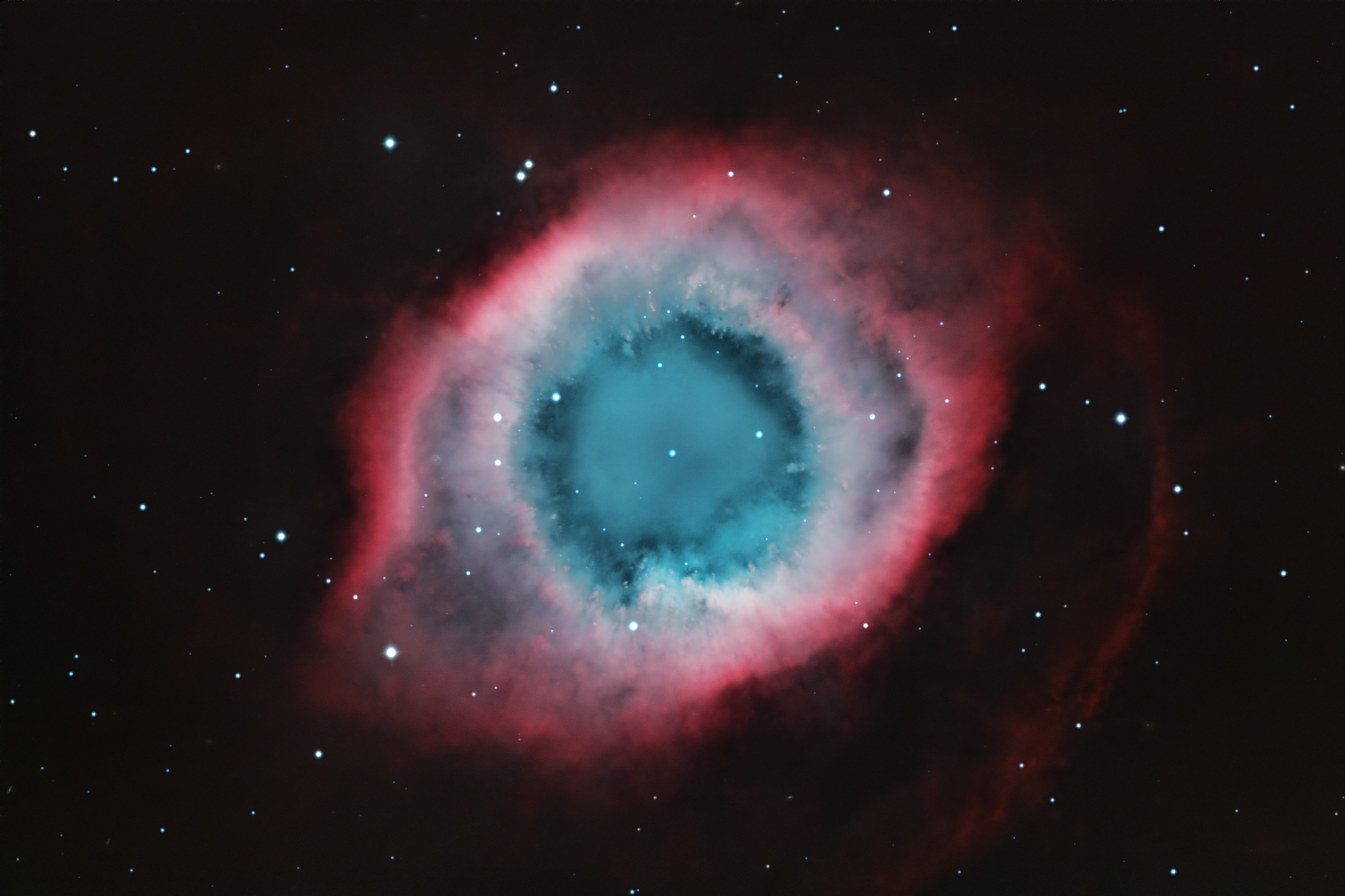
NGC 7293 - The Helix Nebula (The Eye of Sauron)
When a star sheds off its outer atmosphere it comes out looking like
just a disc of gas. Actually it is a sphere of gas that is expanding
in all directions at the same time. These are called planetary nebulae.
And what is left at the center is a white dwarf star. This one is about
650 light-years away in Aquarius
|
placeholder
|
- Location: IC Astronomy Observatory, Spain
- Date: July 2023
- Mount: Paramount MX+
- Telescope: Takahashi FSQ-106ED SPA-1 CCD
- Camera: FLI PL16803 @-25c
- Exposure: 19x5 min SHO 1hr 35min
|
- Location: El Sauce Observatory, Chile
- Date: July 2023
- Mount: Mathis MI-1000
- Telescope: Planewave CDK24 f/6.6
- Camera: QHY600m @-25c CHI-1
- Exposure: 17x5 min HSO 4hrs 25min
|
- Location: El Sauce Observatory, Chile
- Date: July 2023
- Mount: Mathis MI-1000
- Telescope: Planewave CDK24 f/6.6
- Camera: QHY600m @-25c CHI-1
- Exposure: 24x5 min HSO 2hrs
|
|