|
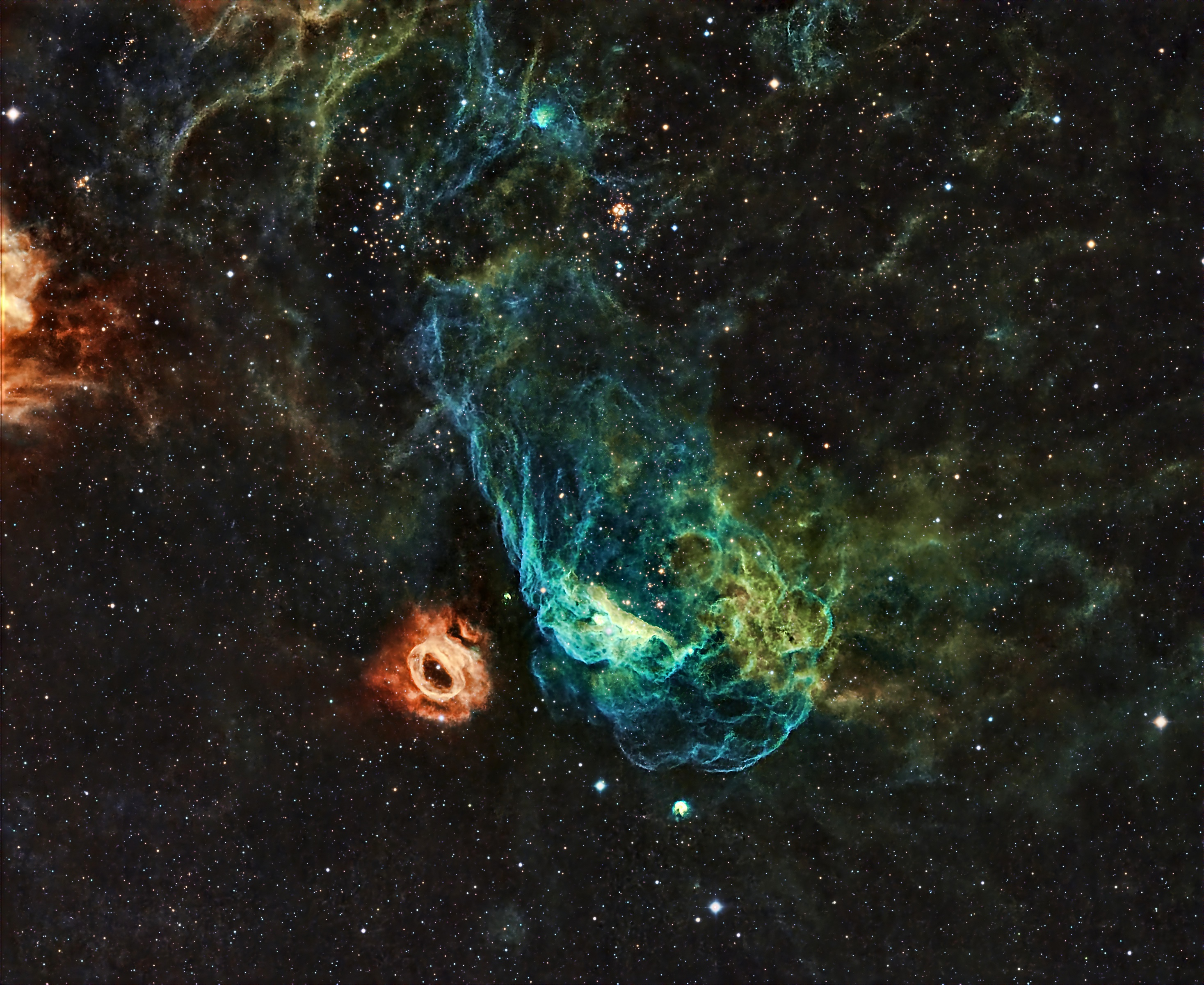
NGC 6888 - The Crescent Nebula (WF)
This is a cool wide-field view of the area surrounding the Crescent Nebula
(in the center). It's a faint object and requires a filter with good
contrast. It's in the constellation Cygnus and sits about 5000 light-years
away. This image was processed using OHS filter combination
|
Cygnus North
This is the northern section of the Veil Nebula in the constellation Cygnus,
the Swan. It is part of a larger structure known as the Cygnus Loop. It's
a supernova remnant whose original star exploded between 10,000 and 20,000
years ago and was roughly 20 times more massive than our Sun. It sits about
2400 light-years away from us
|
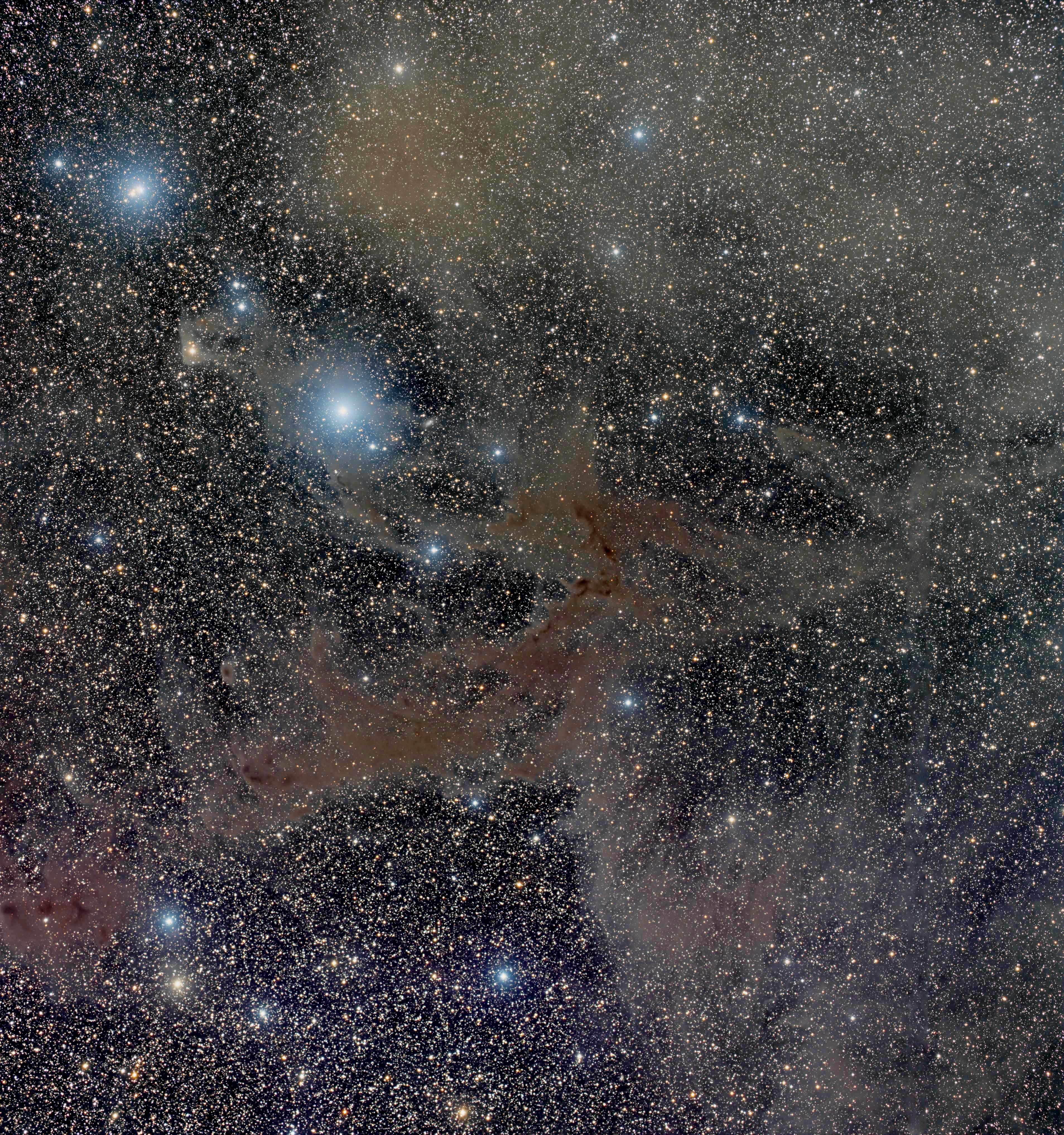
Dust in Chamaeleon
This is an image of some interstellar dust in the constellation Chamaeleon,
the Chameleon or Lizard
|
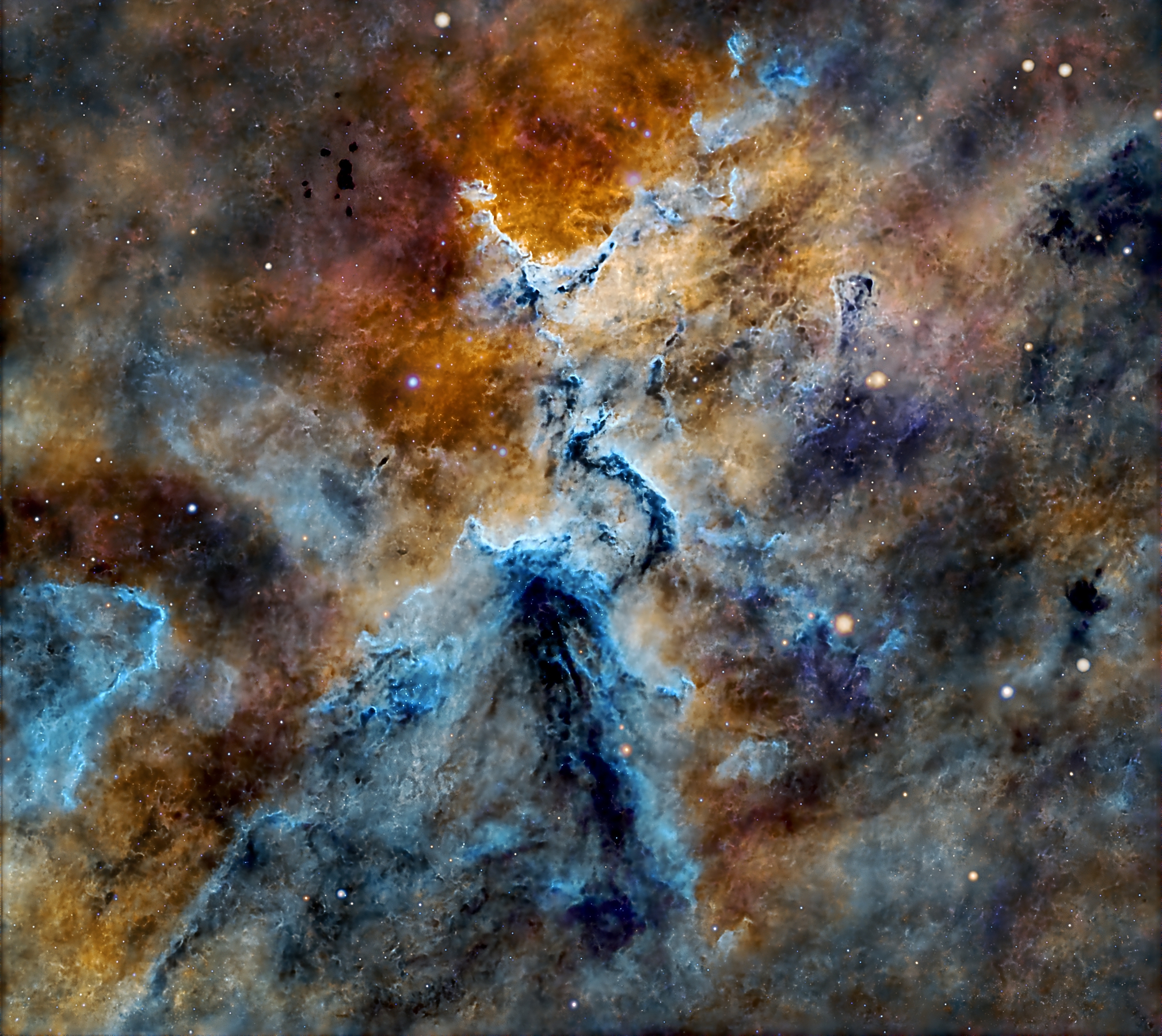
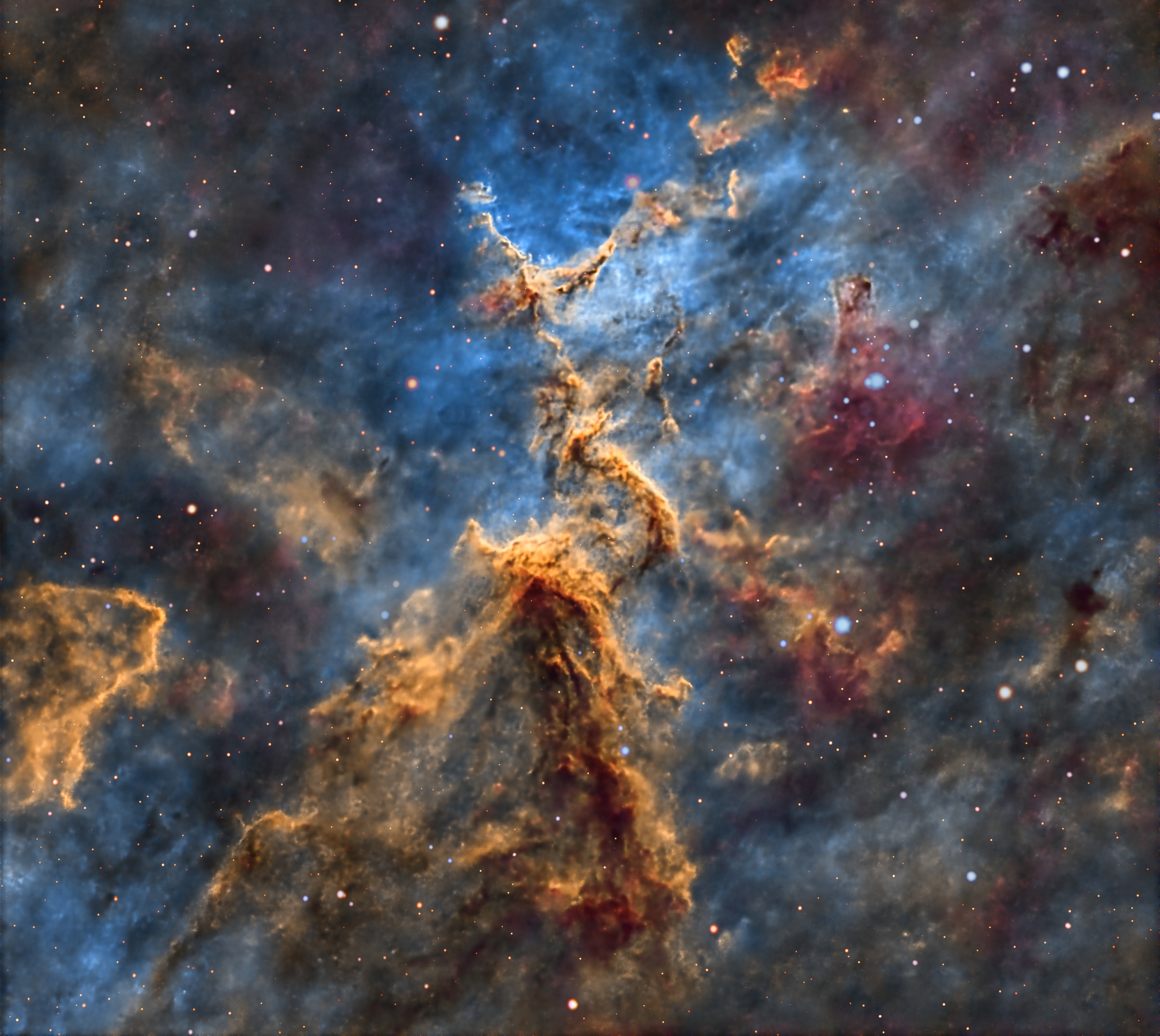
Sh2-190 - The Heart Nebula
Also known as the Running Dog Nebula, this is a close-up view of the
interior of the Heart Nebula. This nebula is located in the
constellation Cassiopeia and is about 7500 light-years away. The majority
of this nebula is made up of ionized oxygen and sulfur, which give the nebula
its blue and orange/gold colors
|
- Location: IC Astronomy Observatory, Spain
- Date: April 2024
- Mount: Paramount MX+
- Telescope: Takahashi FSQ-106ED SPA-1
- Camera: FLI PL 16083
- Exposure: 69x5 min SHO 5hrs 45min
|
- Location: El Sauce Observatory, Chile
- Date: September 2023
- Mount: Mathis MI-1000
- Telescope: Planewave CDK24 f/6.6
- Camera: QHY600m @-25c CHI-1
- Exposure: 51x5 min OHS 4hrs 15min
|
- Location: Heaven's Mirror Obs, Australia
- Date: January 11, 2021
- Mount: Paramount MX+
- Telescope: FSQ-106ED AUS-2
- Camera: FLI PL16083 @-25c
- Exposure: 8x10 min Ha and OIII 1hr 20min
|
- Location: IC Astronomy Observatory, Spain
- Date: January 2022
- Mount: OS EQ
- Telescope: Officina Stellare ProRC 700
- Camera: FLI PL16803 @-25C SPA-2 CCD
- Exposure: 62x5 min HSO 5hrs 10min
|
|
Sh2-190 - The Heart Nebula
This is the same image as the one above except that I processed it in a
completely different way. By changing the color scheme
different details can be seen
|
IC 63 or Sh2-185
The central star in this image is Gamma Cassiopeiae. Just up and to the
left is the main part of the nebula. This is an active star-forming region,
heavy in Hydrogen gas. It was discovered by Max Wolf in 1893. The
radiation from this central star is in the process of eroding the
nebulosity that surrounds it. The areas that are less dense disappear,
leaving the more dense areas which usually hold newly forming stars.
This nebula lies about 10,500 light-years away
|
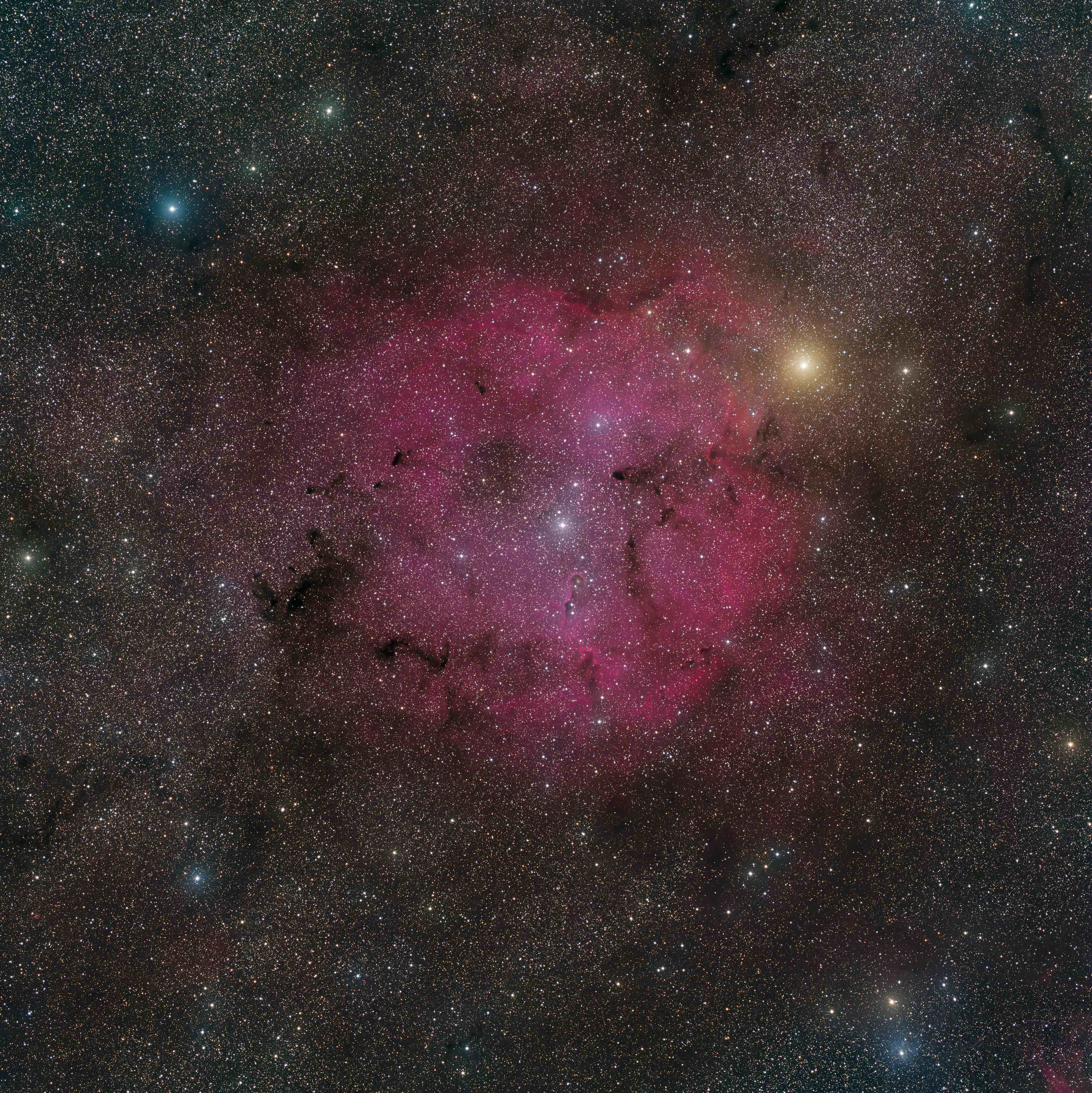
IC 1396 - The Elephant's Trunk Nebula
Located in the constellation of Cepheus (the King of Ethiopia, husband
of Cassiopeia and father of Andromeda). In the deep interior of this nebula
is the Elephant's trunk, which is a dense globule and an area of star
formation. It's about 2400 light-years away
|
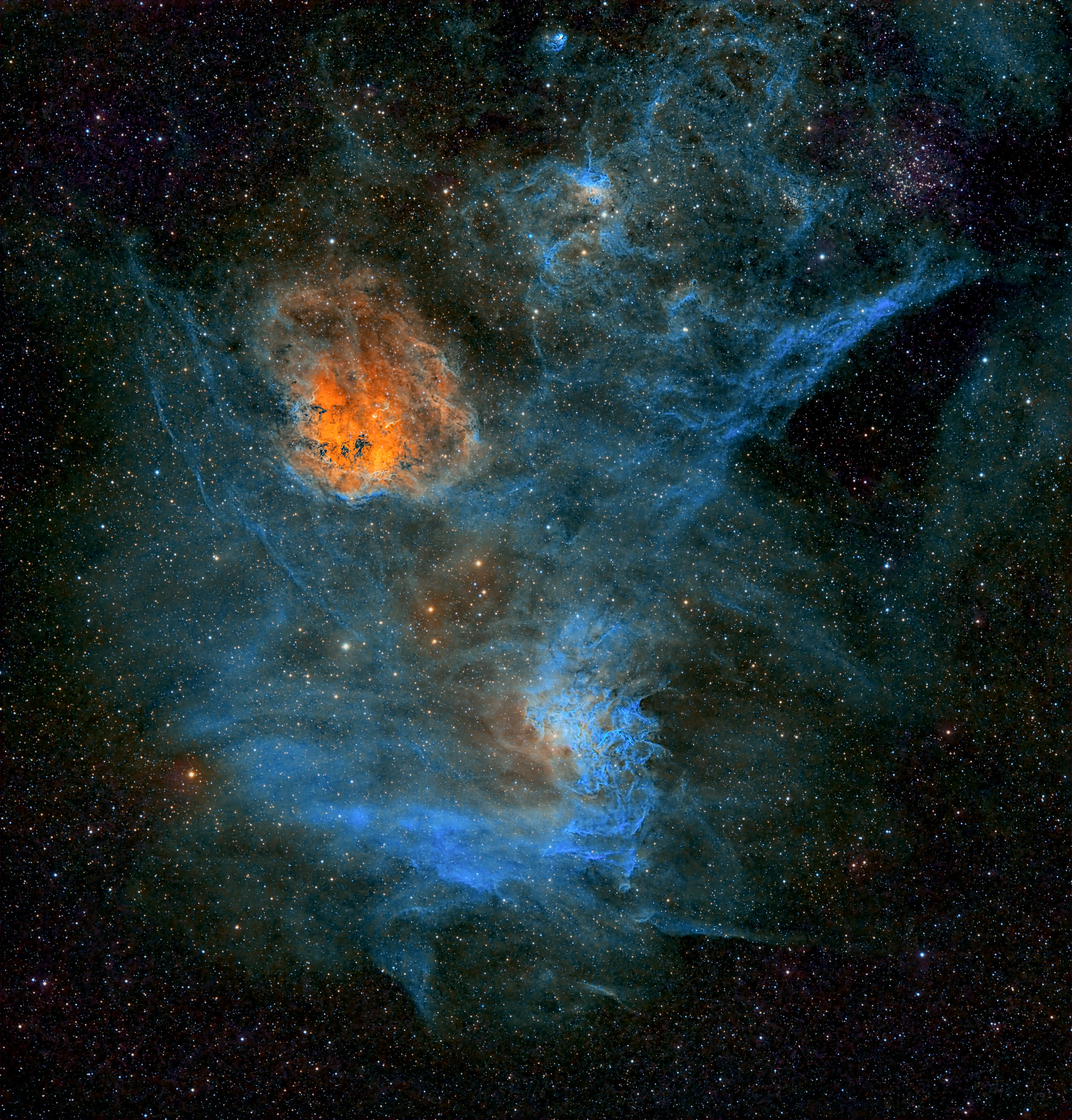
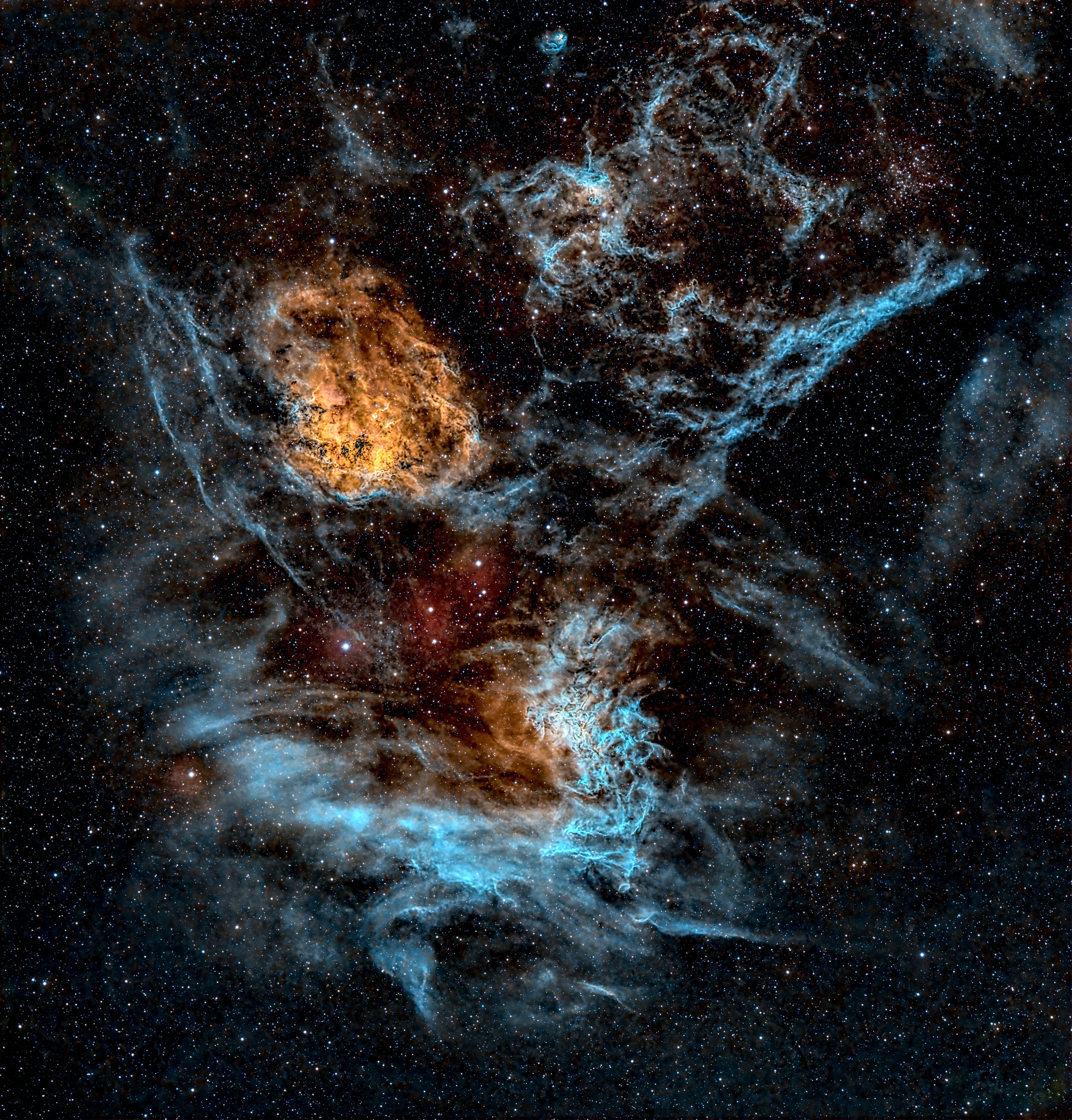
IC 405 - The Flaming Star Nebula
This nebula sits in the constellation Auriga (the Charioteer) - just about
1500 light-years away and 5 light-years across. It's both an emission and
reflection nebula. This particular image was processed in the Hubble Palette
OHS. The following two images show how different an image can be when the
palette is changed around
|
- Location: IC Astronomy Observatory, Spain
- Date: January 2022
- Mount: OS EQ
- Telescope: Officina Stellare ProRC 700
- Camera: FLI PL16803 @-25C SPA-2 CCD
- Exposure: 62x5 min SHO 5hrs 10min
|
- Location: IC Astronomy Observatory, Spain
- Date: December 2023
- Mount: Paramount MX+
- Telescope: Takahashi FSQ-106ED SPA-1
- Camera: FLI PL 16083
- Exposure: 91x5 min HSO 7hrs 35min
|
- Location: IC Astronomy Observatory, Spain
- Date: August 2022 - September 2023
- Mount: Paramount MX+
- Telescope: FSQ-106ED SPA-3
- Camera: FLI PL16083
- Exposure: 98x5 min LRGB+Ha 14hrs 10min
|
- Location: IC Astronomy Observatory, Spain
- Date: November 2020 - September 2022
- Mount: Paramount MX+
- Telescope: Takahashi FSQ-106ED SPA-1
- Camera:FLI PL16083 @-25c CCD
- Exposure: 42x5 min OHS 10hrs 30min
|
|
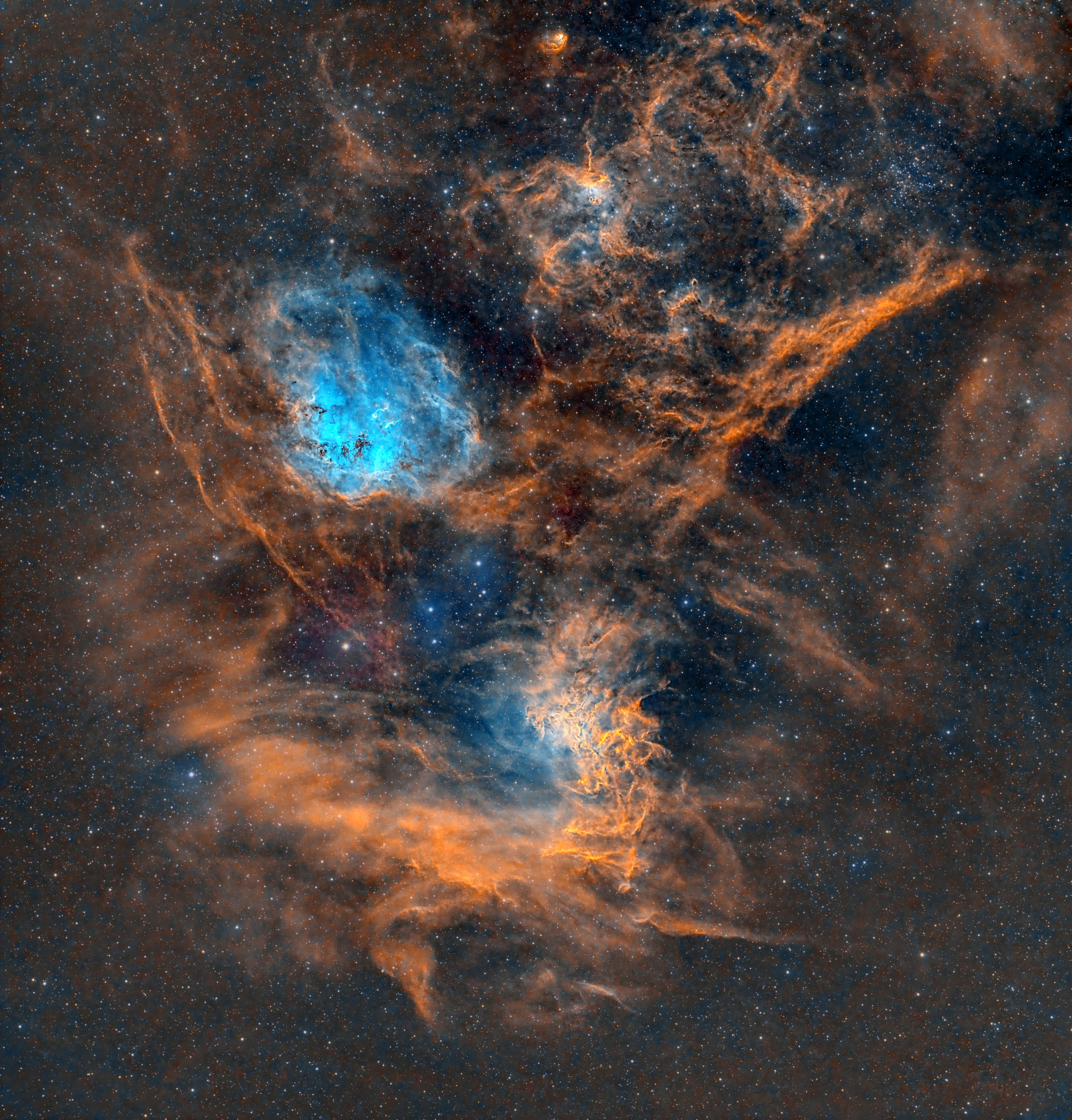
IC 405 - The Flaming Star Nebula
This version was processed in HSO.
|
IC 405 - The Flaming Star Nebula
This third version was done with the SHO palette.
|
IC 1848 - The Soul Nebula
This nebula is commonly known as the Soul Nebula. Located in the
northern constellation of Cassiopeia, the Queen mother of Andromeda, this
emission nebula contains a number of small open clusters embedded
in its interior. Just to the lower-left of the Soul is the Heart Nebula,
another emission nebula
|
IC 4812 - The Coalsack Nebula
The Coalsack Nebula lies about 600 light-years from Earth in the Southern
constellation of Crux, the Southern Cross. It is one of the rare DSOs that
can be seen with the naked eye. It plays an important part in the mythologies
of the Australian Aboriginal people, and forms the head of the Emu in the Sky.
For the Inca people, this nebula was called Yutu, a partridge-like bird in
South America
|
- Location: IC Astronomy Observatory, Spain
- Date: November 2020 - September 2022
- Mount: Paramount MX+
- Telescope: Takahashi FSQ-106ED SPA-1
- Camera:FLI PL16083 @-25c CCD
- Exposure: 42x5 min OHS 10hrs 30min
|
- Location: IC Astronomy Observatory, Spain
- Date: November 2020 - September 2022
- Mount: Paramount MX+
- Telescope: Takahashi FSQ-106ED SPA-1
- Camera:FLI PL16083 @-25c CCD
- Exposure: 42x5 min OHS 10hrs 30min
|
- Location: IC Astronomy Observatory, Spain
- Date: November 2023
- Mount: Paramount MX+
- Telescope: Takahashi FSQ-106ED SPA-1
- Camera: FLI PL16083
- Exposure: 75x5 min SHO 6hrs 15min
|
- Location: Heaven's Mirror Obs, Australia
- Date: August 2023
- Mount: Paramount MX+
- Telescope: FSQ-106ED AUS-2
- Camera: QHY600m @-25c CMOS
- Exposure: 12x5 min LRGB 4hrs
|
|
Lupus Dust Panel 3
This one is a dark nebula in the constellation Lupus, the Wolf.
A dark nebula is simply a cloud of gas or dust that is cold and dense
enough to block the light coming from stars or objects behind it
|
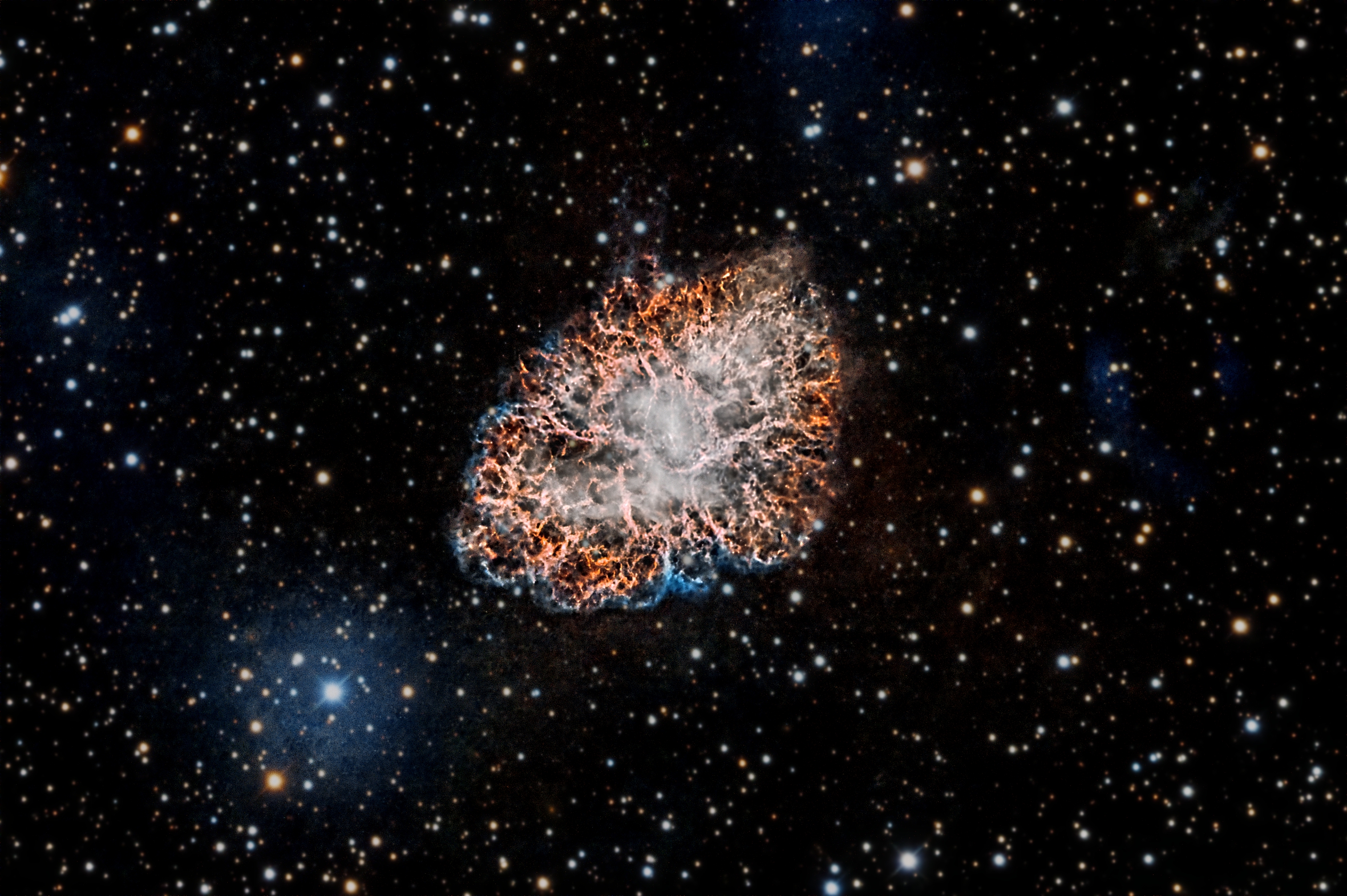
Messier 1 - The Crab Nebula
The Crab nebula is a supernova remnant as well as a pulsar wind nebula
located in the constellation Taurus (the Bull). It sits about 6500
light-years away. It was given its name because of an early drawing
that resembled a crab. Remember, telescopes weren't as good back in
the 1600s and 1700s as they are now. At its heart is a pulsar star
which is only about 18 miles in diameter and spins at a rate of 30.2
times per second as it emits massive amounts of x-ray and gamma-ray
radiation
|
Messier 6
Messier 6 is actually the open cluster at the center of the image.
I include it here because of the nebula right next to it - IC 4605.
It is a reflection nebula located in the constellation Scorpius, and
illuminated by its central star HD 148605
|
Messier 6
This is a close-up view of the object in the panel to the left, taken
with a larger telescope
|
- Location: Heaven's Mirror Obs, Australia
- Date: November 2024
- Mount: Paramount MX+
- Telescope: FSQ-106ED AUS-2
- Camera: QHY600m @-25c CMOS
- Exposure: 60x5 min LRGB 5hrs
|
- Location: IC Astronomy Observatory, Spain
- Date: October 2023
- Mount: Officina Stellare EQ Mount
- Telescope: Officina Stellare ProRC 700
- Camera: QHY600m @-25c SPA-2
- Exposure: 74x5 min LRGB 6hrs 10min
|
- Location: Heaven's Mirror Obs, Australia
- Date: July 2021
- Mount: Paramount MX+
- Telescope: FSQ-106ED AUS-2
- Camera: FLI PL16083 @-25c
- Exposure: 72x10 min OHS 12hrs
|
- Location: El Sauce Observatory, Chile
- Date: May 2023
- Mount: Mathis MI-1000
- Telescope: Planewave CDK24 f/6.6
- Camera: QHY600m @-25c CHI-1
- Exposure: 72x5 min OHS 6hrs
|
|
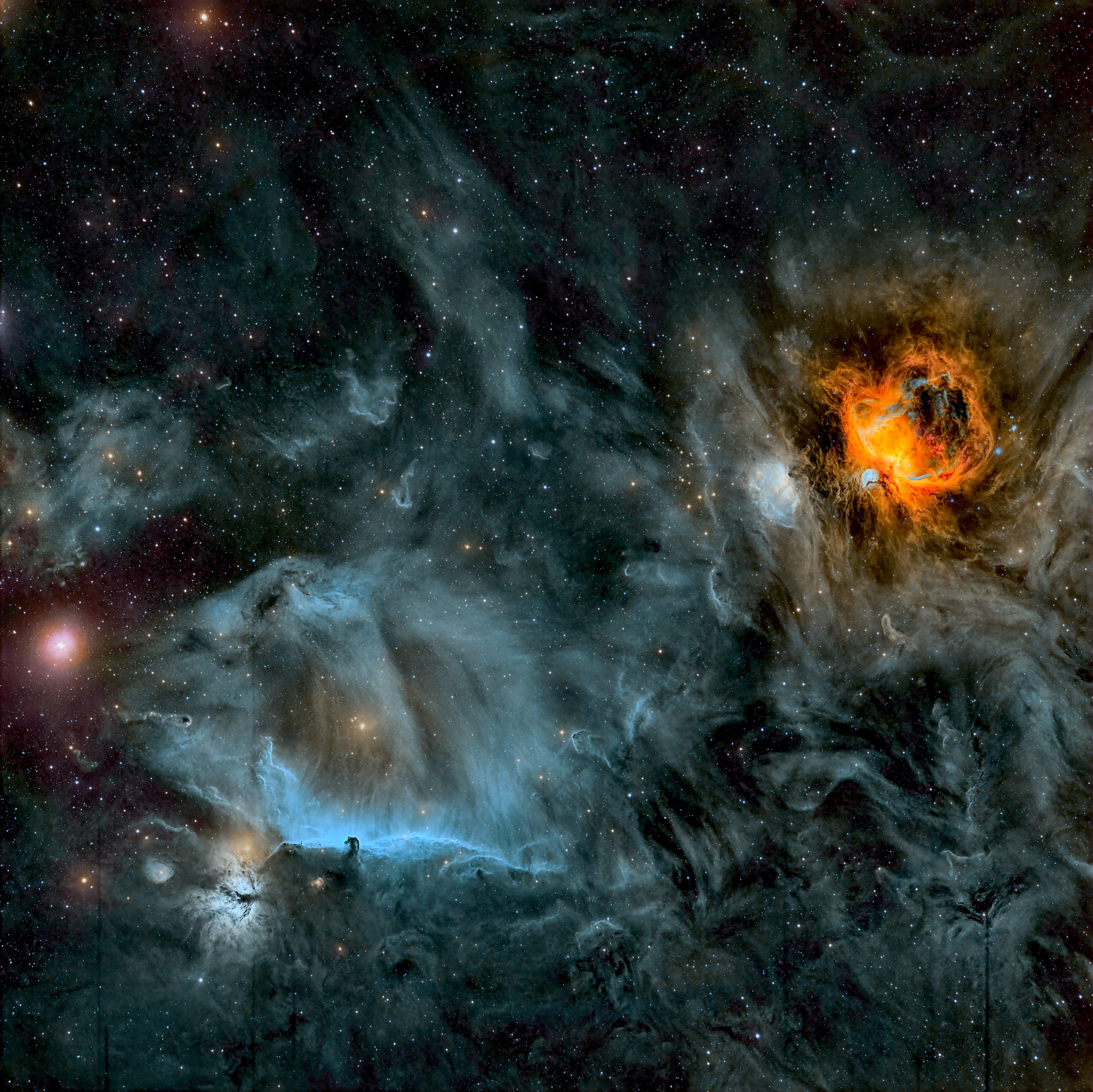
Messier 42 Wide-Field
A wide-field view of the larger molecular cloud around Messier 42, the Great
Orion Nebula, which is the orange area to the right side. The Orion Nebula
is a fascinating object. It sits about 1344 light-years away and has a mass
of about 2000 times that of the Sun. It's also about 25 light-years across at
its maximum. It is the largest star formation region closest to Earth. At
its center is an area known as the Trapezium, where a number of hot, new
stars can be seen. This is one of the most studied and photographed objects
in our night sky
|
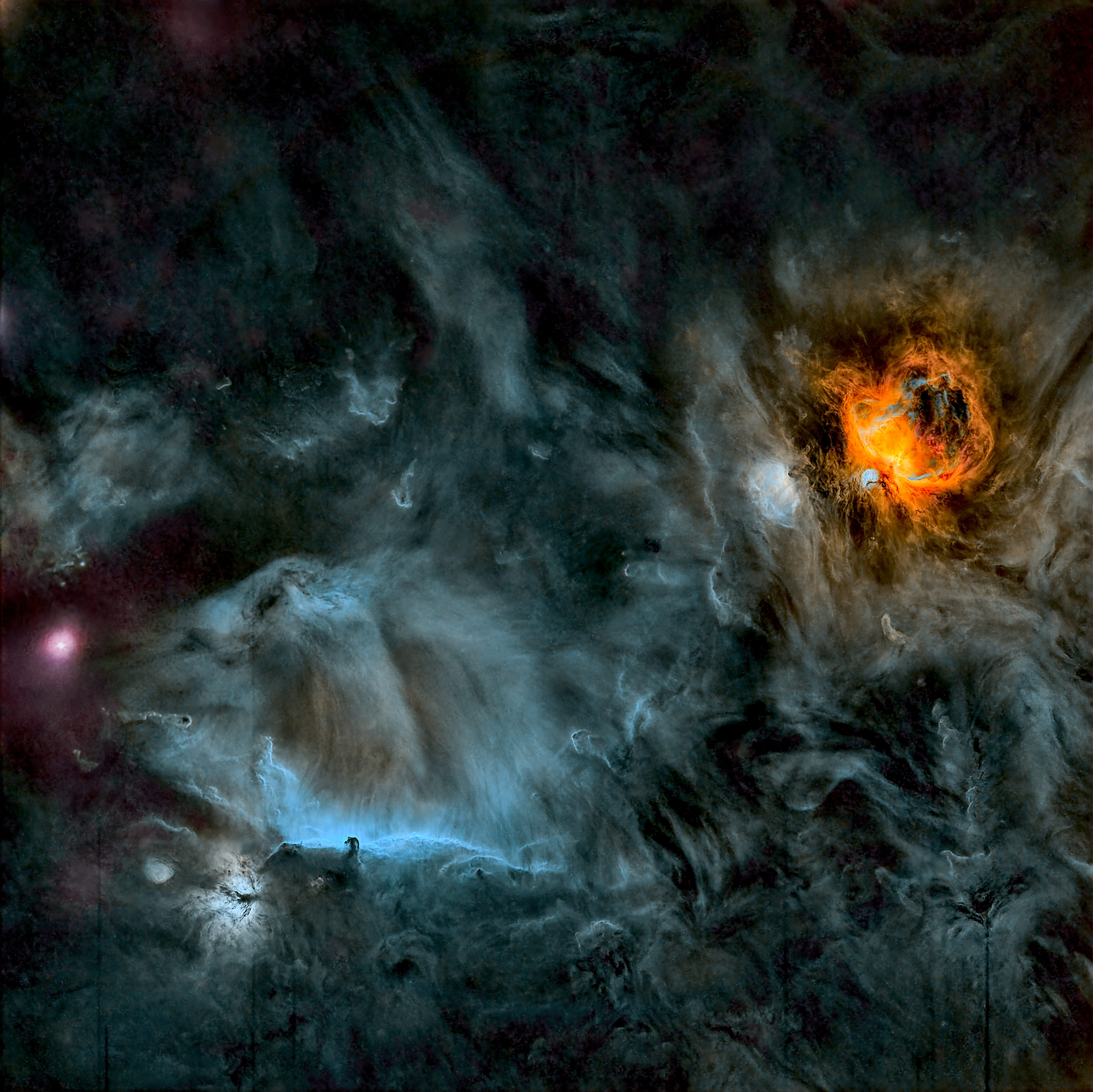
Messier 42 Wide-Field - Starless
This is the same image as the one to the left except that all of the stars
have been removed. I like this version, as it has kind of a surreal look
and feel to it
|
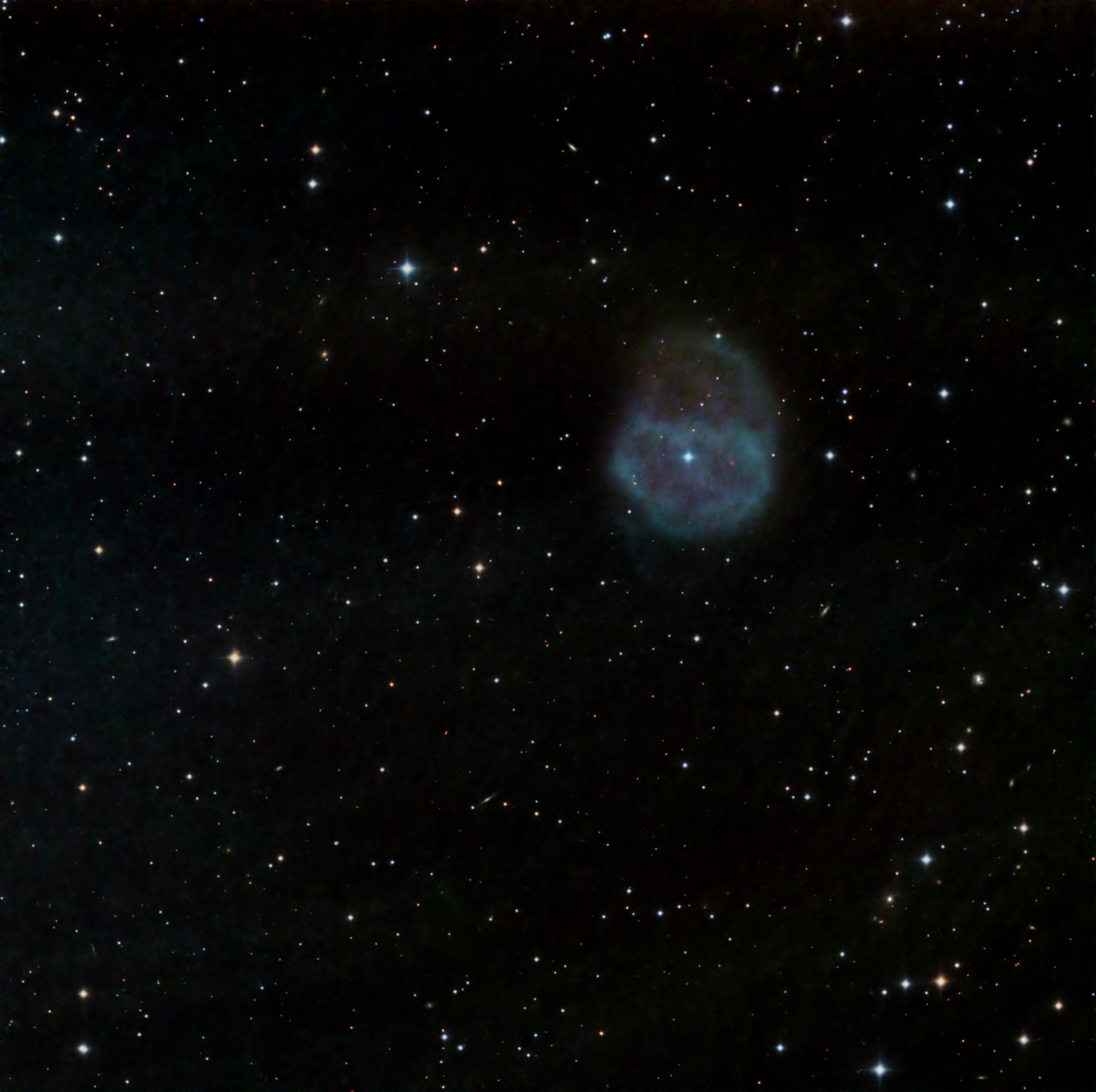
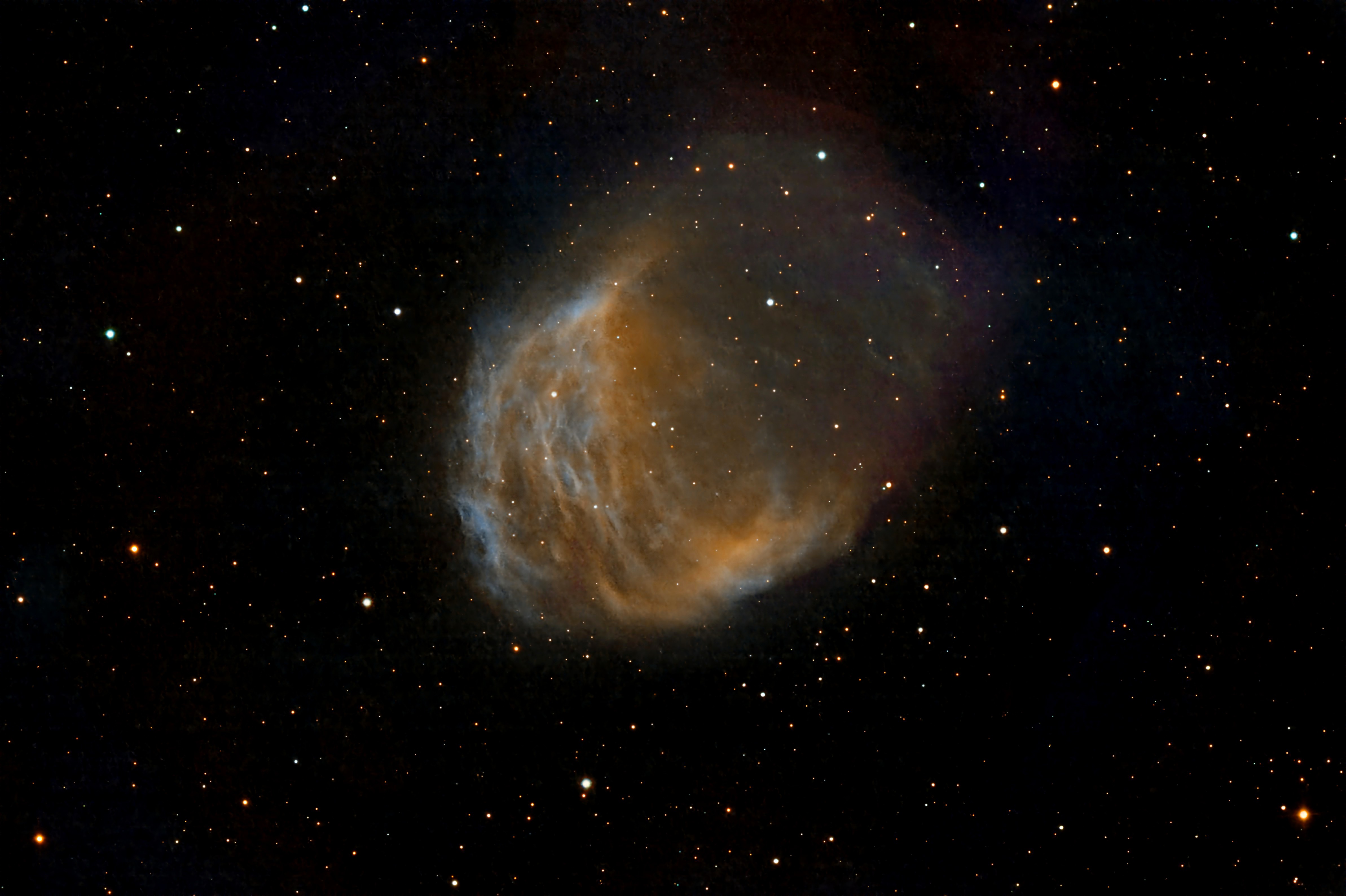
Sh2-274 - The Medusa Nebula
This object is a planetary nebula, and was discovered by UCLA
astronomer George Abell in 1955. Abell thought that it was an old planetary
nebula. Then, in 1975 researchers found that it was indeed a PN. The nebula
is very large due to its expansion over a very long period which makes its
surface brightness very low. That means that you'd need to use a camera with
longer exposure times to see it. It is about 1500 light-years away in the
constellation Gemini
|
Sh2-1
Known as Sharpless-1, this is both a reflection and emission nebula as well
as a diffuse nebula in Scorpius. It sits about 650 light-years away from Earth.
This image was processed using visible light filters (RGB) as well as a hydrogen
filter which brings out the deep red hydrogen region on the left side
|
- Location: IC Astronomy Observatory, Spain
- Date: November 2023
- Mount: Paramount MX+
- Telescope: FSQ-106EDX4 SPA-3
- Camera: FLI PL16083
- Exposure: 127x5 min OHS 10hrs 5min
|
- Location: IC Astronomy Observatory, Spain
- Date: November 2023
- Mount: Paramount MX+
- Telescope: FSQ-106EDX4 SPA-3
- Camera: FLI PL16083
- Exposure: 127x5 min OHS 10hrs 5min
|
- Location: El Sauce Observatory, Chile
- Date: November 2024
- Mount: Mathis MI-1000
- Telescope: Planewave CDK24 f/6.6
- Camera: QHY600m @-25c CHI-1
- Exposure: 18x5 min OHS 5hrs 15min
|
- Location: Heaven's Mirror Obs, Australia
- Date: October 2024
- Mount: Paramount MX+
- Telescope: FSQ-106ED AUS-2
- Camera: QHY600m @-25c CMOS
- Exposure: 60x5 min LRGB+Ha 5hrs
|
|
NGC 2014
This nebula, located in the Large Magellanic Cloud (LMC), is a red
emission nebula which sits at an impressive distance of 163,000
light-years away
|
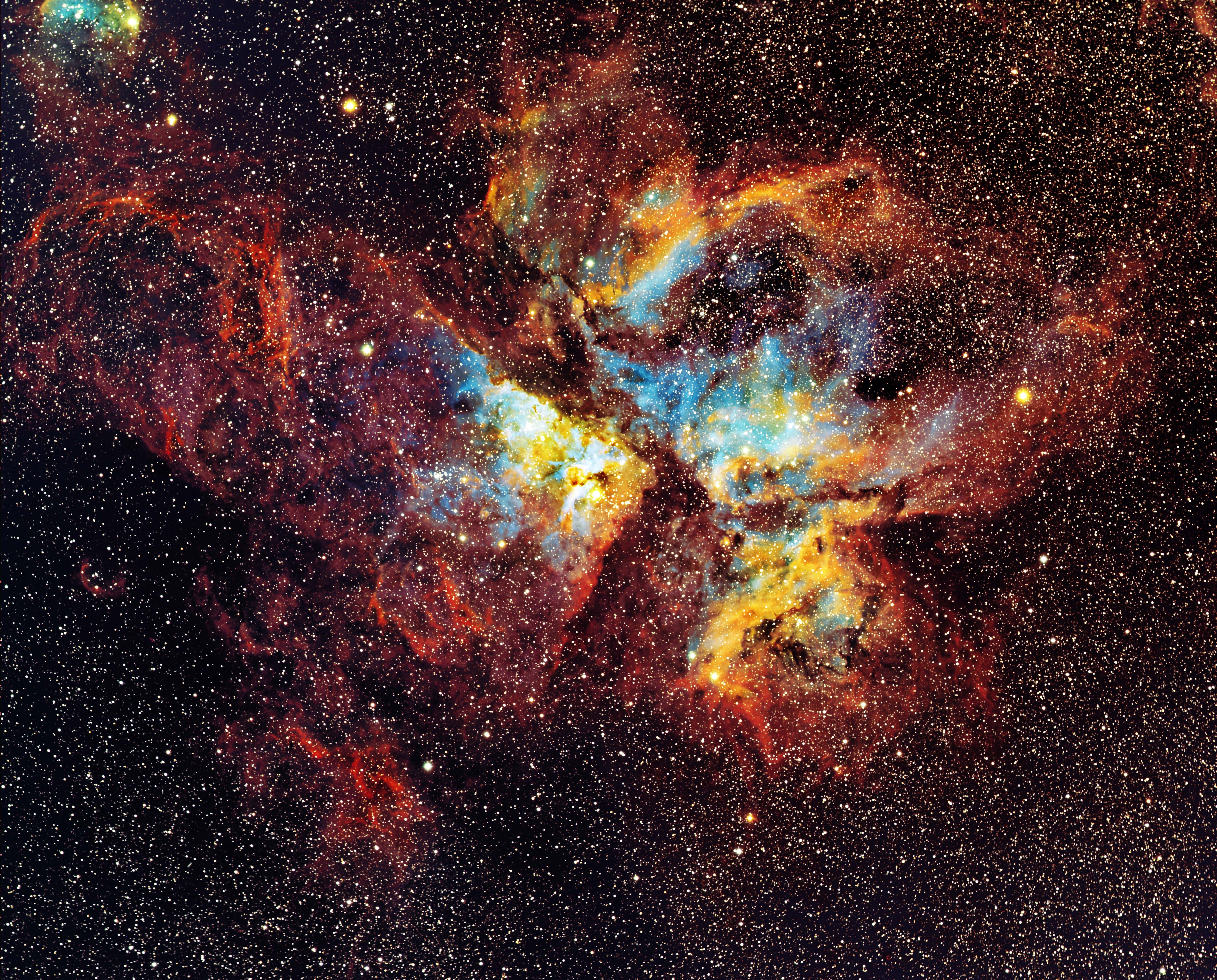
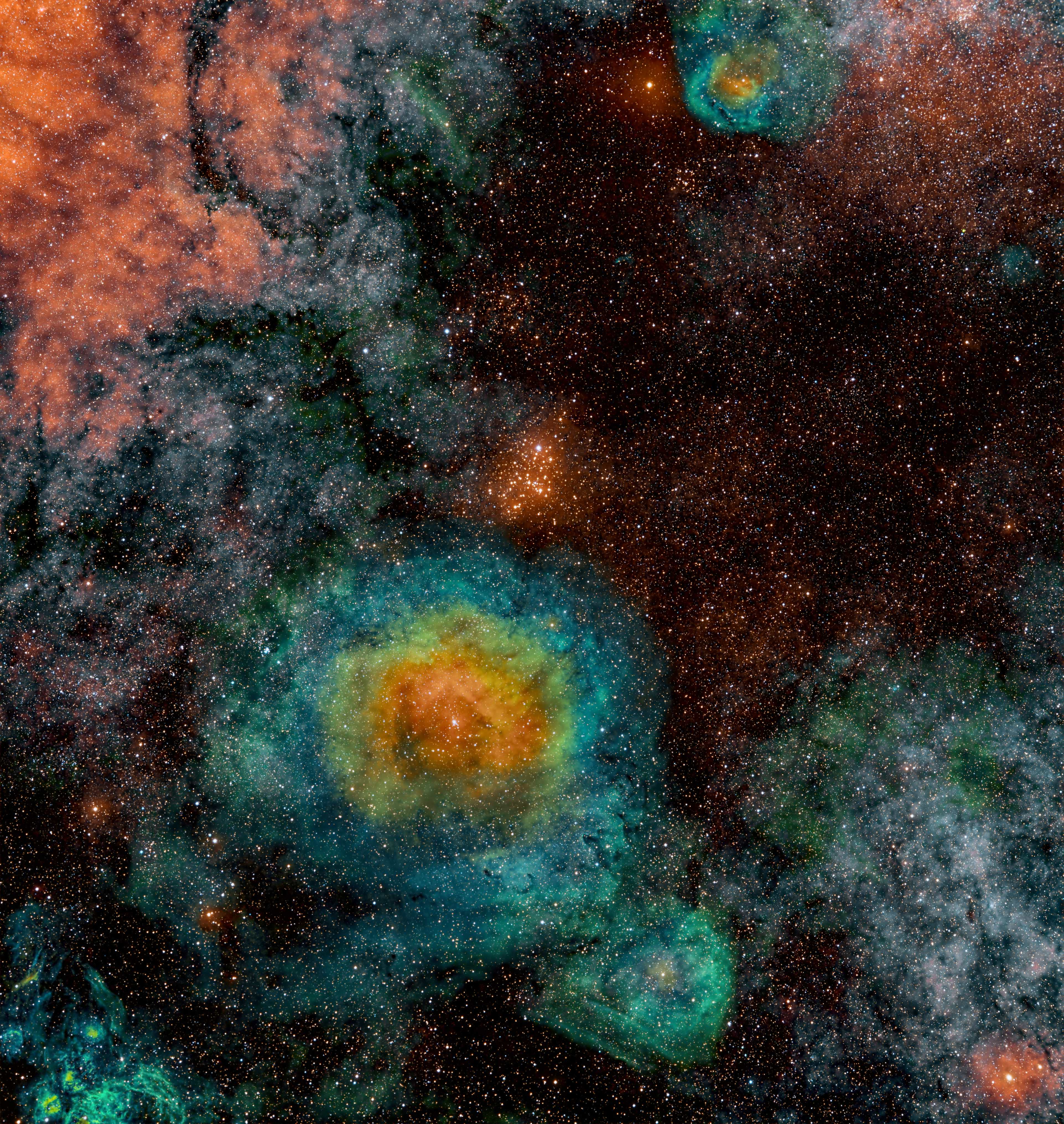
NGC 6188 (The Rim Nebula) and NGC 6165
Also known as the Dragons of Ara, the Rim Nebula is just a small part
of a much larger molecular cloud. This part of the planetary nebula
contains an emission nebula that includes some dark nebulae as well.
It lies about 4000 light-years away from us and is about 300 light-years
in diameter. The small blue nebula in the upper right has two sections:
an outer bubble and an inner bubble - probably from an earlier mass
ejection from its central star, a type of star that burns hot and lives a short life.
Since the larger nebula is often referred to as the Fighting Dragons of Ara,
this smaller nebula is called The Dragon's Egg
|
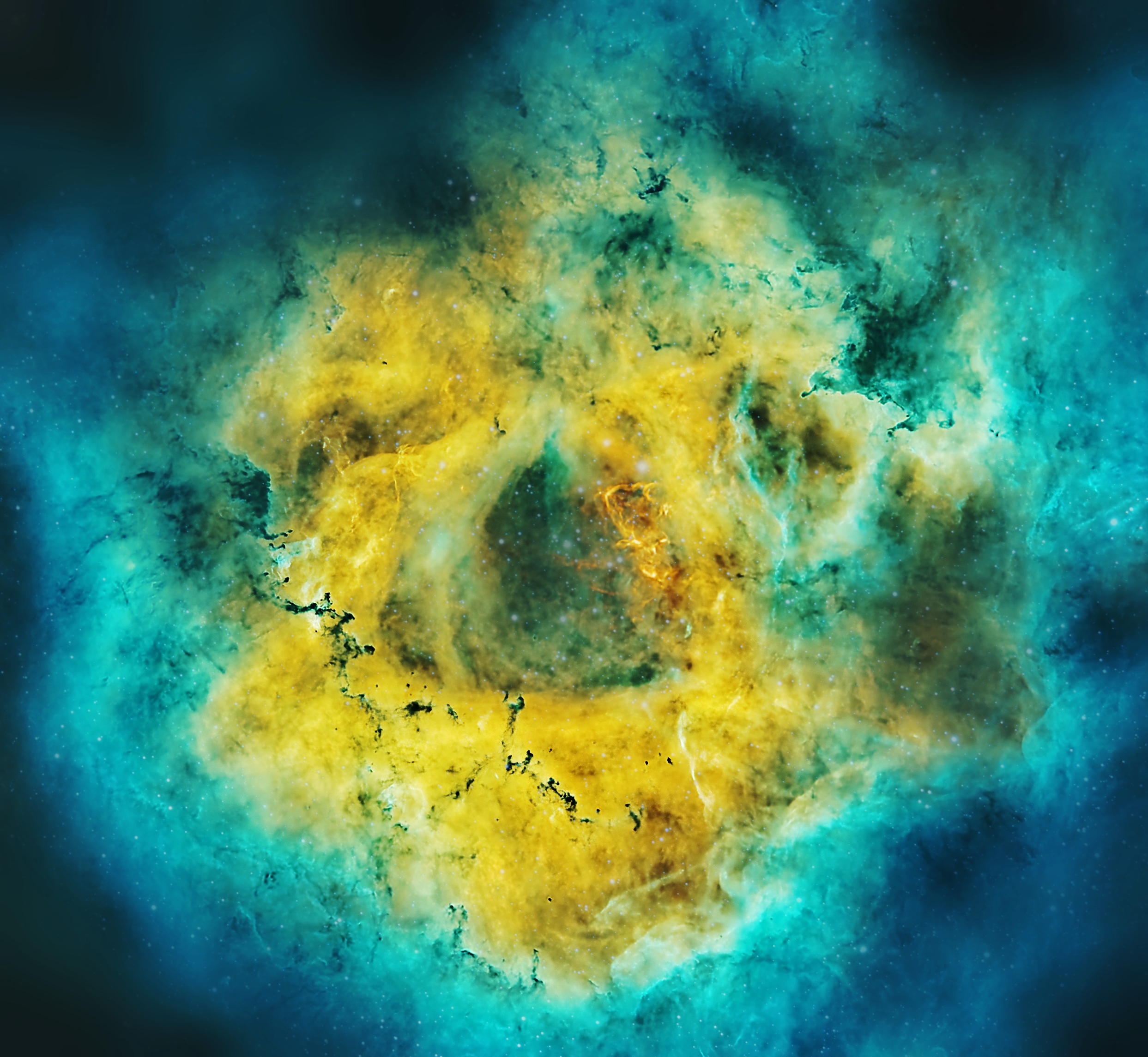
Caldwell 49 - The Rosette Nebula
This object, located in Monoceros (the Unicorn), is part of a much
larger molecular cloud complex. It sits about 5000 light-years away
and is about 130 light-years in diameter. Some say that it resembles
a human skull and is sometimes called the Skull Nebula. It has, at its
center, an open cluster. The radiation from these hot, young stars excites
the gas nearby and heats it until it begins to glow - making this an
emission nebula. There are around 2500 hot, new stars. Most of the active
star-forming is in the lower central region. For this version I removed
the stars and applied a portrait tool in PixInsight to give it this
unique look
|
placeholder |
- Location: El Sauce Observatory, Chile
- Date: October 25, 2020
- Mount: Mathis MI-1000
- Telescope: Planewave CDK24 f/6.6
- Camera: FLI PL9000 @-25c CHI-1 CCD
- Exposure: 8x10 min LRGB+Ha 1hr 20min
|
- Location: Heaven's Mirror Obs, Australia
- Date: May 2023
- Mount: Paramount MX+
- Telescope: FSQ-106ED AUS-2
- Camera: QHY600m @-25c CMOS
- Exposure: 20x5min HSO 1hr 40min
|
- Location: IC Astronomy Observatory, Spain
- Date: October 2023
- Mount: Paramount MX+
- Telescope: Takahashi ESQ-106ED SPA-1
- Camera: FLI PL16083
- Exposure: 93x5 min OHS 7hrs 45min
|
|